


 844-937-8679
 Login
Login


What are digital badges?


Written by Michael Feder

Reviewed by Christina Neider, EdD, Associate Provost of Colleges

Digital badges are changing how people showcase verified skills to employers. As skills-based hiring continues to grow, digital badges help connect education with career readiness in a clear and shareable way. These credentials provide employers with transparent insight into what candidates know and can do.
What are digital badges?
Digital badges are more than visual icons. They are verified, shareable representations of skills that learners have demonstrated through real coursework, training or assessment.
Each badge includes embedded metadata that provides context about:
- The skill achieved
- How it was assessed
- When it was earned
- The issuing institution
This makes digital badges a trusted, transparent way to communicate skills to employers who are increasingly prioritizing what candidates can do.
What’s the difference between certificates, microcredentials and badges?
Certificates, microcredentials and digital badges are often used interchangeably — but they mean different things. Generally speaking:
- Certificates show that someone has completed a course or program.
- Microcredentials are smaller, skills-focused credentials earned through assessments or demonstrated work.
- Digital badges are the visual, shareable representation of microcredentials. They make it possible to showcase skills visually online while also linking back to the verified details behind what a person has learned.
For example, completing a data analytics course might earn a student a microcredential in data visualization, which can then be shared as a digital badge on LinkedIn.
Together, they go beyond showing what an individual has completed. They help tell a more complete story about the skills a person has and signal the next steps in one’s career and education.
Do employers recognize digital badges?
With hiring managers often reviewing large pools of candidates, standing out matters. Digital badges help make skills more visible, accessible and actionable.
The badges may help employers:
- Gain clearer insight into what a candidate can do as a result of the courses and programs completed
- Better understand how and where those skills were developed
- More easily identify candidates with role-aligned, career-relevant capabilities
- Recognize a commitment to continuous learning and staying current in a field
- See how a candidate’s skills connect to immediate and future opportunities
But do employers pay attention to digital badges? Increasingly, the data says yes. A 2024 study published in the Small Business Institute Journal found that more than half of HR directors surveyed in 2020 felt digital badges would be important in the future.
Additional reporting is mixed. Some outlets say awareness and adoption need to grow. Others point to how far digital badges have come in terms of awareness, suggesting the trend will only continue in light of skills-based hiring. Credential Engine, a nonprofit organization, cites the burgeoning number of digital badges and related credentials as an asset to workers and employers alike.
How digital badges support career growth
The hiring process continues to trend toward a skills-based model. In fact, almost 70% of employers surveyed by the National Association of Colleges and Employers in 2025 say they leverage skills-based hiring.* That sounds great, but it leads to real challenges in accurate skills assessment. How can an employer verify a candidate has a skill they say they have? Enter digital badges.
Digital badges help bridge the gap between education and employment. They empower learners to own their skills story in real time while giving employers clearer insight into the capabilities behind a credential.
While skills can be listed on a resumé, digital badges offer a more dynamic, easy-to-scan and searchable way to showcase verified capabilities, whether on LinkedIn® or other professional platforms.
Digital badges also allow learners to identify and share their skills as they build them. Instead of waiting until the end of a program to retrospectively consider what they’ve learned and then find an effective way to word that on a resumé, learners can highlight relevant achievements in real time. This allows them to stay visible, relevant and competitive throughout their educational journey.
Where can digital badges be displayed?
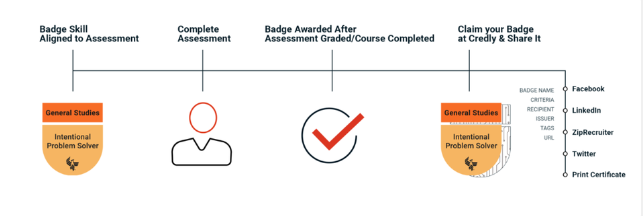
Once earned, digital badges can be easily shared across professional platforms, including LinkedIn, digital portfolios and online resumés as outlined below.
What industries use digital badges?
Digital badges aren’t just for the tech industry. Many other fields leverage them too, including:
- Education
- Healthcare
- Nursing
- Professional development
While this is not a complete list, it does point to the spectrum of sectors that currently find value in digital badges.
How to earn digital badges at University of Phoenix
University of Phoenix recently celebrated issuing 1 million digital badges, signaling a University-wide commitment to skills-based learning. The University offers nearly 200 badge templates available in undergraduate, graduate and professional development courses. Some course-level badges are also available as part of carefully architected pathways — structured learning journeys that map how skills build over time and connect to specific career outcomes.
Learn more about skills-aligned learning at University of Phoenix, or request more information about the University’s degree and certificate programs.
LinkedIn is a registered trademark of LinkedIn Corporation and its affiliates in the United States and/or other countries.
*The NACE Job Outlook survey calculates percentages on the total number of responses for each question.
Read more articles like this:




ABOUT THE AUTHOR
A graduate of Johns Hopkins University and its Writing Seminars program and winner of the Stephen A. Dixon Literary Prize, Michael Feder brings an eye for detail and a passion for research to every article he writes. His academic and professional background includes experience in marketing, content development, script writing and SEO. Today, he works as a multimedia specialist at University of Phoenix where he covers a variety of topics ranging from healthcare to IT.
ABOUT THE REVIEWER
Christina Neider is the associate provost of colleges and former dean of the University of Phoenix College of Social and Behavioral Sciences. Neider’s career spans more than 30 years in academia, healthcare and the U.S. Air Force. She has held several academic leadership roles at University of Phoenix, and she is the Vice President of membership for the Arizona Chapter of the Healthcare Information and Management Systems Society.

This article has been vetted by University of Phoenix's editorial advisory committee.
Read more about our editorial process.
Read more articles like this: