


 844-937-8679
 Login
Login


Research Ledger

RSE Administration

2024–2025 Scholarship Report: College of Doctoral Studies & Institutional Contributions
The University of Phoenix embraces the scholar-practitioner approach based on the principles of the Boyer Model. According to the University Scholarship Council's definition:
Scholarship stems from the active efforts of scholar-practitioner-leaders who apply their expertise and skills across various academic and professional domains. This work contributes to the expansion of knowledge while enhancing teaching, learning, or the respective field." Ernest Boyer described scholarship as not only "engaging in traditional research" but also "seeking connections, bridging the gap between theory and practice, and effectively communicating knowledge to students.
The College of Doctoral Studies (CDS), alongside the Research and Scholarship Enterprise (RSE), has long tracked the research trail produced by our faculty and staff for many years, not only as part of their own demonstration of scholarship activity, but also for requirements associated with such roles. The RSE's contributions to the following statistical insights for CDS, as presented here, reflect data collected from 2024-2025. Data for 2026 will be presented herein next year.
Narrative Summary of 2024–2025 Scholarship Contributions
Prepared by the College of Doctoral Studies and the Research and Scholarship Enterprise (RSE)
The first graphic [Table 1] below depicts the volume of reported scholarly works across primary colleges for FY25. The College of Doctoral Studies leads the institution with 438 scholarly works, followed by Liberal Arts & Humanities (359), Nursing (320), Behavioral Sciences (310), Business (307), and Education (227). Other academic units, including Health Administration, Science & Mathematics, Criminal Justice & Public Administration, Information Technology, and Public Health, also demonstrate steady scholarly activity.
This growing culture of inquiry, innovation, and impact is reflected not only in the volume of work produced but also in its diversity across disciplines, formats, and scholarly domains. Below is a breakdown of our collective achievements. In this, doctoral faculty and students are a major driver of scholarly output for the university, positioning the College of Doctoral Studies as a central engine of research and professional dissemination for the university.
I. Research Engagement Across Colleges: A Distributed Culture of Scholarship
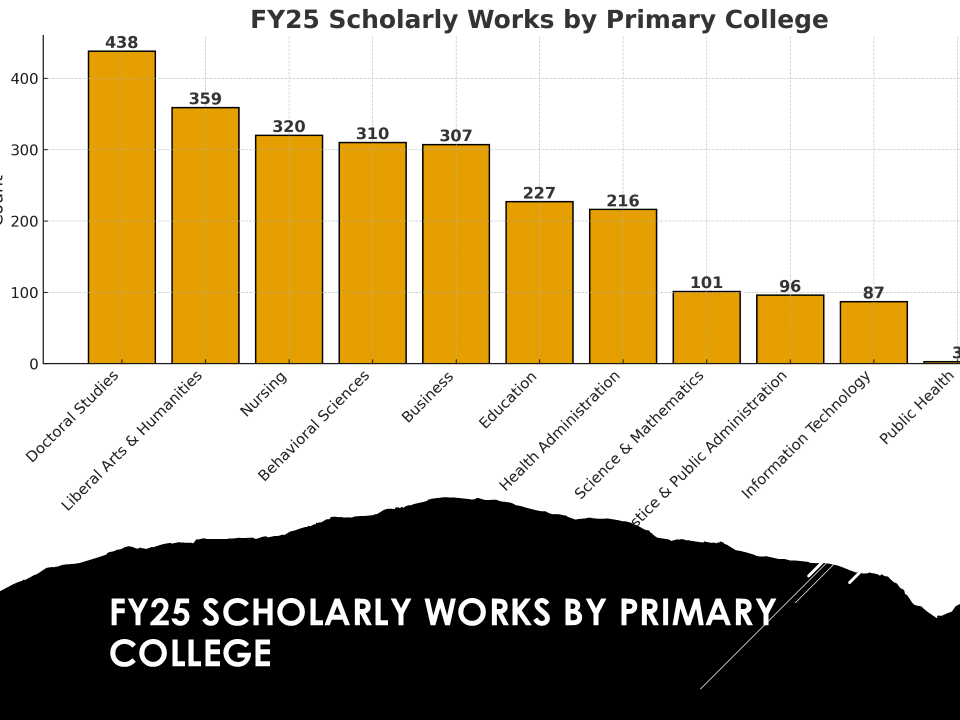
These contributions affirm that scholarship is thriving across our academic ecosystem, not confined to one college or specialty, but dispersed across all corners of our academic community.
II. The Nature of Scholarship: Insights from Boyer’s Domains
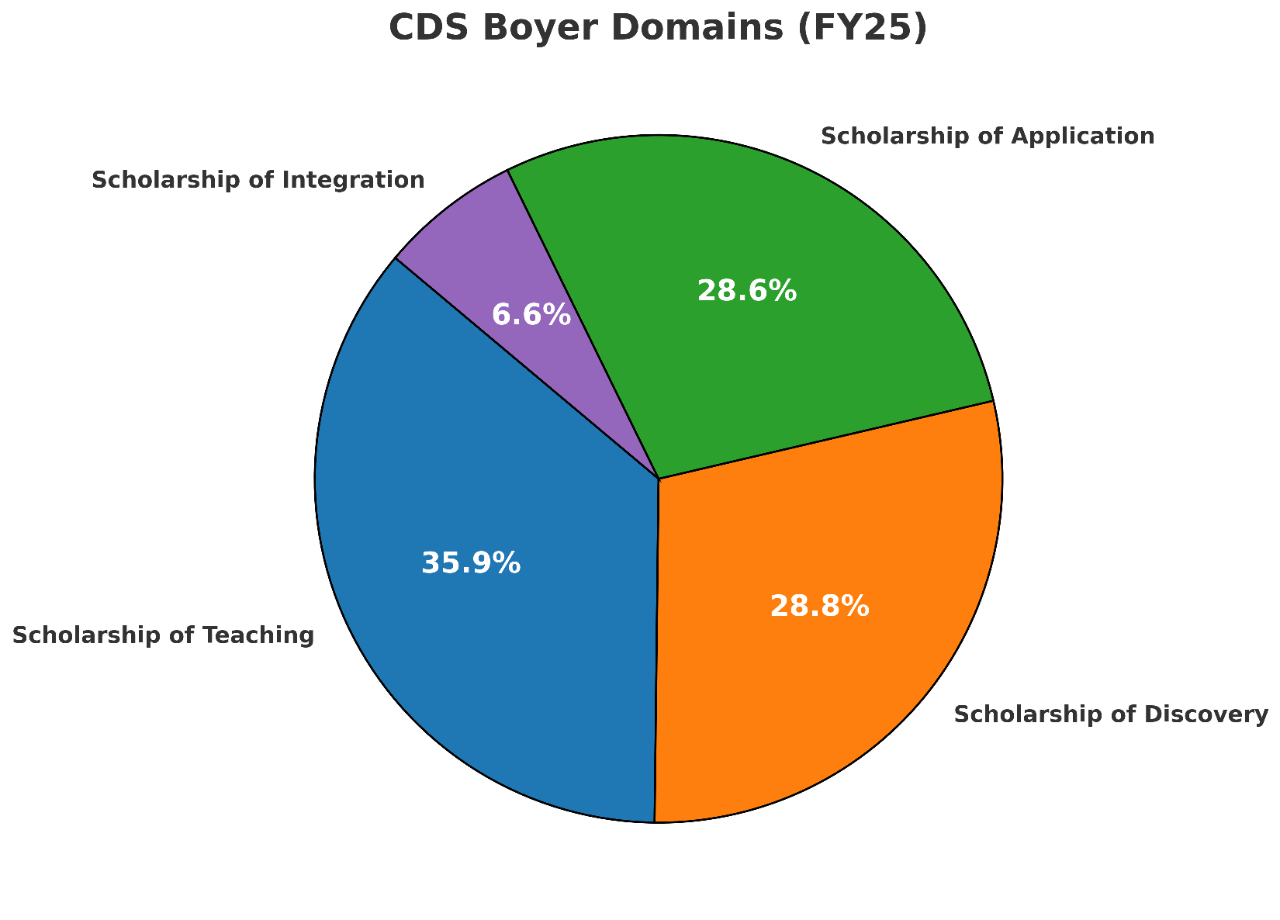
When viewed through the lens of Boyer’s Model of Scholarship, the FY25 data for the College of Doctoral Studies reveals a well-balanced and highly active scholarly profile of work. here si how this breaks down for CDS. [See Table 2 below].
Scholarship of Teaching accounts for the largest share of contributions, representing evidence-based instructional innovation, reflective practice, and learner-centered inquiry. This domain continues to anchor much of the scholarly activity within CDS.
Scholarship of Application follows closely, highlighting the college’s strong commitment to translating research into real-world practice. These contributions reflect the practitioner-scholar model—where inquiry directly informs organizational, clinical, and educational improvement.
The Scholarship of Discovery domain shows continuing investment in original research, methodological rigor, and knowledge generation. Doctoral faculty and candidates increasingly advance new theoretical insights across disciplines.
Contributions to the Scholarship of Integration demonstrate a meaningful interdisciplinary focus, where scholars synthesize insights across fields, generate new connections, and deepen collective understanding through integrative thinking.
This distribution underscores the vitality of the doctoral scholarly community, one that consistently blends teaching innovation, applied research, and theoretical advancement in ways that support learners, practitioners, and the broader academic mission. To this end, it aligns with our institutional mission, illustrating that we are not only generating knowledge but actively teaching, applying, and integrating it in meaningful ways.
Table 2.
III. Types of Scholarly Contribution: How Our Work Shows Up in the World
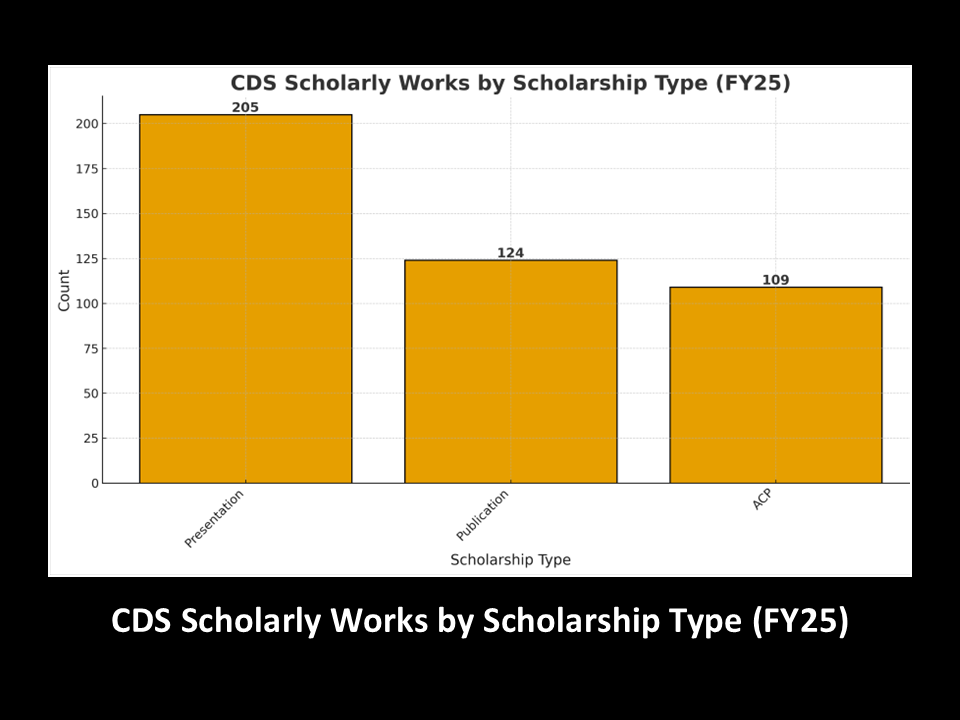
Looking at the form our scholarship takes, we see a dynamic blend of traditional and community-facing outputs.When examining scholarly contributions through the lens of Scholarship Type, the FY25 data for the College of Doctoral Studies highlights an engaged and actively disseminating academic community. [See Table 3 below].
Presentations represent the largest category, with 205 delivered across conferences, symposia, and professional forums. This reflects strong visibility for CDS scholars and a clear commitment to sharing research, engaging peers, and contributing to the broader academic dialogue.
Publications, with 124 total entries, demonstrate the college’s continued investment in producing peer-reviewed knowledge. These works include journal articles, book chapters, research reports, and other forms of written scholarship that advance theory, applied practice, and methodological understanding.
Applied Scholarly Projects (ACP) account for 109 contributions, showing how CDS scholars translate research into tangible solutions. These projects reflect practice-driven inquiry, organizational problem-solving, consulting work, and research-integrated professional activities that directly impact workplaces and communities.
- Taken together, these categories demonstrate a balanced and vibrant scholarly portfolio, and one that blends traditional research dissemination, written scholarship, with hands-on applied work. This distribution exemplifies the role of the practitioner-scholar model and signals the wide-ranging impact CDS faculty and students have across academic, professional, and applied fields.
The diversity across these formats reflects a shift toward engaged scholarship, where knowledge-brokering occurs beyond archival purposes, and is also activated in classrooms, communities, and professional networks.
Table 3.
Reflections on Data
The data we have gathered regarding research produced within the university from 2024–2025 clearly depicts the tremendous work and impactful scholarly activity that occurs frequently throughout our institution. With the College of Doctoral Studies playing a significant leadership role and conduit for facilitating all things research, alongside the meaningful contributive work efforts of its constituents, the university as a whole continues to evolve into a space where research informs practice, teaching, innovation, and transformative potentials in a variety of communities. Together, these contributions present the connective tissue that builds strength and progress within our research community, where research produced is rich in content and purposeful in its reach.
Table 1.