Degrees of Success Alumni Podcast Episode 16 - Dr. Pamela Lindsay

# Why human connection is irreplaceable in education
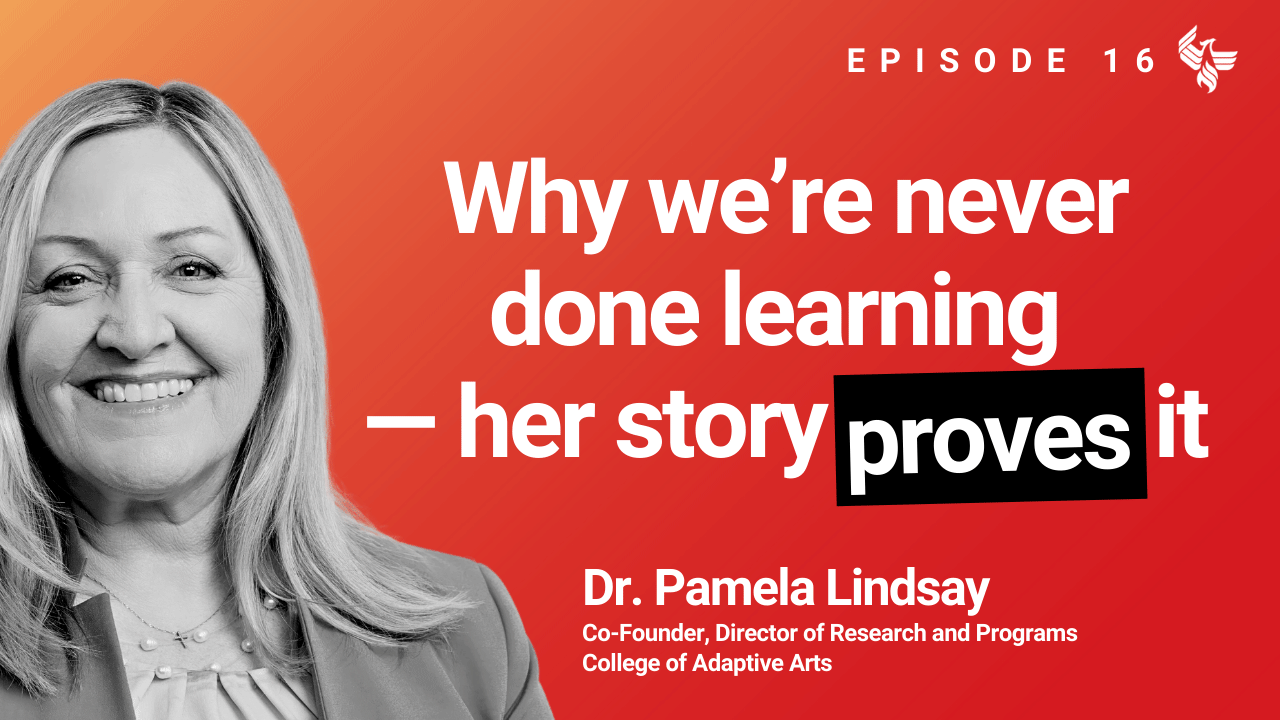
## Why Human Connection is Irreplaceable in Education

×  
Chapter 1: Opening Quote 0:00 - Life is about finding the people who get you and sticking with them. That encapsulates all of it. 0:05 5 seconds Students at University of Phoenix who find the place where somebody gets them, just stick with them. 0:10 10 seconds Just stick with them and you'll, you'll get over that mountain. 0:25 25 seconds - I wanna talk about your doctorate that you received here at University of Phoenix. Is this where CAA was born in your mind? Chapter 2: Founding of CAA 0:33 33 seconds - Yeah, well, CAA at this point in time is an inclusive collegiate partnership. 0:39 39 seconds So the first college that we were able to sit ourselves onto was West Valley College in Saratoga, California. 0:50 50 seconds We had gone through 10 plus years of just being all over the community in whatever space we could find. 0:57 57 seconds And it changed all the time. 0:59 59 seconds Our goal was to have an equitable spot on the college campus for our students. 1:04 1 minute, 4 seconds Like other adults in the community have access to when they wanna go back to school, they go, if they wanna go to college, they go to the campus. 1:11 1 minute, 11 seconds And so whatever that campus is, we needed a campus space and just that central hub. 1:18 1 minute, 18 seconds And it took, just like with my University of Phoenix program, it took a lot because it's like trying to get the brain around it. 1:27 1 minute, 27 seconds Now what do you do again? 1:29 1 minute, 29 seconds And now is that, would it be like a department of our college and you know, just trying to explain what it is. 1:34 1 minute, 34 seconds So here's what it is. It's its own private nonprofit, charitable 5 0 1 c three.org program for adults with intellectual and developmental disabilities. 1:47 1 minute, 47 seconds It's private college program. 1:50 1 minute, 50 seconds As a private college, it's providing, you know, professors and campus space and all the things that you would expect at a college. 1:59 1 minute, 59 seconds It's an equitable college for these adults who historically have not had access to structured high higher education in the same way that other adults have in our communities. 2:10 2 minutes, 10 seconds And they're one of the last groups in our community that has really had the gate shut on them at the college campus. 2:17 2 minutes, 17 seconds And not, not because they don't want to educate them, they would ask all the time for ourselves and others. 2:23 2 minutes, 23 seconds We, we were always going into meetings at colleges 'cause they were looking at how do we serve these adults? You know, how do we do it in an equitable way? Chapter 3: What Is CAA? 2:32 2 minutes, 32 seconds And we would say, just put us on campus. We have a program, it's all developed. We just need a place. 2:37 2 minutes, 37 seconds And then to show how it works so we can replicate it on other campuses or other people could, we can start the movement. 2:44 2 minutes, 44 seconds Just put us on your campus and the first college to say, we have space, we can do that. Come on over. Was West Valley the only one so far? 2:53 2 minutes, 53 seconds And so we are forever indebted to them that it's our, our flagship campus there, just the creative 3:02 3 minutes, 2 seconds forward progressive thinking of the West Valley Mission College District. So unbelievably supportive to our students. 3:10 3 minutes, 10 seconds So we situated ourselves there. 3:12 3 minutes, 12 seconds And then from there we've been able to put together the depth of programs 3:22 3 minutes, 22 seconds that, that our students really expect when they're coming to tour college. - Tell me about some of those programs. 3:30 3 minutes, 30 seconds - Well, we have 10 schools of study. So now we're a college of liberal arts. 3:35 3 minutes, 35 seconds Everything from science and, and dance and digital media studies with, you know, movie making Chapter 4: Schools of Study 3:44 3 minutes, 44 seconds and all that to communications and language studies, Spanish, Italian, Chinese, you know, whatever it is that they want to study. 3:52 3 minutes, 52 seconds Our job is to come up with a way to make it happen in a school of study. 3:56 3 minutes, 56 seconds And so they, our schools of study are very broad, like communications houses a lot. 4:02 4 minutes, 2 seconds We have a brand new one that just opened up the School of Leadership and Civic engagement, which comes out of classes that were happening 4:10 4 minutes, 10 seconds where the students really wanted to be able to work in that area during their class time as part of their structured learning. 4:18 4 minutes, 18 seconds We have diploma tracks undergraduate, graduate, and postgraduate our students, as I said, with Downs Autism, 4:26 4 minutes, 26 seconds any, any, any ability that they had come in with any learning ability. 4:31 4 minutes, 31 seconds And people say like any level, but we really don't look at it as levels. 4:34 4 minutes, 34 seconds It's just what are your strengths today and what are we working on as your next step? 4:38 4 minutes, 38 seconds So their programs are progressive, where whatever it is that they need today is what they'll get in that class. 4:46 4 minutes, 46 seconds They're gonna put in the hours of experience with and exposure to skills that are required to complete that class. And when they complete it, they get their credits. 4:54 4 minutes, 54 seconds So we have students graduating with an undergraduate diploma from our college who are at all different areas of learning in different subject matter, 5:03 5 minutes, 3 seconds but who have passions and have been pursuing them, things that they love. 5:07 5 minutes, 7 seconds And then when they get into graduate studies, it, then in an even bigger way, it's how do we contribute with that in the community? How do we get out into the community with that? 5:16 5 minutes, 16 seconds How do we start doing something with that? 5:18 5 minutes, 18 seconds And then postgraduate studies is just again, how to maybe globally, so like locally, nationally, globally, just continuing to move out. Chapter 5: Student Progression & Diplomas 5:27 5 minutes, 27 seconds We had some art students that were part of a global art exhibit, which is wonderful and inclusive global art exhibit to show their work, their meaningful work and just things like that. 5:39 5 minutes, 39 seconds We, it's, it's based on what they want to do and what their goals are, of course, but we have those opportunities for them. 5:45 5 minutes, 45 seconds And then if they finish their postgraduate diploma and they still wanna learn, then they can do a postgraduate too with another emphasis. 5:52 5 minutes, 52 seconds And we're getting better and better as time goes by at being able to develop the infrastructure of 6:00 6 minutes administrative databases and all those things needed to manage transcripts and learning goals and helping the students 6:08 6 minutes, 8 seconds and families understand where they are on their diploma journeys, you know, in their portals and just putting the, putting them in the driver's seat. 6:15 6 minutes, 15 seconds Say, here's where I am, here's what I need, here's how I wanna do it. 6:19 6 minutes, 19 seconds And I'm getting, you know, a, a larger and larger student advisory capacity going within our college. 6:26 6 minutes, 26 seconds You know, when you're a, a startup nonprofit, still pursuing a code that really fits what you do and funding that really fits what you do. 6:36 6 minutes, 36 seconds It's, it's an interesting task to try to build things and staff them and, and you know, you get really good at being, you know, 6:44 6 minutes, 44 seconds le tiny but mighty and just bringing in everybody's ideas and you know, knowing that you don't have to invent every wheel. 6:53 6 minutes, 53 seconds And that's what we really hope is to find other programs doing the same thing that we are with lifelong opportunities for unlimited numbers 7:00 7 minutes of students online, on site with all these different areas of study. And really focusing on getting adults everywhere. 7:08 7 minutes, 8 seconds Anyone who wants to come in and learn to be able to find those opportunities, they can then learn to take actions on and move forward and, and make changes with. 7:17 7 minutes, 17 seconds So we're looking for 'em. 7:19 7 minutes, 19 seconds And I hope anybody that listens to this podcast that knows of a program will contact us. 7:25 7 minutes, 25 seconds We have a lot of friends and programs that are those post senior or those like more finite number of people or number of years or whatever in different colleges and different communities. 7:34 7 minutes, 34 seconds But we know they're out there and we don't wanna invent every wheel. 7:38 7 minutes, 38 seconds And, and that's another thing, somebody that comes into the diploma program at University of Phoenix, for example, say their doctorate 'cause that's where I was 7:46 7 minutes, 46 seconds and they don't know where they're going, but they just know what they have a passion for. 7:50 7 minutes, 50 seconds And maybe they don't have a job doing that right now, but it's something they'd like to do. 7:55 7 minutes, 55 seconds That's, you know, that's really the key is to just as we're finding, to be able to get, to get 8:04 8 minutes, 4 seconds what you are doing, put together in a way that you can share it with other people and get it encapsulated somehow so you can offer it. 8:13 8 minutes, 13 seconds That's, that is such a tough thing to do when you know you're trying to figure it out yourself. 8:19 8 minutes, 19 seconds And the, the assistance that I had in trying to put together the ideas that I had for our programs 8:27 8 minutes, 27 seconds that were just, you know, how do I encapsulate that, as I've said, has been just invaluable. 8:32 8 minutes, 32 seconds But for anyone encapsulating what it is that you are learning and what your specialties are becoming and finding out where you can take those to make a change. 8:40 8 minutes, 40 seconds I think that's, that is one of the big things that I know the alumni program too wants to reach out and help people with that have come 8:48 8 minutes, 48 seconds through programs at University of Phoenix and that is all of our goals. That is the goal. Yeah. Chapter 6: Why Focus on Adults? 8:55 8 minutes, 55 seconds - You had this experience with your daughter and then you created this incredible college. 9:04 9 minutes, 4 seconds When did you make the decision for it to be adults that are neurodivergent or IDD as opposed to children? 9:11 9 minutes, 11 seconds What, what, what was that that, - So that's a great question. 9:15 9 minutes, 15 seconds We were coming up with all kinds of programs for my daughter, you know, at the age, age range of five to 22. And definitely five to 18 till they get out of high school. 9:24 9 minutes, 24 seconds Lots of programs, lots of parents starting programs for the kids, you know, when they're at home and they're not, you know, independent 9:32 9 minutes, 32 seconds or working on trying to become as independent as they can and maybe getting out of the home. 9:37 9 minutes, 37 seconds But when they're younger, there's a lot of programs in the Bay Area where we were so many that you could never possibly take part in all of them. 9:45 9 minutes, 45 seconds I mean, just wonderful things and all these startup things. 9:48 9 minutes, 48 seconds I was singing all these new programs popping up, popping then the theater and everything else. 9:53 9 minutes, 53 seconds And so yeah, we, my co-founder and I were working with the theater program previously for the kids and I was bringing my theater background when I 10:02 10 minutes, 2 seconds went back for my master's and my daughter was diagnosed and I had to take the big break. 10:06 10 minutes, 6 seconds I actually was looking at children's theater, taking children's theater out to teach kids about all kinds 10:13 10 minutes, 13 seconds of, you know, lessons and equity and diversity and inclusion and all those wonderful things that we were embedding into the shows. 10:23 10 minutes, 23 seconds And the show. 10:25 10 minutes, 25 seconds One of the shows that I did when I first got with that group was, it was a musical version of The Odyssey for Children and I played Athena 10:33 10 minutes, 33 seconds and it really was life changing because that group and that experience made me want to do that with the art form, you know, with my art. 10:41 10 minutes, 41 seconds And so Athena was the second stage of my Alice, and it's Alice and Athena and I just love her, her owl, I didn't even think about it at the time. 10:52 10 minutes, 52 seconds The, the wisdom and the, the, the owl is the symbol and the, yeah, it was just such a great experience. 10:57 10 minutes, 57 seconds And then just that, that imagery of that, it was kind of cool for me. 11:01 11 minutes, 1 second So kind of the starting to then where I was going with it, with education and leading, you know, forward and, and trying to get out in front of it 11:10 11 minutes, 10 seconds and just like, you know, Athena did with Odysseus, you know, so symbolic in different ways. It can make it whatever, you know, but find a lot in. 11:19 11 minutes, 19 seconds But anyway, so I have Alice and Athena are my two things, but realizing doing that with the kids, that that was really a joy of mine. 11:26 11 minutes, 26 seconds But then what happened was in that theater program that my co-founder and I were working on and my daughter was coming out of high school just finishing high school up, she was buddy coaching in it, so was my son. 11:37 11 minutes, 37 seconds Our first musical was Wizard of Oz. 11:40 11 minutes, 40 seconds And my son wore all black and had a dog puppet and he was toto, let's go this way, you know, was wonderful with them kinda like a buddy coach. 11:47 11 minutes, 47 seconds And my daughter was buddy coaching Glenda and was able to do Glenda in one of the shows just for fun. 11:54 11 minutes, 54 seconds So they, we were all involved in it and then all of a sudden, you know, the, some of our most beloved actors that had started with 12:01 12 minutes, 1 second that program were aging out and they couldn't come back and do a show and there was no adult theater program 12:07 12 minutes, 7 seconds that they could just slide right into that was similar, approaching it the same way, which was everybody of all abilities on stage together with this wonderful play 12:16 12 minutes, 16 seconds that was the model was, it's beautiful 'cause it's, theirs didn't have to look like anybody else's play. 12:21 12 minutes, 21 seconds A lot of improvisation and fun and joy in music and collaborative camaraderie, everything I loved, right? 12:29 12 minutes, 29 seconds Yeah. So that's what was being built there. 12:31 12 minutes, 31 seconds So we thought, well let's do it for the adults and we'll make this college of adaptive arts. 12:34 12 minutes, 34 seconds 'cause we had some town hall meetings and they were telling us they wanted a college and telling us the problem of not having college. Could it be a real college? Could you teach reading? 12:43 12 minutes, 43 seconds And like, okay, so the first workshops that we did involved all kinds of different subject matter kinda in the arts. So everything was through the channel of the arts. 12:51 12 minutes, 51 seconds And then as it moved forward, then we just started to develop more specific classes for those areas and then ended up with the schools of study 13:00 13 minutes and now it's a college of liberal arts with 10 schools of study and and on like that. 13:04 13 minutes, 4 seconds So it's really a matter, I think often for families and for parents of really needing to be, and rightfully so focused on your child, the age that they are, what they have, what they need, Chapter 7: Arts as a Foundation 13:13 13 minutes, 13 seconds and making sure that you're finding the programs for them at that point. 13:19 13 minutes, 19 seconds And then you do hit a point where a lot of people call it kind of the cliff of service drop off and it's not expected. 13:27 13 minutes, 27 seconds There's a sense that there's gonna be so much there for them, they seem so happy in what they're doing and then all of a sudden it just kind of drops 13:35 13 minutes, 35 seconds because, you know, there aren't the programs that the parents are creating and running and everything like there are for the younger kids. And for reason, there's reasons for that too. 13:43 13 minutes, 43 seconds So that was something that we could contribute access to doing these whatever it is that they have a passion for 13:51 13 minutes, 51 seconds and they want to be part of their life ways they wanna contribute to the community, whatever that is for them, that we could bring that to them. 13:59 13 minutes, 59 seconds And so d and I would just say we're their agents, like I mentioned before, Dee and I were their agents and we just created the stage with the light on them. 14:10 14 minutes, 10 seconds And we, if we look at an organizational structure for college of adaptive arts, the very bottom is us as co-founders and our board 14:18 14 minutes, 18 seconds and our staff is up there kind of like this, you know, the people that are the stage managers and that you'll see out on the stage. 14:25 14 minutes, 25 seconds But, but the, the students are the ones up on that stage, the community's really gonna see and it's their voice we want them to hear. 14:32 14 minutes, 32 seconds And when there's ever an opportunity to, you know, be at city hall to talk about something to, there's no anything going on. 14:42 14 minutes, 42 seconds We really hope the students can be the ones out there. 14:45 14 minutes, 45 seconds And so that's where this new department of leadership and and civic engagement is coming in, is to really build up not just self-advocates 14:54 14 minutes, 54 seconds and advocates for the college or, but to really build up those community leaders that are going to be able to step out on that same level. 15:03 15 minutes, 3 seconds And just as CAA created an inclusive place for an inclusive model for higher education, have an inclusive model for community engagement. 15:11 15 minutes, 11 seconds So we're all involved and their voices aren't just heard, but they're at an active part of change making and, you know, societal change and pursuing social justice. 15:22 15 minutes, 22 seconds - CAA just sounds incredible and it sounds like it's really supporting people and giving people similar to your daughter, that encouragement, that confidence to be able to your point 15:30 15 minutes, 30 seconds to go out and serve and to create other environments for people like-minded or possibly in the same 15:38 15 minutes, 38 seconds or similar situation, to also also feel empowered and confident. So simply incredible. 15:45 15 minutes, 45 seconds You've had so many students within this 15 years, right? - Yeah, yeah. - Tell me one of the success stories. 15:53 15 minutes, 53 seconds Tell me about what it looks like for people to go through this process and a particular person or two that had a re a really pivotal moment. Chapter 8: Student Success Stories 16:01 16 minutes, 1 second - Yeah. Well there's one student in particular that I think of automatically. 16:07 16 minutes, 7 seconds People say, oh, it's, you know, this college is really only for those who would be able to go to community college but might have a learning disability or they're very high functioning. 16:16 16 minutes, 16 seconds So, and they, but, but what about, you know, our student who doesn't read and, you know, they just to understand it's for everybody. 16:24 16 minutes, 24 seconds So we had a student come in who we thought was, you know, mostly everybody kinda thought was nonverbal, 16:33 16 minutes, 33 seconds it was just selective speaking I think, but very nonverbal and had some physical issues, deformities 16:41 16 minutes, 41 seconds and things going on and had not ever thought about being involved in different kinds of physical activities 16:49 16 minutes, 49 seconds or arts that's physically, you know, dance, things like that. 16:53 16 minutes, 53 seconds And so actually found out that they could participate in dance and came in and found their way that they were gonna bring their spirit to that art form. 17:05 17 minutes, 5 seconds And it was incredible and, but didn't have the confidence to pursue other areas of learning. 17:13 17 minutes, 13 seconds Like, for example, reading that was so difficult or science or, no, don't even talk to 'em about science. They don't want school, they don't want homework. 17:21 17 minutes, 21 seconds We don't have homework by the way. 17:22 17 minutes, 22 seconds So the students love that everything happens in class like it would if you were homeschooling everything's in class so that they get exposed to things with the instructor in a way 17:31 17 minutes, 31 seconds that's guided and strategic and then they have home activities they can do, but it isn't about grades and being competing with other people. 17:38 17 minutes, 38 seconds It's about where you are and moving that forward, whatever that ends up being by the end of the semester. 17:43 17 minutes, 43 seconds So once the student comfortable with that, then started pursuing some of these other areas and ended up finding a huge love of poetry 17:52 17 minutes, 52 seconds and literature and still is working on those reading skills that now has been exposed, not only exposed to but has experienced, you know, great literature that they never approached before. 18:03 18 minutes, 3 seconds And being able to be part of conversations and get out into the community to 18:11 18 minutes, 11 seconds present information or what have you in, in a way that they're speaking so wonderfully 18:18 18 minutes, 18 seconds and communicating in their own communication style so beautifully because they have the confidence to do it and not even thinking about being nervous about it. 18:27 18 minutes, 27 seconds So just overcoming all the boundaries of fear of failure and anxiety and those things that get in the way of really feeling like you could approach higher education 18:36 18 minutes, 36 seconds and finding out that it can be for you and that it will be set up for you. 18:39 18 minutes, 39 seconds And then being able to broaden the scope of what you're learning to the point where now you're in the community communicating, you're in the community dancing, you're in the community, 18:48 18 minutes, 48 seconds sharing messages in so many different ways and impacting people. 18:53 18 minutes, 53 seconds So that's really neat. And then another student who did go to a community college, we was with us for several years. 19:01 19 minutes, 1 second We did not know that that student actually got their diploma from that community college and they completed it, but they didn't have any place to put what they were interested in. 19:11 19 minutes, 11 seconds And then that was journalism and working on a paper and had always worked on school papers and was really active in the paper at that community college. 19:20 19 minutes, 20 seconds And we had no idea that their dream was to like be an editor right, of a paper and or to create their own paper. 19:27 19 minutes, 27 seconds And this they, they knew they could do it and how to do it, but what would the resources be and where would you have, where would you do that, where you'd have the support to be able to do that. 19:36 19 minutes, 36 seconds And so we said, well, okay, let's start a paper. 19:40 19 minutes, 40 seconds And so this was a graduate student who's now in our workforce development program and we started finding more and more of this out and oh my gosh, you have that much journalistic background. 19:50 19 minutes, 50 seconds Bring us in your columns, let us see what you've written. 19:53 19 minutes, 53 seconds And so her, her goal is to be a professor at the college and now she's producing our first Cardinal Times newspaper for our students and reporting on things. 20:04 20 minutes, 4 seconds The students went to a Barracuda's hockey game, they're invited to go to Barracuda and she interviewed a player and she wrote an article about that and they invited her to come and interview a player. 20:13 20 minutes, 13 seconds And that was just incredible, you know, opportunities that what journalist in the Bay Area has a chance to do 20:21 20 minutes, 21 seconds that every day and know back in the clubhouse and you know, get involved. 20:25 20 minutes, 25 seconds And so, and then a student that just recently discovered photography as an interest, who 20:32 20 minutes, 32 seconds before thought he might like to maybe work in the classroom with, with fellow students and things as a staff member, maybe a goal for him. 20:40 20 minutes, 40 seconds And then he got involved with photography in one of the classes with an amazing teacher and now he wants to be a photographer. So guess what? He's a photographer. 20:48 20 minutes, 48 seconds He's the photographer for the, the times that the other student is the editor for. 20:54 20 minutes, 54 seconds And they are the team that are building this paper up and now he's finding this area totally out of the box and non-traditional. 21:02 21 minutes, 2 seconds And he's going other places and doing photography for them because he's learning how to take some great pictures and he's doing it just, you know, he loves what he does 21:11 21 minutes, 11 seconds and if he can, you know, build into doing this vocationally in some way, it would just be a dream come true. 21:18 21 minutes, 18 seconds And so not ever having explored that, he didn't even know he had that interest. 21:22 21 minutes, 22 seconds And now he's the photographer, the the photographic journalist for our, for our paper that we're producing for our college. 21:31 21 minutes, 31 seconds So just really neat stories like that all the time all around. 21:35 21 minutes, 35 seconds And those that really had an anxiety going back to school because they had felt like with maybe learning disabilities or whatever the issues were, some 21:44 21 minutes, 44 seconds of them have had real extreme bullying in their past and they're just not sure it's a safe space. 21:49 21 minutes, 49 seconds So we also have an arts behavioral model that is, you know, making sure that students are respecting each other and coming in with, you know, positive attitudes of, 21:58 21 minutes, 58 seconds of supporting each other and that they can trust each other in that space. 22:02 22 minutes, 2 seconds And the old theater term of we're going to leave it at the door, we employed that we're going to be glad we're gonna leave it at the door. 22:09 22 minutes, 9 seconds And learning that is a skill. 22:11 22 minutes, 11 seconds That's a, I mean that takes a while sometimes for students to be able to understand the concept of leaving it at the door, but an important one path. 22:19 22 minutes, 19 seconds And then in the interpersonal relationships, not just at the college, but with feathers outside of it, you know, the more they're able to employ things like attitude 22:27 22 minutes, 27 seconds and respect and you know, mutuality in their relationships in their classes, then they will know how to apply that outside of class and be encouraged to do that. Chapter 9: Behavioral & Social Model 22:36 22 minutes, 36 seconds And we treat the class space as a professional environment and how you come into the space and how you interact with others in the space, which can be very new to our students. 22:46 22 minutes, 46 seconds And so that's regardless of if they're there for one class or 10 years, that's always gonna be a part of their learning process of those professional skills. 22:55 22 minutes, 55 seconds And then we have a school of business now too for them to pursue, you know, other kinds of professional skills, 23:02 23 minutes, 2 seconds but you know, those social, cognitive, developmental skills that we work on within this curriculum that really was shaped 23:09 23 minutes, 9 seconds and, you know, put into a, a structure that you could share and train, you know, with others that is the foundation of everything. 23:19 23 minutes, 19 seconds Not how high do you kick or how well do you write a sentence or you know, how you can, you do a, a lab experiment on your own to prove a hypothesis. 23:28 23 minutes, 28 seconds It's, you know, it's just what is your personal best today in your areas of learning choice 23:35 23 minutes, 35 seconds and what does it mean for you to move forward to your next steps and to continue to do that throughout your life. 23:43 23 minutes, 43 seconds - You've made a pivotal change for these students. You've created a place for them to feel comfortable. 23:50 23 minutes, 50 seconds You've created a place for them to feel powerful and you've created a place in them to where imposter syndrome is something of the past. 23:59 23 minutes, 59 seconds And I could, I could only imagine how that had to be transformative for them, their future and the next generations coming behind them. 24:09 24 minutes, 9 seconds So for them, and I'm sure if I were to meet any of them, especially the two that you had mentioned, one, a journalist, one a photographer, 24:18 24 minutes, 18 seconds and doing this with the times and also setting up the brand new paper for the college, congratulations and an awesome thank you. 24:26 24 minutes, 26 seconds And your faith, your, your optimism is clear. 24:32 24 minutes, 32 seconds Like it is part of the vision and it is part of the value of the college. 24:35 24 minutes, 35 seconds And you could see it moving into your students as well as they move forward in their life and in their careers. 24:42 24 minutes, 42 seconds And that in itself is absolutely incredible. 24:45 24 minutes, 45 seconds So thank you for that. Thank you for driving through and pushing past, 'cause I imagine it couldn't have been all unicorns and glitter, there had to have been within this 15 years a little bit. 24:55 24 minutes, 55 seconds There had to have been some rub. 24:57 24 minutes, 57 seconds Was there, was there, was there any, what what challenges did you deal with within this 15 years getting to this point? Chapter 10: Biggest Challenge: Gaining Support 25:04 25 minutes, 4 seconds - The biggest challenge is when people just aren't getting behind you. 25:07 25 minutes, 7 seconds When you know that what you have can, can con when you know that what you have is viable and it's, and 25:14 25 minutes, 14 seconds and you just are trying to find the support and no matter how much you talk about it, no matter how much how you put it out there, it's just not like 25:25 25 minutes, 25 seconds taking root, you know, and you know that it needs to, and it should and it can, and it's not, it's not hard to do. 25:32 25 minutes, 32 seconds This is just us all getting together to do it. You know, we're training our teachers, right? 25:36 25 minutes, 36 seconds You could have taught somewhere else for 20 years in special ed. We still are gonna need to train you in our methods. It may not be a good fit. 25:44 25 minutes, 44 seconds You know, it's like just teaching people what it's about and well, usually it is, but you know, it's definitely coming in and learning how we teach in the classroom, which is very different. 25:53 25 minutes, 53 seconds But that's the main thing is just getting people to get behind what you're doing and what the students are doing. That's been the big challenge. 26:02 26 minutes, 2 seconds And of course, as you're around longer and longer in the community, people start to get it more and more understand it. 26:08 26 minutes, 8 seconds You have people spreading the word for you, but then they're talking to people that have never seen it. 26:13 26 minutes, 13 seconds And it's really, it really requires people, meeting the students, seeing what we do to really understand it, seeing it on that campus and understanding what kind of a, of a, 26:23 26 minutes, 23 seconds of a inclusive partnership that can be and how that brings these individuals in our communities that haven't had access. 26:31 26 minutes, 31 seconds How it brings them access and how it is such a social justice issue. 26:35 26 minutes, 35 seconds That, and funding, of course, always funding, but it comes, it's the right thing at the right time. 26:43 26 minutes, 43 seconds By no fault of our own. 26:44 26 minutes, 44 seconds I mean, we were just, you know, told by everybody else it was the right thing at the right time. 26:48 26 minutes, 48 seconds And we jumped in and we always say, Dee and I, we call each other we're Sisters of the Swell, which is this, this watercolor that she got. 26:58 26 minutes, 58 seconds We have two women on surfboards, you know, waiting for the wave. 27:01 27 minutes, 1 second 'cause we always talked about, we didn't even know that we were kind of catching one at the time that we were, that this really was so, such a big hole in our educational system. 27:13 27 minutes, 13 seconds And then you've gotta, it's exhausting to ride it, get up on it and try to ride it to shore. 27:17 27 minutes, 17 seconds Then you get there and you feel like, oh, okay, we hit that milestone and then, you know, you're soaking wet and you're tired and you're looking around 27:24 27 minutes, 24 seconds and you see all of these other people with their surfboards that were out there at the same time, you didn't even know were there. 27:30 27 minutes, 30 seconds And then you're just saying, Hey, okay, let's, let's climb this hill together and see if we can get into the valley over there, you know, and where you, and so, and you don't even know what's there, but you know, you gotta go to something else. 27:41 27 minutes, 41 seconds So you're all just climbing the hill together and getting strength in each other. We call our supporters mountain movers. They really, truly are. 27:49 27 minutes, 49 seconds But you're climbing that mountain or trying to move that mountain, you know, and then you get to the other side and now you know, there's, there's, you know, somewhat 27:57 27 minutes, 57 seconds of a bounty over there to be able to try to, you know, be part of, but you know, is it gonna go, are, are you gonna be at the table? Chapter 11: Climbing the Mountain Together 28:06 28 minutes, 6 seconds Is someone else gonna be invited to the table? 28:08 28 minutes, 8 seconds So now you're all over there looking for tables to be able to sit at, you know, and we're talking about our students really, you know, being able to get them a seat at the table in these places. 28:18 28 minutes, 18 seconds And so just, you know, all the, all the work that's required to really just have that hope and optimism 28:25 28 minutes, 25 seconds and what you're doing founded in the fact that you know, that you've, you know, gotten where you are, that you have what you have underneath you, but primarily you have that meta support, all those people 28:35 28 minutes, 35 seconds that are climbing that mountain with you and that together you can come up with the information and the resources required to stand on, to get to each new level. 28:45 28 minutes, 45 seconds Like when mountain climbers put in their hook, and I'm not a mountain climber, I'm gonna call it a hook and a rope, you know how they have to do that, you know, and if you have multiple yeah. 28:54 28 minutes, 54 seconds And somebody at the top, you know, helping you out and you know, you have to learn to do it before then you can even really get on, get up there at all 29:00 29 minutes to any degree, which we had to learn, kind of build our processes. 29:05 29 minutes, 5 seconds So all those things were challenges, but it really is just primarily being able to continue 29:12 29 minutes, 12 seconds to communicate until you can just build that group around you that understands, gets it, and wants to go there with you in anything that you do. 29:21 29 minutes, 21 seconds - Absolutely. Dr. Pamela, you were phenomenal. 29:24 29 minutes, 24 seconds And the, the things that you've accomplished with your partner and, and simply your, your goals and aspirations moving forward, wanting to be able to touch 29:33 29 minutes, 33 seconds and serve more so that they can feel more successful and empowered. 29:39 29 minutes, 39 seconds It's admirable. And so we are proud that you are a university Phoenix alum. 29:45 29 minutes, 45 seconds We are so, so grateful that you joined us today in sharing your story. 29:50 29 minutes, 50 seconds I know that the listeners and the viewers are definitely going to be able to get something from this that brings us to the end of this episode of Degrees of Success. Chapter 12: Closing Remarks 30:00 30 minutes I'm your host, Frida Richards. 30:02 30 minutes, 2 seconds Don't forget to like, comment, and subscribe and remember that your next chapter just might be your best one yet. See you soon. Sync to video time
University of Phoenix alumna Dr. Pamela Lindsay shares her journey as an educator. She discusses the intersections of education, technology, personal growth, the impact of AI on marketing, and the importance of human connection in a rapidly changing world.

The video was uploaded on 5/22/2025.  
You can[view the video on YouTube.](https://www.youtube.com/watch?v=uDxiD9rfnsk)  
The video lasts for 30 minutes and 24 seconds.

**Key Moments**  
00:00 - Opening Quote  
00:26 - Founding of CAA  
02:30 - What Is CAA?  
03:40 - Schools of Study  
05:20 - Student Progression & Diplomas  
08:50 - Why Focus on Adults?  
13:10 - Arts as a Foundation  
16:00 - Student Success Stories  
22:30 - Behavioral & Social Model  
25:00 - Biggest Challenge: Gaining Support  
28:00 - Climbing the Mountain Together  
29:56 - Closing Remarks