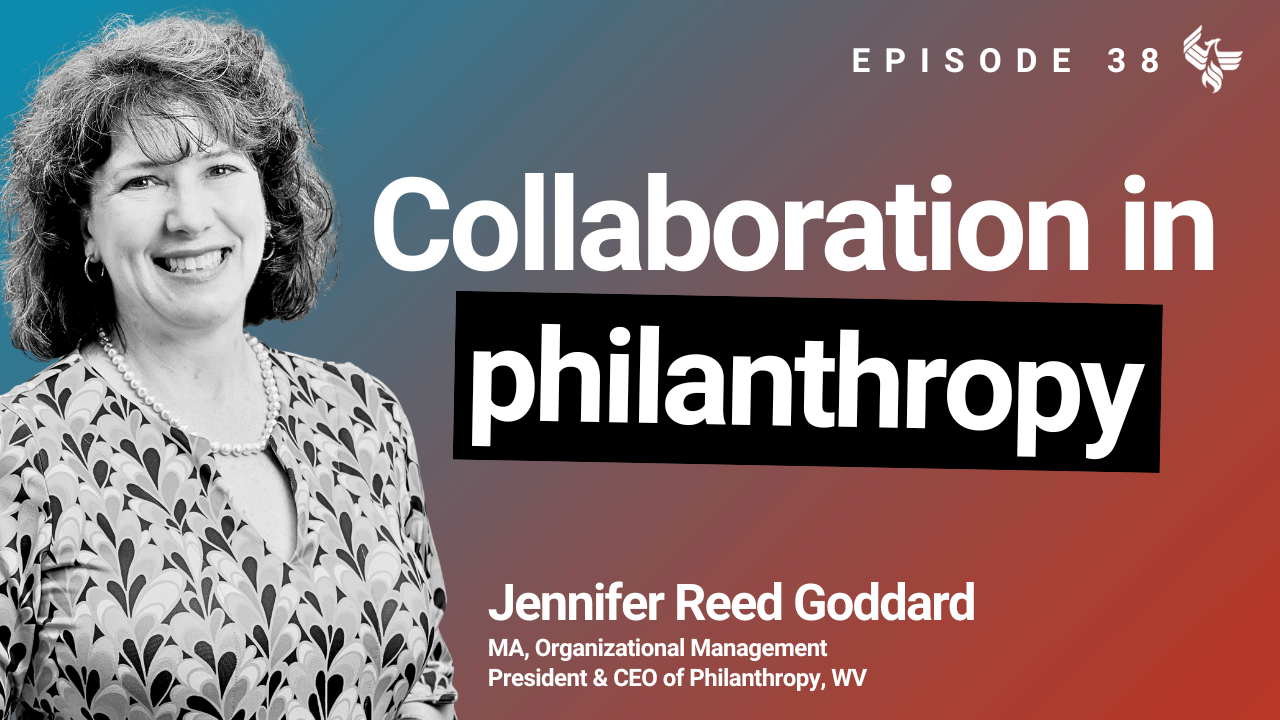
Degrees of Success™ Alumni Podcast Episode 38 - Jennifer Reed Goddard

# Collaboration in Philanthropy

## Collaboration in Philanthropy

[Embedded content](https://www.youtube.com/embed/L8RANLALBrQ?rel=0&controls=1&fs=0&modestbranding=1&cc_load_policy=1)

×  
Introduction and Guest Background 0:00 We need those people with all the different skills. We need people who don't just have time or money, but people who are passionate and excited about the work. 0:11 I've seen with my work over the years, certainly at the YWCA and also with Philanthropy West Virginia in the last year, people care about the organizations that they volunteer 0:21 in. And we need to keep feeding that, making sure people support. the organizations that they're passionate about, or find the passion. 0:28 You might not know you're passionate, but you might have skills and you might have time. 0:43 Welcome to the Degrees of Success podcast. Today we have a leader shaping the future of philanthropy and collaboration in the state of West Virginia. 0:51 Jennifer Reed Goddard is the president and CEO of Philanthropy West Virginia, the statewide network that brings together grantmakers, foundations, corporate funders, United 1:01 Ways, and individual philanthropists to strengthen communities and increase impact. 1:07 With a career spanning nonprofit leadership, communications, and strategic partnership building, Jennifer has dedicated her work to connecting people, aligning resources and advancing mission driven solutions. 1:19 Today, we're going to explore how her leadership journey has evolved, what effective collaboration really looks like, and how intentional philanthropy can drive meaningful 1:27 change across a community. Let's dive in. Jennifer, welcome to Degrees of Success. 1:34 I recently listened to your feature on a podcast called Fostering Solutions. 1:39 And one thing that struck me was your passion for community involvement at a very young age. You had told a story about you and your mother lobbying to get a school bus for your local community. 1:49 I'm curious, like looking back at that lobbying or that community involvement that you had at a young age, did you understand the magnitude of the impact of what that school bus Early Community Involvement and Family Influence 2:00 would bring to your community? And how else has your family kind of influenced the way that you serve your community today? 2:07 That's a great question. know, I think in hindsight, no, that was just, you know, my mom and dad were really all about do what needs done. 2:16 Take care of your community, take care of whatever it is that needs done, and uh don't wait for other people to step up. 2:23 That's what we do. We step up and help in our community in any way we can. 2:29 And uh no, wasn't a matter of uh that was the most important thing for me. It was mom said, we're going to go do this. 2:36 We went and did it. oh But it was important, know, there are those little school, the community I lived in didn't have sidewalks and it was really important to make sure that people could get to 2:46 school safely in my mom's opinion. And she and the other moms got together and they went out with all the kids in tow and we knocked on doors and told them how important it was. 2:56 ah But to me, I'm very fortunate that just my parents instilled in me and my brother the importance of 3:04 doing what is right and doing what is important for the greater good in most cases. 3:10 It's not just about you, it's about everybody in the community. What was your education like growing up in West Virginia? 3:16 What were you most interested in in school subject wise? I had a really great opportunity. 3:22 It was a very small school just because of the luck of the draw. I mean, it's funny how when I moved into Charleston in the 1970s, it was really booming. 3:32 There were a lot of people coming into the community. There were a lot of people. I wasn't the only new kid in the neighborhood. 3:40 There were quite a few other people that were new in the neighborhood and in the school. And just had a chance because... 3:47 Charleston, West Virginia is one of the best kept secrets in the world. You know, it's a small town and uh it's a city. 3:55 So we have a, you know, vibrant cultural opportunities, lots of natural beauty, lots of diversity in the community. 4:03 And uh I've been really fortunate to have been here for most of my life. We have so many different opportunities for people even to this day. Living in Charleston and West Virginia's Rich Culture 4:12 We have a ballet, there's a symphony, there's a museum. And we're 20 minutes down the road from some hiking and biking. 4:19 We're an hour from some of the best world-class whitewater rafting. We're two hours away, three hours away from amazing skiing, snow skiing and snowboarding all within our state. 4:30 So it's a really great place to live and work. And I'm really lucky that I get to be here. That's amazing. 4:35 ah So I'd like to talk a little bit more about your education a little bit. I know you have your undergraduate degree in journalism. 4:42 And so I'm kind of curious that that led into a career in public relations a little bit. so eventually into philanthropy now. 4:49 So what attracted you to the field of mass communication? And as someone who also studied communication, what keeps you in the industry as well? 4:59 You know, at my heart, I would say I'm a storyteller. I've always enjoyed stories. You asked earlier what one of my favorite subjects it was. 5:07 Really, I enjoyed reading and writing and creative writing. 5:12 Really had a lot of opportunity to explore those different things. You know, as simple as it was doing a school newspaper, I got to be on the school newspaper when I was in junior high school and then in high school. 5:26 And so journalism was a really great place for me to go in my education. Education in Journalism and Public Relations 5:32 When I went to college, Ohio University has an amazing journalism program that's constantly in the top 10 of journalism schools. 5:41 So I learned early on how to write on deadline, how to be accurate, how to be accountable for what you, you know, when you're telling someone's story, you want to be accountable. 5:51 And I think that those are all great things that came into play in how my career has evolved because when someone trusts you with their story, you have to do the right thing. 6:00 And uh I really enjoy the opportunity to tell people stories, to share information. 6:06 I always have had great uh leaders in the community and great mentors in the different uh career opportunities that I've had to really help me 6:18 grow and continue expanding my career in some really, I think, exciting and meaningful ways. 6:24 Are there any specific mentors from your your college days that really come to mind right now whenever you think about where you are presently in your career that guided you along 6:34 the way? know it's funny because when I was in college, I didn't really have a great experience often with some of my professors because some of them were just so uh focused on true 6:47 journalism and because I was going into public relations, some of the J-School guys were just like, you're in PR, you're not a serious journalist. 6:56 And I had a great professor in ethics and he was one of those people who he 7:04 treated students like they were adults. He trusted us. He gave us license to explore ideas and try out different things. 7:13 When we were providing oh our assignments, turning them in, he was uh really big on real life examples and really learning from real life scenarios that he brought to us in the 7:25 classroom. Having someone who was teaching ethics and expecting us to... 7:33 hold ourselves to an ethical standard early in our journalism careers was really important. 7:39 He didn't push us to give these really obscure examples. 7:46 He really wanted us to take what we learned and what we knew and apply that and then take what he was teaching us and sharing with us to make sure that we really just kept ethics Mentors and Ethical Foundations in Career 7:58 as that constant as we were working in whether it was, you know, straight up journalism, newscasting, broadcast, print or public relations. 8:10 Public relations, I think gets a bad reputation because people think about public relations as spin. 8:16 And it's, it's, there are ethical standards for people in public relations. I'm a member of the Public Relations Society of America, and I'm accredited in public relations. 8:25 And so there's an ethical standard and a code of conduct that people expect us to adhere to. 8:33 Having that grounding early in my educational life has really carried through everything that I do. 8:39 And also, again, I had parents who expected me to be accountable. And I think that when you get those important people in your life who just reinforce the things that you've learned and heard your whole life, and you just continue to hear that, Pursuing a Master's Degree and Career Development 8:54 you realize that there are things that you just want to hold onto. That's beautiful. Whenever you were experiencing your undergraduate uh education, was graduate education something that was in the forefront of your mind? 9:07 Or when did that come into play? When did you think that I needed to take that next step into getting a master's degree in organizational leadership? 9:16 When I was in undergraduate, in hindsight, I realized I was just in a hurry to get out there and start working, which now I'm like, whew, that was really ridiculous. 9:26 I should have enjoyed it more. I should not have been in a hurry to get into my career. I graduated. 9:31 But then again, my parents said, you have four years, get it done. oh So I did. And when I graduated, I wanted to get a job. 9:39 And I thought, oh, I've got this degree in public relations. I've made these great contacts. 9:44 I had a great internship. I'm gonna go and I'm gonna go to the big city and get a great job. 9:50 And when I graduated, it was really challenging to find a job in public relations. It was really challenging, I think, to find a job anywhere. 9:56 So I moved home, I was fortunate. oh And then using all those newly minted skills, I used to tell people, hey, you know, I have a degree in journalism and public relations and I'm looking for a job. 10:07 you know of anything or know of anyone that could hire me? And... 10:13 Within a couple months that paid off and I ended up getting my first big full-time job. 10:19 And then that just kept, you know, kept happening. I've always been able to network and use my contacts to keep moving to the next thing. 10:27 And so I was, as I said, I was really ready to get into work and didn't really have an idea that I wanted to, uh to get a master's degree. 10:37 And it wasn't until I had been working for quite a few years and I had great 10:42 I was in a great environment and I had great uh bosses and they were like, hey, you you've been working here for a couple of years now and we really want to see people that we think 10:52 can be into the management track, get a degree, start learning a little bit more, you know, get some, get a master's degree. 11:00 How do you think you might want to do that? How can we help you with that? And so because they were willing to support me in that while I was working full time, and this was before it was so easy to do everything online. 11:11 oh You know, I had had certain ideas like I really didn't want to have to take accounting that much. 11:17 I didn't really want to have to get into a lot of the the business courses that I didn't shakely enjoy in undergrad. 11:25 So I really looked for a program that was going to help me grow in certain aspects. Work with West Virginia Kids Count and Impact on Children 11:32 And I felt like being able to learn more about human resource management, being able to really, really learn about management, sort of the MBA, but without the 11:41 without that accounting and statistics side of it. That was what really sold me on that program. 11:49 I want to go back to something real quick. So you started talking about kind of the beginning of your career. 11:55 In your bio, you mentioned you kind of credit the beginning as your role of the Director of Communication for West Virginia Kids Count Fund, where you produced the first four 12:03 annual data books on the well-being of children and families, which continues to this day, from my understanding. 12:10 So I'd like you to tell us a little bit about what those data books mean, how they came to life, and how does it make you feel knowing that 12:17 it has kind of this lasting impact? You know, I really felt like the work that I was doing when I was at the Kids Count Fund was so important because I, again, I think I didn't recognize it when I was a kid, but I 12:31 certainly recognized it as an adult. And as I worked in child advocacy, that not every child has a very positive experience growing up. 12:42 And there are always children who are hungry and who are experiencing homelessness and living with uh 12:48 with people, maybe they're living in foster care or they're living with people who are struggling. 12:54 And so being able to be a part of that opportunity in West Virginia, our mission was really to connect people in West Virginia to help change the trajectory of children's 13:07 lives in our state and improve it for the better. so being from where I, you my experience and my skill set of being able to tell people's stories and explain why it was important to help change the lives of children in West Virginia was 13:22 really a great opportunity. It was a uh position that I was able to use a lot of my skills and my strengths and uh learn more about how to be connecting with people and building those long-term strategies. Transition from Corporate PR to Nonprofit Leadership 13:38 That was a great thing was that, In the four years that I was there, we did a lot to call attention. 13:44 We did a lot to partner schools and businesses and partner um a lot of different backgrounds to work on the common purpose of improving the lives of West Virginia's 13:55 children and families. And, you know, it's really important because sadly, I don't think a lot of things have changed for the statistics in our state. 14:08 But I will say that I I have seen so many important programs that have been started, so many oh solutions that are really great solutions. 14:19 But I think that because so many people want to be one and done, they think that they can throw money at something one time and then it's going to fix it. 14:28 And I think that that to me is the really exciting part about where I am now in philanthropy. 14:34 is that I can work with funders and I can understand their goals and their needs and the expectations that their organizations have and I can really help build things that are 14:45 maybe going to change because I can help tell the story and remind people that you can't just band-aid things. 14:52 You really have to be a reliable partner in changing the opportunities for West Virginia's children and families. 14:59 That's beautiful. You also just kind of answered my next question too that I had was that you worked in corporate communication for many years to either doing consulting for fortune 500s, but 15:09 ended up shifting back into the nonprofit world. um You moved into, were the chief program officer and eventually the CEO for the uh YWCA Charleston and now the president and CEO of Philanthropy West Virginia. 15:25 um Kind of curious if you could expand on what would you say is like one benefit and one challenge to working in the corporate PR industry or the corporate industry versus working 15:36 in the nonprofit industry? You know, working in the corporate arena, you have a lot more resources and you also have, I think, less control when you're in a true corporate setting because I was in an 15:50 organization, for example, it was 17 states that we were operating within and there were people who, know, and oftentimes they didn't really uh understand what we were doing. 16:03 And it was my job in corporate communications to explain this project that was highly technical and 16:08 involved moving dirt and earth and replacing pipelines and making sure that people understood that, uh you know, it was really important that this work had to happen. 16:17 And it was unfortunate that they maybe had built a structure crossing that right of way. 16:24 And it was my job to help them understand how important it was that the project that was coming through their community was going to help make sure that it was happening safely 16:33 and that it was going to support the infrastructure of the entire state in the uh energy utilities. 16:41 And it was great, like I said, because we had a lot of resources and it was also challenging because I wasn't, you I was far enough down the food chain that I didn't get 16:51 to make the big decisions. I had to implement the strategies and support the goals in the work that we were doing kind of boots on the ground. 17:00 And it was challenging and it was really exciting and it was really great being in that corporate environment, as I said, that's how I got my master's degree because I don't think I could have afforded that at that time or pursued it if I was in the nonprofit About Philanthropy West Virginia and Its Mission 17:15 arena. But because I was in a corporate environment, they gave me the support I needed to make that happen. 17:22 And then being in the nonprofit side of things, of course, you have your mission and you have passion and you have energy to do the work, but it can be really challenging to find 17:32 the resources. And it's a constant, constant struggle. uh And in today's environment with, uh you know, federal funding being cut, there are even more demands on all of the funders uh in the world who are being asked to support these 17:50 nonprofits who are doing great work, but through no fault of their own, they find themselves having their budgets cut because they... 17:59 We're heavily reliant on federal funding to do programming that's really vitally important to people in their community. 18:05 So today, as we've talked about, you serve as the president and CEO of Philanthropy West Virginia. 18:11 So tell us a little bit about the mission of Philanthropy West Virginia and your hope for the future of the organization with you at the helm. 18:18 I've been with Philanthropy West Virginia since the beginning of 2025 and Philanthropy West Virginia is an organization that's been around in our state for 31 years. 18:31 The mission is to really create a community of philanthropy to build the network of people who are supporting all of the nonprofits in our state to improve the lives of families and 18:46 those who live here. And our funders run the gamut. We have community foundations, private foundations. 18:53 We have, you know, United Ways corporate uh foundations, just a large array of different organizations who are really committed to making our state a better place for everyone. Philanthropy During Crises and Natural Disasters 19:07 And every organization has its own unique mission or they operate within the, the codicil of their, uh 19:17 their benefactor, the founder of their organization. so, you know, there are a lot of different voices, a lot of different facets to philanthropy in West Virginia. 19:28 And through the work that I do, it's really my role to make sure that they're getting information that affects philanthropy, for example, during some of the changes that were 19:42 happening in 2025 with the federal budget cuts. It was my opportunity to talk with a lot of folks in the nonprofit world. 19:50 And then I sat in, I can't even tell you how many conference calls in a couple weeks span, just trying to understand the scope and the magnitude of what was happening to a lot of 20:00 organizations that were doing great work. And then distill that information and share it with our members so that they could understand what was happening during. 20:10 uh For example, during the government shutdown, when there were people who were unsure about where their next meal was going to come from, I had an opportunity to share with our 20:20 network all of the work that was happening in real time, how they might consider changing the way that they did things or expanding in some areas to make sure that they could 20:31 really move more quickly. And that to me was really exciting and important because I really feel like 20:39 you know, philanthropy, while it can't fill all the gaps, it certainly is uh important in every community. 20:47 And it's important to make sure that philanthropy has the best chance to understand what their role is in the community and how they can fill in where it's necessary during times 21:00 of crisis. And it's not just been during the federal issues. We've also had The Role of Volunteers and Community Engagement 21:06 tremendous flooding in West Virginia. We've had a lot of challenges during this year. 21:13 We had gosh, big waves of flooding that happened across our state. 21:19 And it just has been really challenging to make sure that philanthropy has been able to step up and guide the resources where they needed to be. 21:29 I don't know about you, but one thing that always inspires me whenever, you know, tragedy, natural disasters, things like that happen is when the nonprofit community really 21:39 mobilizes. um What kind of mobilization really kind of excites you whenever these things happen? 21:47 For me, it's really understanding how people really know what their role is. 21:54 And when people are not worried about turf issues, they're really focused on getting results and getting things fixed in the right way. 22:06 That's what really excites me is that I think I've seen a difference in my career is that a lot of the really good hearted people don't have the ego associated with 22:17 with their work, they're in it for the work and they're in it for the greater good and being able to step up and help support people so that they can get information more 22:27 quickly, get connected more quickly. That's the most important thing. And that really excites me that we've got, I think, a really strong network in our state of funders and nonprofits and government agencies, you know, and just regular people who 22:43 are those oh those leaders by default, they're not elected officials, they're not uh paid to do certain jobs, but they're just their communities leaders and people look to them in times of 22:53 crisis and they say, how can we all help each other? And people really make great things happen. 22:58 And to me, that's really one of the most special things about West Virginia is that people in West Virginia have always stood together in times of crisis. 23:07 They've always, you know, realized that sometimes no one's coming from the outside to help and they just help each other. 23:14 And sometimes you'll have people who really don't have a lot of resources. They're still out there helping each other because that's the way people in West Virginia work. 23:22 That's beautiful. uh What sort of advice would you give to someone who is wanting to get involved either with Philanthropy West Virginia or just nonprofit work or getting more involved in their 23:34 community similar to the way that you have over the years? For me, again, if you look backward to early in my career, even after I left the nonprofit sector early in my career, I had people in my career who supported me volunteering. 23:50 And I think that that's something that in West Virginia for sure, and really all over the country, communities run on volunteers. 24:00 So if you're a supervisor and you have a lot of staff, maybe you're at a point in your career like I am. 24:08 helping mentor the younger employees in your organization and as a development opportunity say, hey, why don't you find a board that speaks to you, a mission that speaks to you and 24:18 join a board of directors. Spend that time helping others and building your own skills. 24:25 you know, when I was in my twenties and all of a sudden they asked me to be the treasurer, I'd been on a board for two years and they said, hey, we really need a treasurer. 24:34 Why don't you become our treasurer? I was like, that's not really my thing. 24:39 But they're like, oh, you can do it, we'll help you. And so it built my skills, it built my confidence, it helped me in my career because I was able to do things in an environment where I was supported and wanted and they didn't 24:51 really care that I didn't have credentials. And I think that that's really important. 24:57 And from where I sit, I've seen a shift. I don't think that there are quite as many people who are serving as volunteers. 25:05 They may do. ah The one and done, know, like go and volunteer for a day to go pack food boxes, which is really important. 25:13 Or they may go and, you know, run a race and get raise money or they'll donate money, which, and we need all those things. 25:20 But I do think that we still need volunteers. People, people in communities, the only way you can really ah continue to have a community that's growing and prospering is if you have people who are willing to spend their time 25:33 and volunteer in meaningful ways and there's something for everyone. I mean, in my career, I've been involved in a wide variety of different boards of nonprofits, you know, because I love so many different opportunities. 25:46 I love the ballet. So I was on the board for the ballet in our community. I enjoyed, you know, I'm passionate about women's health issues. 25:54 I was on the board of directors for the women's health organization. I was on our capital market board of directors. 25:59 It's a nonprofit economic development organization for the farmers market and some indoor shopping. 26:06 And it's a really fantastic place. And it kind of created that third space for our community. 26:11 uh So it's really important. And as someone who's on a nonprofit uh payroll, being able to have board members that I can count on is vitally important. 26:23 We need those people with all the different skills. We need people who don't just have time or money, but people who are passionate 26:32 and excited about the work. I've seen with my work over the years, certainly at the YWCA and also with Philanthropy West Virginia in the last year, people care about the organizations that they volunteer 26:45 in. And we need to keep feeding that, making sure people support the organizations that they're passionate about or find the passion. Reflections on Success and Future Goals 26:53 You might not know you're passionate, but you might have skills and you might have time. When I was on the Habitat for Humanity uh Marketing Committee, 27:01 I didn't, I'm not a builder, but I learned a lot about how you build a house. How do you finance a house? 27:07 How do you, uh you know, get volunteers involved in building a house from the ground up? 27:13 And it was really exciting. And, know, people really need to find that passion and find that way to help elevate everyone in their community through some service and some community uh activities. 27:27 It's just as much an education as formally going to school is an education, as learning from the real life experience and also seeing the scaffolding that kind of forms around 27:38 nonprofits and philanthropy really is that kind of inspiring click for some people where they can say, oh I am capable of doing this. 27:47 Right, you're exactly right. And it also builds great networks. um You know, we're all connected and when you run into someone that you, I mean, I've had so many great mentors in my life, in this community, and I keep bumping into them because 28:02 we end up showing up at the same events or, you know, they're on a committee now for the organization for Philanthropy West Virginia. 28:10 I'm, you know, I didn't know that at the time when I was interviewing for the job, but it's been nice to reconnect with people that 28:16 I knew early in my career who are volunteers for this organization. It really makes a difference. 28:22 Yes, it does. I do have one last question for you. So as as you look back at your career, as we've been talking about it today, how has your vision of success changed from your younger self who was helping your mom lobby for a 28:34 school bus to now who is working to bring together nonprofits and organizations and leaders from all over your community? 28:41 That's a great question. You know, I think that the most important thing is to be known as someone with integrity, someone who is accountable for their own actions. 28:55 I wouldn't have defined success when I was younger in that way, but when I've talked with people and I've had, you know, every career has its ups and downs and challenges. 29:06 And just being able to have people say, well, we knew we could count on you. We knew that you were the kind of person we needed in this organization. 29:16 And that was really gratifying because when you work hard and you continue to focus on the work, that's what gets you the best results. 29:29 If you're in it for the glory and the money, that satisfaction might not ever come. 29:36 But really, I have been really fortunate. I've been really passionate about my jobs over time. 29:43 And not to say that I am only about the work. 29:49 I'm really grateful for the opportunity to be able to have work that I'm passionate about and to have great satisfaction in the work that I do. 29:58 And also at the end of the day, walk away and go on to enjoy my life outside of work. 30:05 They don't, they're not mutually exclusive. It's, really been exciting to find an opportunity where I can, I can have, you know, a great career and a great life and work with really smart people and really, um, passionate 30:21 people. And it's, I think West Virginia, as I've said, is a really underrated, underappreciated place. 30:28 And I think that a lot of folks would be pleasantly surprised if they came here. Um, they might want to stay. 30:35 Jennifer Reed Goddard is the president and CEO of Philanthropy West Virginia. Thank you so much for joining me on the Degrees of Success podcast. 30:43 Thanks for having me. I enjoyed it.
University of Phoenix alumna Jennifer Reed Goddard, president and CEO of Philanthropy West Virginia explains how partnership-building shows up in real work across nonprofits, funders, and community institutions.

The video was uploaded on 4/23/2026.  
The video lasts for 30 minutes and 58 seconds.

**Key Moments**  
00:00 - Introduction and Guest Background  
01:59 - Early Community Involvement and Family Influence  
05:27 - Education in Journalism and Public Relations  
07:58 - Mentors and Ethical Foundations in Career  
08:49 - Pursuing a Master's Degree and Career Development  
11:28 - Work with West Virginia Kids Count and Impact on Children  
13:30 - Transition from Corporate PR to Nonprofit Leadership  
17:05 - About Philanthropy West Virginia and Its Mission  
21:06 - The Role of Volunteers and Community Engagement  
26:46 - Reflections on Success and Future Goals