Degrees of Success™ Alumni Podcast Episode 39 – Dr. Shaun Ward

# Law Enforcement Leadership and Mentorship
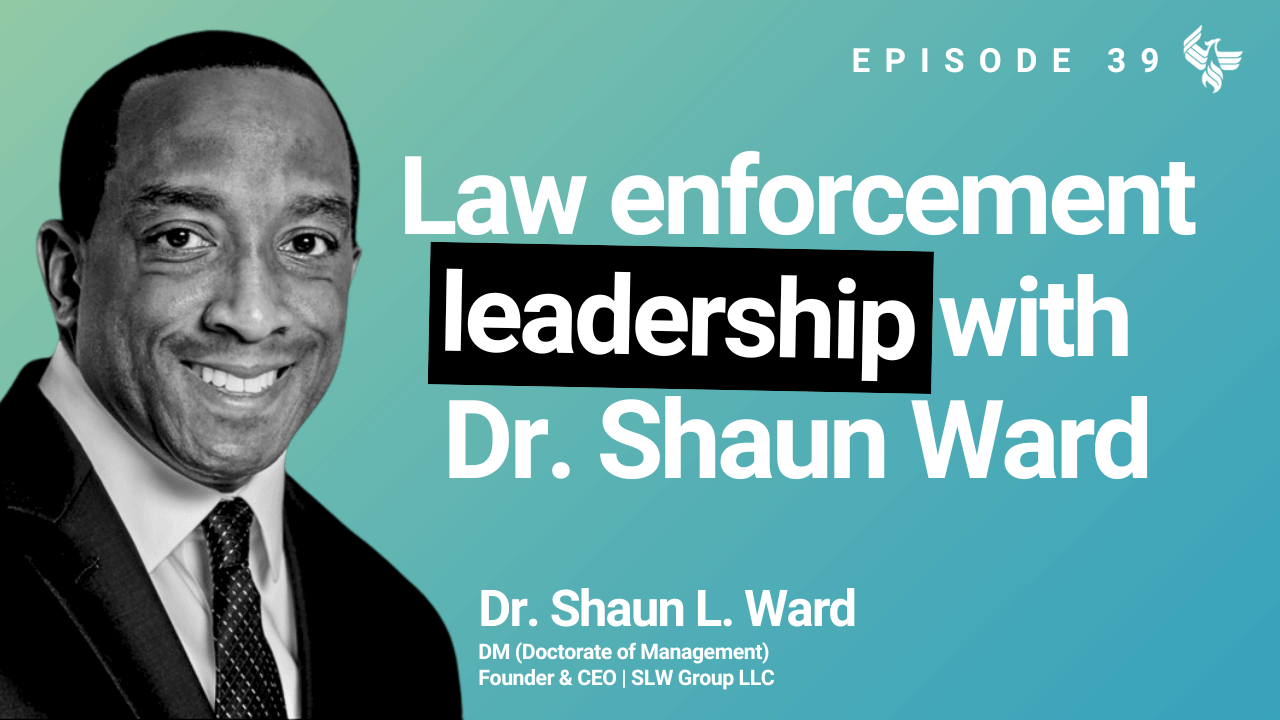
## Law Enforcement Leadership and Mentorship

[Embedded content](https://www.youtube.com/embed/Ip-xO-utynM?rel=0&controls=1&fs=0&modestbranding=1&cc_load_policy=1)

×  
Chapter 1: Introduction and Main Themes 0:00 There are over 340 million people in this country alone. There's so much to learn, so many people to learn from. 0:10 Do not shortchange yourself because education today is not education years ago. Education today is more accessible. 0:19 You have a lot more resources. You have many more people who are willing to help and to guide you and to also, you know, lock... 0:29 arms with you and walk you along this journey. So don't doubt yourself. Just go for it. It's endless. 0:37 It could go in any direction. Accept it. Understand it. 0:42 But understand too, that when you do attain, because you will, no one can take that away from you. 1:01 Welcome to the Degrees of Success podcast. I am your host, Keith Chandler. 1:06 On today's episode, our guest is someone whose journey brings together leadership, service, education, and purpose in a powerful way. Dr. 1:14 Shaun Ward is a law enforcement leader, scholar practitioner, and the founder of SLW Group, a people-centered consultancy focused on improving organizational performance through research, strategy, and innovation. 1:27 With more than 20 years of experience in policing and public safety leadership, Dr. Ward has served in critical supervisory and training roles and continues to influence the profession through evidence-based practice. 1:39 He holds a doctorate in organizational leadership where his research examined how leadership behaviors impact motivation among law enforcement supervisors, and he brings that scholarship directly into real-world application. 1:52 Beyond his professional work, Dr. 1:53 Ward is deeply committed to mentoring, personal development, and service. Values all shaped early in life by faith, family, influence, and reinforce throughout his career. Chapter 2: Dr. Shaun Ward's Background and Family Influence 2:04 Today we're gonna explore his journey, his leadership philosophy, and what success really looks like when purpose and preparation come together. 2:11 So let's get started. Dr. Shaun Ward, welcome to Degrees of Success. Thank you so much. 2:17 It's a pleasure to be with you and everyone else who's listening and who will listen. 2:23 This is a great opportunity to share and I'm looking forward to the discussion. I want to go kind of back in time a little bit if you don't mind. 2:31 uh know you come you mentioned you're from New Jersey. You come from a big family and not just that a big military family. 2:37 So curious how does a kid make his voice heard amongst a big loud military family in Newark, New Jersey? 2:45 Wow, that's interesting because there's so many dynamics, but uh let's walk this and then we can jog and run. 2:55 born and raised in North New Jersey with a big family, a lot of family who are related by blood and related by love. 3:06 And with that, many of them were servicemen and women. 3:10 uh You also have many of them in law enforcement, so public service was among me. 3:19 And for me, being around service, being around family members, oh that really just gravitated towards me to hear those stories, to be able to help provide solutions for 3:35 people, uh to be able to develop connections and relationships, to provide resources for people who might not have. 3:44 those opportunities because of access. So just seeing that, um, living it, being a product of it myself. 3:53 Um, and that atmosphere was just everywhere that I went both in New Jersey. 3:59 And even when I left at the age of 15 to go to South Carolina to live with my aunt and uncle, he was a career serviceman. 4:08 In fact, he was in the air force and his final destination was Charleston because he retired there. Chapter 3: Early Education and Overcoming Challenges 4:15 So it followed me along the way and I knew that my trajectory was going to be somewhere, either military or public safety. 4:25 And so I was just inherent to it. 4:29 I wanted to continue to continue that journey to be that next generation of family and friends along that path. 4:40 I'm curious as to what your relationship was like with education in elementary, high school. 4:45 What were your early career aspirations before you uh ended up going on to college? 4:52 Education was something that was instilled in me very young because I was told and I firmly believe that's something that no one can never take away from you. 5:02 Knowledge is something that can never be erased from your mind. 5:07 And because of that, we stayed in school, my siblings and I, uh we moved around a lot, a lot in elementary and middle school. 5:19 uh But school was a priority. 5:23 And for me, school was an opportunity to escape some of my environments growing up. 5:33 And my environments, I don't speak to them as negative environments. 5:39 I just speak to them as environments in which I knew that could be better. 5:47 Right? Yes, we have wonderful moments of laughter, wonderful moments of love, wonderful moments of just kid experiences, right? 5:58 But school for me was my way of knowing that there is a way to become better. 6:08 And I know without that, uh I would have a tough time continuing to navigate throughout life. 6:17 And I knew it really didn't give me that aha moment until I was in the fourth grade. 6:24 And in the fourth grade, uh I was held back that grade. 6:31 being held back, that was something that my family certainly did not tolerate. 6:40 But it was one that charged us enough 6:45 and instill something to me knowing that I did not want to be who my environment tried to define me to be. 6:59 I knew that I did not, at that very early age, because me being the oldest of five children, I had great responsibility. 7:11 At that time, my mom was a single mother, um until she married. 7:16 And then even during that experience, there were some single moments that I had to mature and become that mentor, that brother to my brother and sisters. 7:30 And I had to help mom out. So a lot of my youth, I did not have as traditionally as others. 7:40 had moments, but my reality was more of being the big brother, being the supporter, being the one that helped with homeworks and school uh as much as I was needed. Chapter 4: Path to Law Enforcement and Mentorship 7:55 I uh had the opportunity to skip the eighth grade. 8:01 So I did that because uh sixth and seventh grade, I really took it serious enough, my grades serious enough. 8:09 And the principal at that time saw that. And I was able to skip the eighth grade. 8:15 So, so I got back right back on track and, and just wanted to continue the forge ahead. Wow, that's beautiful. 8:23 I love the setback, even at a young age, you didn't let that set you back. It enhanced your ability to move forward. 8:32 So continuing on with education a little bit, you attended Brevard College. Was there anything in particular that happened there or was there anything that kind of drew you into getting into law enforcement? 8:43 What was kind of the first thing that kind of turned the light switch on and said, this is a career that I want to pursue? Well, I always wanted to be in law enforcement. 8:51 Really? uh In fact, initially I didn't want to do local law enforcement. It was federal government. Okay. 9:00 Just because when I grew up, many of my family members and their friends were all local law enforcement. 9:08 So I wanted to be in law enforcement, but I wanted to go as high as you could possibly go. Right? And so the federal government was my... 9:19 my my North Star at the time. And I applied for an internship with the Federal Bureau of Investigation and I didn't get accepted. 9:30 So then I started, you know, saying, okay, I can still do something. What is that something? 9:36 You know, at the time I was studying integrated studies with emphasis in criminal justice and computer information systems. 9:46 and I was studying a minor at the same time in pre-law. So I knew I wanted to be in that space. 9:53 And then um at that time, that college again was a two year. And then at my two year, it transitioned into a four year. 10:02 So I stayed. And during that time, it was called campus police at the time. 10:09 And I remember the chief of police offered me an internship. 10:14 um because doing integrated studies, you know, having some project as well. 10:21 So the internship really turned me on much closer to law enforcement because I started to learn from that chief at that time. 10:32 I started to build relationships and to get to ride around with the local police department at that time. 10:39 uh So, okay, so this local law enforcement thing is not bad either. 10:46 So, and then the campus went from that campus police chief left. 10:52 And then this is where things really became, you know, pivotal for me. And I knew law enforcement was it. 10:59 It's when I met the new director of the security department who was in the Marine Corps, who 11:10 who was the security director for a Fortune 500 company. 11:17 And he come to the college and we just started talking. I was already within my internship. 11:24 So of course he wanted to know who I was, where I was from, why I'm doing this work and why I want to be in law enforcement. 11:34 And we forge a relationship where it went from, 11:40 him being a mentor to being a really close friend and he calls me his son uh because he saw something in me that I didn't even know existed. 11:55 Not that he saw something to me that I really couldn't see. I didn't even know it was there. 12:03 And one of the things that when you hear him speak about our experience together. 12:09 He will always say that, you know, I was just a young kid and I just pulled up my uh bootstraps, tied them tight and just went to work. 12:24 And I owe a lot of that to him because it wasn't that he stepped in, he was just present. 12:35 uh He was present from being my boss. He was present from being a friend, present from being a mentor. 12:46 He was just present and it was something that he wanted to do. It certainly wasn't something that he had to do. 12:56 I just saw how genuine he was, how caring he was. And again, it just brings it back to my anchor. 13:05 uh being able to just love people and doing the right things for the right reasons. 13:13 Not looking to try to benefit because the benefit in itself is the relationship. And I saw that in him. 13:20 I bring my grandmother, I bring him, I bring my mom, I bring family and friends throughout my life. Chapter 5: Insights from Boots on the Ground 13:28 And that is my North Star. That will always remain my North Star because I just love people. 13:37 You know, uh the word no doesn't exist for me. If it's no, it just means not right now. 13:45 Or if it's no, it just means, okay, let's adjust to get a yes. 13:51 So, so, so for me, you know, my life journey, personal and professional, uh is one that's centered around people. 14:01 uh One that's centered around, you know, trying to oh develop and find solutions, not just for the short term, but how can we sustain them along the way? 14:15 And as we do that, how can we bring people with us so we can be a force multiplier? 14:21 So the problem we once had is a problem that we can try our best for it to not to resurface because not only the solutions, but we have the people behind it. 14:32 I love that motivation, especially for the career in law enforcement. I think it takes that level of empathy to really lead with that type of service mindset. 14:43 um You did serve as a police officer uh active for many years. 14:48 I'm kind of curious as to what kind of major things did you learn whenever you were actually boots on the ground as a law enforcement officer? 14:56 Was there anything that kind of surprised you about the profession? 14:59 uh that you didn't know before you actually got involved with the work on the ground. Yes. 15:06 So what surprised me was how needed uh police officers are in this work uh for so many different reasons, right? 15:20 Not just arresting people or writing citations, but truly being that medium for folks who are going through the toughest times in their life. 15:35 And, and, and regardless of, of the level of emergency that they may perceive it to be, it is still an emergency to them. 15:47 And, and, and, and, know, oftentimes we were, we're folks first line of defense, you know, last line of defense, you know, we are those connectors, right? 16:00 Whether it's connectors to, you know, 16:04 problem solving from criminal behavior, whether it's a connector for providing resources or connecting them with a certain group or being able to uh transport them, take them, escort them to a location when they feel safe. 16:25 That's what policing is. And it's not really, I don't like the word policing. 16:33 Although that's in the name, right? That's what service is, right? That's just what it is. 16:40 You know, you, right. You, you cannot get into this work without serving on every level in every capacity. 16:51 You know, oftentimes we're triaging situations, but we still have to show up and be present and present our best selves. 17:01 and offer the best possible solutions as we're tree-logic. 17:07 So, so my big aha moment was just recognizing that every call for service, someone needs you. Chapter 6: Pursuing a Doctorate in Organizational Leadership 17:19 And, and, and, and, and, and oftentimes, you know, I remind people that when we all are growing up, what's the phrase that we hear all the time? 17:32 You know, whether it was told to us or we tell it to young ones today, whenever you have an emergency, you dial 911. 17:42 And because of that, guess what? We're going to show up. 17:47 So when we show up, we have to understand that that is the condition that either ourselves or loved ones or others been accustomed to for so many years. 18:01 If you have an emergency, you dial 911. 18:05 Now, unfortunately, you know, I will also say that every time 18:12 people believe themselves to have an emergency, they dial 911, which majority of calls for service aren't criminally related. 18:24 Many of them are socially related. 18:27 So that's why it's important that we partner with these organizations to be able to supplement our response to help their needs because they can do that. 18:40 Because when we show up and we're dealing with a quality of life issue, that just delays a little bit more time for them getting the necessary services that they need. 18:52 That's a good segue into kind of revisiting education a little bit. um You have your doctor of management and organizational leadership. 19:01 um At what point did you decide that you wanted to go back to school to pursue a doctorate degree? 19:08 Not just any degree, but a doctorate degree, one that takes an intense amount of work and research. um What motivated you to do that? Yes. 19:16 So I was speaking to my mentor at the time. 19:19 One of my mentors at that time, he was still with the United States Secret Service and he was the assistant deputy director there. 19:30 at that time, around that time, he was going back to school for his second PhD. 19:39 Wow. Yes. He got his first one. in engineering and then went back to get one in business administration. 19:48 So as we were talking throughout that conversation, I had a young daughter at the time. She was still a toddler. 19:56 And again, it goes back to Shaun. For one, you know, there's a small percentage of the country's population who has this level of education. 20:08 And two, he said, you know, No one's gonna take this away from you. 20:17 And he also said that should you attain it, there's doors that's gonna open for you that you've already identified. 20:28 And there's doors that's gonna open for you that you didn't even know exist. 20:34 And if you want to be the best version of yourself, and if you want to continue into this law enforcement space, 20:44 then begin to understand the significance of an impact and influence you can have having this level of education to bring into the profession. 20:56 So when he said that, because it is not common for law enforcement uh professionals to have this level of education, it is more common now, but years ago it wasn't. Chapter 7: Research on Leadership and Motivation 21:11 uh because sometimes the requirements didn't suggest having an associate's bachelor's, master's degree. 21:20 And early on in this profession, I'm not even sure if a high school diploma was necessary. 21:27 Over time, it progressed into these types of educational requirements. 21:32 So when he said that, and he said, it's gonna be a small moment in time that you're gonna experience this. 21:41 And you're going to have late nights and early mornings in this moment in time, but you will see that it will be well worth it. 21:50 It was a great experience. It was a challenging experience. 21:54 The environment was very, very well set up for me to be successful with the University of Phoenix for sure by far. 22:04 Had all available resources. The only thing that really, really challenged me. 22:09 until the very end was it all being abstract, right? 22:16 There was no logic behind it because all through, even with the University of Phoenix obtaining my master's degree, it was all logic. 22:27 You know, you study this, you read that, you understand this, you know, you take your quiz and or tests, you can sort of, you know, still 22:39 be successful because there was an A and a B. 22:44 But in my doctoral experience, it's almost like, yes, there's an A and a B, but you also have to create your version of an A and a B. 22:58 And then you have to be able to justify that with other people's version of an A and a B. 23:06 title of your dissertation was Leadership and Motivation of Law Enforcement Supervisors, a Phenomenological Study. 23:13 I'm kind of curious as to why you ended up choosing that topic and what did you learn in the process of creating your dissertation? 23:22 Yes, again, you know, me just loving people, right? 23:25 So, so I think my, my scholarship leans more into qualitative studies, being able to understand lived experiences, talk to people, you know, um, watch people, you know, and their behaviors. 23:40 So I knew I wanted to be able to dig a little bit deep there. Also in this profession, you know, it's a people centered profession and there's just people. 23:51 that is working in an environment to help other people. But what motivates those people who want to do this work in helping other people? 24:02 Because once the uniform is off, we're all are humans and we're all trying to figure out this thing called life in society, right? 24:13 So I was very curious uh because even at that time, I too was... 24:19 uh When I started my doctoral journey, I was still an officer. 24:26 So, and I knew that I had certain supervisors, certain sergeants uh at that time, then lieutenants and captains, they all had different styles. 24:39 Some that I had a good working relationship with and others challenging. So I wanted to know... 24:46 uh I know how I was motivated to do the job, right? 24:52 So I wanted to lean in a little bit more to understand how these first line supervisors, how they motivate others to do the job. Chapter 8: The People-First Philosophy and Services 25:02 Because anyone would tell you in law enforcement that the toughest job is the first line supervisor. 25:11 So he or she has an extraordinary work to not only 25:18 uh direct people to certain tasks and objectives, but also motivate them to want to achieve those tasks and objectives. 25:29 So I was curious to learn, uh you know, what is the phenomenon among each of these uh leaders uh and how they do they work in motivating their officers. 25:43 And for me, the similarities were there. 25:48 Because with this study, I was able to do several different types of uh first-line supervisors. 25:57 And the commonalities were very, very uh eye-opening for me. 26:03 One in particular that I can always speak to was treat others as people first. 26:09 That was common among these supervisors. We all know we have a job to do. Chapter 9: Advice for Educational and Career Advancement 26:18 But in that job, you know, we have roles and responsibilities. It does not remove the fact that you're still a person. 26:27 You know, you still have feelings, you still have, you know, uh thoughts, you still go through things along this life journey that's gonna be challenging. 26:41 You still gonna have setbacks. You're still going to go home. 26:47 at the end of your shift and possibly face some of the issues that you responded to while you were working on shift. 26:57 All those things are real. 26:59 So it was interesting to me to try to understand what these supervisors were doing to be able to continue to encourage their officers to show up and to not to just want, not to just do the job. 27:17 but want to do the job. I love your people first philosophy and that's a great segue into some of the work that you do today. Chapter 10: Closing Remarks and Final Thoughts 27:25 You're the founder of SLW uh Consultancy. I'd love to learn a little bit more about what you do, your mission and the services that you provide. 27:35 Yeah, we primarily is neuro leadership, uh neuro for the fact of executive function. 27:44 When you're talking about completing tasks, when you're talking about, you know, oh regulating your emotions, when you're talking about impulse control and you want to make decisions with clarity. 27:56 So what are the things that we can do oh cognitively to ensure that the decisions we make is clear? 28:05 And the leadership aspect of it, oh the word ship in leadership, when it's conjoining with the word, it means the condition of, right? 28:16 So when it means the condition of, look at that as what is the condition of this leader, this person, right? 28:27 And for me, it's not all physical. oh It's not all emotional. 28:33 oh A lot of has to do with your mental makeup. So as we start to wrap up the interview today, it's the 50th anniversary of the University of Phoenix. 28:42 We're over 1 million alum strong. You're one of those great alumni that we get to speak to and feature. 28:49 What advice do you have for any of our listeners either looking to pursue a degree um or kind of reach the next level in their careers or their educational pursuits? 28:59 Do it. And I say do it because when you don't do it, then you delay what could have been. 29:10 Oftentimes when you don't do it, you deny yourself access and opportunities, whether the ones that you know exists, even the doors that you don't even know exists. 29:22 There are over 340 million people in this country alone. There's so much to learn, so many people to learn from. 29:31 Do not shortchange yourself because education today is not education years ago. Education today is more accessible. 29:41 You have a lot more resources. You have many more people who are willing to help and to guide you and to also, you know, lock arms with you and walk you along this journey. 29:54 So don't doubt yourself. Just go for it. It's endless. It could go in any direction. Accept it. 30:02 Understand it. But understand too, that when you do attain, because you will, no one can never take that away from you. 30:12 Dr. Shaun Ward, thank you so much for your time today. Dr. Shaun Ward is the founder of SLW Group. 30:19 Thank you again for joining us on the Degrees of Success podcast.
University of Phoenix alumnus Dr. Shaun Ward shares his journey from growing up in New Jersey to building a career in policing, leadership, and organizational consulting.

The video was uploaded on 5/7/2026.  
The video lasts for 30 minutes and 36 seconds.

**Key Moments**  
00:00 - Introduction and Main Themes  
01:57 - Dr. Shaun Ward's Background and Family Influence  
04:14 - Early Education and Overcoming Challenges  
07:47 - Path to Law Enforcement and Mentorship  
13:27 - Insights from Boots on the Ground  
17:15 - Pursuing a Doctorate in Organizational Leadership  
21:04 - Research on Leadership and Motivation  
24:57 - The People-First Philosophy and Services  
26:13 - Advice for Educational and Career Advancement  
27:25 - Closing Remarks and Final Thoughts