Skip to Main Content Skip to bottom Skip to Chat, Email, Text

Degrees of Success™ Alumni Podcast Episode 36 – Dr. Kevin Gazzara

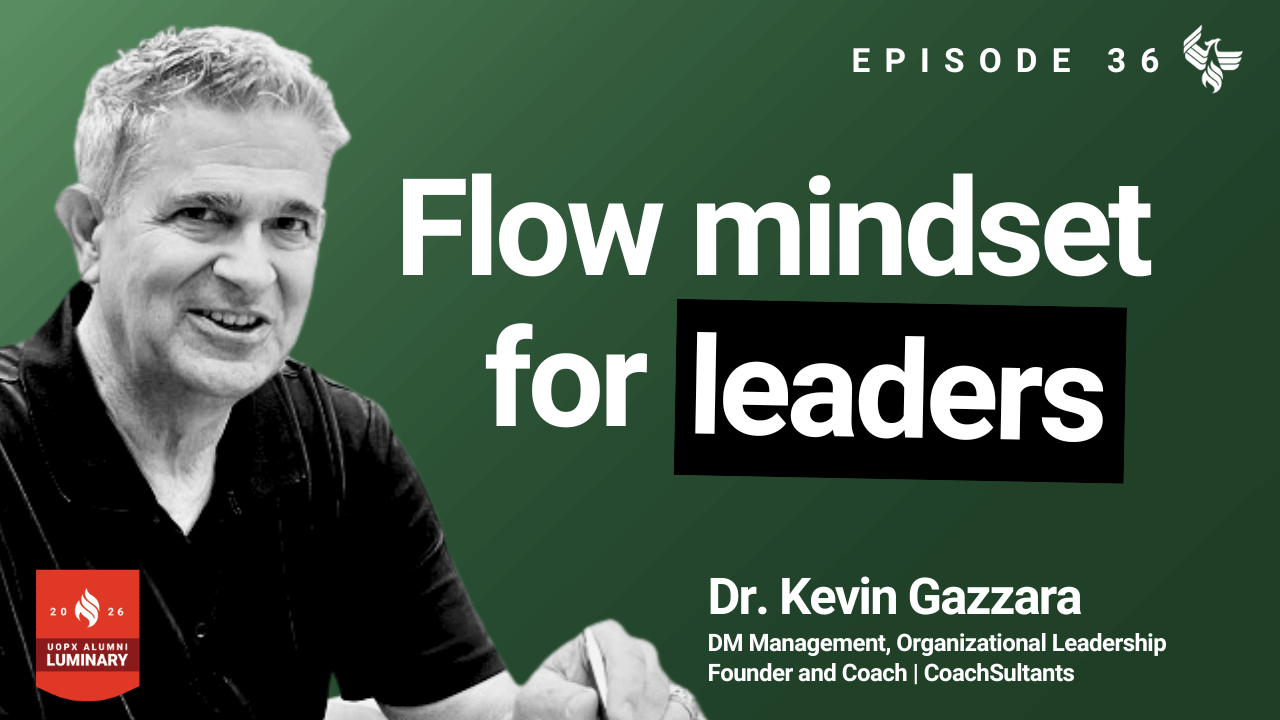
Flow Mindset for Leaders
Flow Mindset for Leaders


Chapter 1: Why You Should Start Before You Feel Ready 0:00 just do it. You want to certainly do a degree of planning. Uh what I find is people wait too long and then once they 0:07 get started they go a I should have done something different and I should have known that two years ago right and I would have known that if I did what we 0:14 used to call it Intel rapid prototyping is you get an idea you get it 80% baked you don't worry about that additional uh 0:22 20% that's going to take you another couple years to advance upon and you and you just and you just do Chapter 2: Meet Dr. Kevin Gazzara: Leadership, Teaching, and Impact 0:41 Hello and welcome to the Degrees of Success podcast. I'm your host Keith Chandler. Today I am thrilled to introduce Dr. Kevin Gazera, a University 0:50 of Phoenix alumnist and 2025 luminary recognized in the category of entrepreneurship. We'll talk more about that later. Kevin's career spans more 0:58 than 30 years in organizational development, leadership, and teaching. 1:03 And after nearly two decades at Intel, he co-founded Magna Leadership Solutions, a firm dedicated to helping organizations build strong leadership 1:11 cultures through practical actionbased learning. He's also an educator, author, and a passionate advocate for developing 1:18 future leaders. Kevin, it is great to have you here on Degrees of Success. Welcome. 1:23 Thanks so much for sharing me with the alumni. It's uh exciting for me to get this opportunity. 1:28 Why engineering? Why did you pursue that particular path? Why did you think it was right for you? Chapter 3: How Early Curiosity Led to an Engineering Career 1:33 It come it comes from my childhood as as a kid. Um I was I was always taking stuff apart. I always in fact my dad 1:40 used to kid with me. Uh and my dad was an you know uh was in in World War II. 1:45 He was an aircraft mechanic. He worked on cars. He liked to build stuff. Uh and I kind of saw that and it and it really 1:53 was attractive to me. So, I like to take stuff stuff apart and my parents were incredibly good and I whether I was taking radios or televisions or washing 2:01 machines or uh bicycles bicycles apart, you know, and and putting them back together, there's always extra pieces 2:08 left over. Uh and they always encouraged me to to continue to do that. So, I was always inquisitive. Um I was always 2:16 reasonable with my hands. I um I really like to get my hands greasy and dirty. 2:21 Uh that was fun for me. Um, and fortunately my one of my neighbors who was my dad's best friend, 2:30 um, was an engineer. Uh, and he saw some some talent in me and said, you know, 2:36 you would do well because of your of how you think and how you look at things and your being inquisitive and so forth. And 2:45 I was I was good enough. I was just about good enough in math and science to be able to squeak through engineering 2:51 school, but it wasn't it wasn't like I wanted to sit down and do equations all the time, but it was important for me to understand 3:00 the things that I was doing uh why and how they came came about. So, so that was kind of what led me to the 3:08 engineering piece. And although I thought, you know, I'm probably I may not be smart enough to be able to uh to 3:16 graduate from engineering school, uh but my dad's philosophy was always do something a little bit harder than you 3:23 think you're capable of doing. And if you're successful, that's fantastic. And if you're not, then then you truly know 3:31 your limitations. So, so I squeaked by my undergradu and then obviously went on 3:38 to you know do my masters and and doctoral work. 3:41 So with with uh that in mind and also just your your passion for teaching you've served as faculty across many institutions around the country 3:49 including University of Phoenix. Um you what's your motivation to keep teaching and keep being a faculty? Is it also Chapter 4: The Real Reason Teaching Creates Long-Term Impact 3:58 wanting to continue learning? do you learn through the process of teaching as well? Um what what keeps you in the classroom? 4:05 Well, I I love to try to make a difference for individuals to get that light to go on. You know, I I was fortunate enough when I was at Intel, 4:13 one of my staff members, she was teaching at the University of Phoenix in the in the 90s, uh early 90s, and she 4:21 just bugged me forever. Um you know, I was a product manager. I was running a team at Intel doing on design of their 4:28 video chips and she was bugging me. She said, you know, you really need to you should come and teach. You know, it's something I so enjoy. And you know, I 4:36 had a young family, you know, we had just moved from uh Philadelphia area to we got transferred to Arizona in 4:44 Chandler with Intel, you know, so life was was pretty busy in general. Um but at some point in time uh there was a 4:52 little bit of a break and I said okay well I'll go and apply and then see if they take me. So I applied and uh the 5:00 University of Phoenix said yeah we could uh we could use your your background expertise and I and I started teaching and I just found out uh that I I really 5:09 love doing it. I was teaching management leadership programs at Intel at the time. So I had some practice of, you know, being stage on the stage or 5:17 whatever you want to call it. And it it was I found it very very rewarding. I wasn't doing it for a 5:25 financial gain. I was really doing it because I I had um you know I I could see the difference. And I and I'll share 5:33 with you just a really interesting story of the last two weeks. there is one of my students uh that I had uh in the MBA 5:42 class at the University of Phoenix um called me out of the blue. Haven't talked to him in over 20 years. Uh and I 5:50 guess he follows me on LinkedIn and he said, "Hey, Dr. Gazera, I wanted to call you. I just took a a senior management position. I've been using a lot of the 6:00 tools that you taught me uh when we did our MBA class many years ago." and he says,"I think they would be bene 6:07 beneficial here. Would you be willing to come and uh and help us as as well?" So, so I said, "Yeah, of course. I'd like to 6:14 do that." So, once again, you know, I've I'm trying to kind of leave a legacy uh and and through teaching, that's uh that's a good way to do it. 6:25 That's wonderful. Uh you mentioned a little bit of your your work at Intel and your your time teaching there um and some of your your tenure. What are some 6:32 of the highlights uh that you kind of take away from your your experience in the corporate world and then how and why did you make that transition into starting your own business? Chapter 5: Leaving Intel: The Risk and Reality of Starting a Business 6:42 Yeah, so I started with Intel in 1989. I was there for 18 years. I left in 2007. 6:49 Um and I had lots and lots of different positions. I came in as a customer marketing engineer, then transitioned to being the product manager. Uh then I was 6:58 the operations manager and then I was a GM for a general manager for a small division. Um and then something 7:05 interesting happened that uh Intel has something they call sbatical. So every seven years you got two two months off 7:14 uh you completely disconnected electronically phones laptops everything uh and and you went off to rejuvenate 7:24 yourself. also did a lot of traveling and things obviously that you wanted that you weren't able to do when you're working full-time and then when you come 7:30 back that's usually a good time to do something different right so I had always been in on the technical side 7:37 with managing you know um chip design and uh marketing product marketing 7:43 customer marketing um and I but I when you're at Intel once you got to a certain level they was an expectation 7:51 that you that you taught their their internal classes, 40 hours for the year. 7:56 So I was I was teaching their management leadership programs as well and the gentleman who was running uh Intel 8:04 University for the world said, "Hey, you know, our guy from Arizona just moved up to Oregon. I need somebody to manage 8:10 Intel University for for Arizona. Would you be interested?" And he was funny. He said, "Would you be interested to come over from engineering to HR, come over 8:19 to the dark side?" and I said uh yeah you know that would be you know I haven't done that it might be 8:26 interesting so I started managing until you for the Arizona and then ultimately for the US uh and that led me also into 8:34 um uh managing their management leadership development programs uh for the world we used to have what we called MTP managing 8:43 through people first line uh fiveday firstline off-site training we used to do 2500 managers a year in 10 different 8:51 countries. Uh and when I left Intel in 2007 in that just from that program, we had 8:58 just finished training our 40,000th manager. So I got I got pretty good at that. But uh to go back to your original 9:06 question um so what led me to make that transition from the corporate world into entrepreneurship uh and starting my own 9:12 company is um I had a 10-year plan that I wanted to retire at 50 and I call it retirement. My wife will not call it 9:21 retirement but I wanted to go and do my next phase of life, right? Um so I created I had a great mentor. I had a 9:28 great coach at Intel. She and I worked together. Uh we stayed um you know we meet on a regular basis um probably 9:37 every other month or so and I had a great financial advisor. Uh so I had really good support system and we had 9:45 this plan of getting my finances, getting my education, getting my training, getting my experience all in 9:52 line in order to be able to go at 50 and and give back. Right? So, uh, I was very fortunate, but I recognized a lot of my 10:01 friends were working with organizations that didn't have $10 million budgets, uh, for management leadership, and I thought, boy, if I can take some of the 10:10 knowledge that I've gained and really help small to medium-size organizations, that would be my contribution. So, in 10:18 2007, my financial advisor called and said, "Hey, you know, anytime you want to punch out, uh, you can go and do 10:26 that." and not really have to worry about anything financially. And if you're successful, that'll be a bonus. 10:32 And if you're not, uh, at least you'll be making a difference. So, I took two of my colleagues with me and in 2000 10:38 June of 2007, the three of us uh uh said, "Hey, we're done." We hand in our 10:45 resignation letters on Friday, and then Monday, we had a we had a company. And uh it's, you know, I would tell anybody 10:52 that wants to do that is it's a little scary. You have to be able to believe and invest in yourself and your ideas. 11:00 Uh you have to have what we call a sustainable competitive advantage. You know, something you're giving that's different than everybody else. So, what do you have? You know, fortunately, kind 11:09 of what we had is uh we were all we were nerd engineers who were able to talk um 11:16 uh human speak, you know, on a from a leadership perspective, but also be able to sit down with and talk the bits and 11:24 bites with the with the engineers and and for for many organizations, there's lots of great leadership and management 11:31 organizations out there. Um I don't think there's a lot or at least our experience has been there's a lot of people that are great trainers but there 11:39 there h isn't a lot of people that say you know I used to manage the relationship having that ability to sit down with someone that you're trying to 11:47 um you know develop as a as a better leader just having that credibility is so so valuable. You can become a great 11:56 professor or a great teacher, but if you don't have that um those years of experience to pull from, it's very 12:04 difficult to be able to place yourself in their shoes. 12:07 Can you describe your approaches and your techniques and what you do to work with organizations to help them be more efficient and and why you enjoy doing Chapter 6: Flow State Explained: How to Unlock Focus and Creativity 12:15 that work? So, so let me start with um a life-changing event for everyone is in 12:22 1996 uh same year I started teaching at the University of Phoenix uh by coincidence one of my good friends at 12:30 Intel gave me a book called flow uh by a gentleman by the name of Dr. Mihi Chick Singh Mihi. If anyone hasn't read Flow 12:38 uh it's it's a must readad. It's in my top five books of all times to read. Uh and in a very short version of it, it's 12:47 uh it's flow was reermed in the '9s of being in the zone, right? So getting in the zone and people understand that rather than if you ask them, are you in 12:55 flow? Some people wouldn't understand that. Um but they understand kind of being in the zone. And and what and what 13:02 Dr. Um, Mihi Chicken Mihi had found out was is that when you have this ba the correct balance between challenge and 13:11 skill, uh, you can get in the zone. And there's eight different factors that contribute to it. The biggest one to recognize 13:19 whether you're in flow or not is is if the sense of time is severely distorted. 13:25 Right? You look up at the clock and it's midnight and you swear it's 9:00 or the clock's broken. Uh and that and that's what flow feels feels like. And the 13:33 interesting about thing about flow is it is not the place that necessarily guarantees productivity. Uh it is the 13:42 place where creativity happens. It's where you will become whatever you're work working on so much that everything 13:48 else uh is is blocked out. Um and and that was always fascinating to me. So once I kind of learned that, I looked at 13:57 my my work uh the things that I was doing and as I was taking on or considering new projects and work, I always kind of plotted them. You know, 14:05 where is this with regard to challenge and and skill and you know, if your skill is super high and the challenge is low, like I've done this a million 14:13 times, I'm good at it. Generally, that kind of leads you into a sense of boredom. Uh and if the challenge is way 14:20 too high and you have no skill or very very low skill that re leads you into anxiety and a little anxiety is okay. 14:28 Massive anxiety basically you just shut down and and think about what how to get out of it more so than than getting into 14:35 it. So once I learned that and I started using that to to work with my staffs, you know, getting making sure they 14:42 understood so that uh the more I was in really really bought bought into it up 14:49 up to the point where you know in 19 uh say 908 14:55 uh 90 98 98 99 um you know I really wanted to do additional research on this 15:02 and that's when I decided to uh to go into the doctoral program at the University of Phoenix. Uh and uh I I was 15:11 very very fortunate. I was in the first group of people uh to go through the doctoral program. So some people don't 15:20 know this. So there were 10 of us that went through. Nine of us graduated. Uh the the other the the 10th person was 15:28 still doing his re he was such a perfectionist. He was continually redoing his uh his dissertation over 15:36 like he I think he went through three dissertations and finally said, "Hey, that was that was enough. He could never get it get over the goal line." In fact, finally settled on the one. Yeah. 15:44 Well, he didn't even settle on. He never finished. He he ultimately he he just said, "Hey, I'm not going to do a fourth one." And uh and the surprising thing is 15:51 is by far he was um and we're still great friends today. there was the cohort we we stayed very very close but 16:00 uh uh he's still a very good friend today and the thing I would say about him is he was certainly the smartest guy in the class she used to teach speed 16:08 reading he could get a book in the morning right and by noon he have the book read and memorized uh and he had this photographic memory was just 16:17 incredible but at the same point in time he was a perfectionist right that nothing was ever good good enough for him brilliant guy wonderful guy friend. 16:26 But um so anyway, so so where I was going with that, Keith was the it really has led me to wanting flow led me into 16:35 this position where I wanted to do more work. Um and I did my dissertation on looking at the relationship of task 16:43 types and task balance on motiv motivation, engagement, and flow. Right? 16:49 I wanted to see if my technique could create that knife element that would create flow. So, uh, so I went to wanted 16:58 to do that. Uh, I went to my, uh, went to my chair, um, and asked him, "Hey, here's what I'd 17:06 like to do. Um, you know, uh, and I want to do a quantitative model. Um, 17:15 would you uh, would you approve it?" He said, "Well, you're going to do a quantitative model. they have to find a an assessment that me measures this. I 17:22 searched there was no assessment and I he says well you'd have to develop your own assessment. He says that'll take too long and you just have to decide do you want to graduate 17:31 uh or do you want to do your dissertation? You could pick one but you can't have both. I said I think that I think I I don't want to pick a 17:39 different topic. I really want to do this. I have a passion for it. And he says well it's going to take you forever uh and I would advise against it. So I 17:47 wrote to very prestigious position and said, "Hey, I here's my proposal. This is I want to try to extend the work that 17:54 you've done. Would you be an adviser for me to help me develop an assessment for this?" And I didn't hear back from him 18:02 for a couple weeks. I thought, "Oh man, I'm going to have to pick a different topic." And then I got a surprising email and he said, he says, "Oh, this is 18:10 really interesting. Um, yeah, I'll help you do I'll I'll do I'll work with you to do that." So he and I developed an 18:17 assessment tool which ultimately became known as the task quotient or TQ. 18:22 They've been distributing it for 20 years now. We validated it. Um uh from the from the time we started to time I 18:31 finished. We did everything in six months. Uh and I graduated right on time uh just to prove uh my uh chair chair 18:40 that I was possible to to to do something that he thought was impossible. And what an honor to get to work with uh someone that got expand on 18:50 the research of someone that you admired so much. 18:54 Yeah, it was it was it was truly a truly a gift. In fact, to the point where I had sent a note to my my chair at the 19:02 time and I sent him a note and I said, "Well, Dr. Chickenhai is going to work with me." And he said, "Yeah." He says, "How do you know that?" I said, "Well, I 19:10 have an email." I said, "Well, send me the email." because he he just didn't quite believe it. Uh and once I sent him 19:17 an email, I said, "Well, if you can, you know, he's going to work with you." I Yeah, absolutely. Then you can then you can do it. So that's my message to 19:25 everyone is is you never know, right? Uh all all someone can say is is no. And if you present it in a proper way, like 19:34 because it wasn't that I just wanted help from him. I really wanted to expand the work that he had done. Uh and he had 19:42 never seen this approach before. So, he was good enough to to be able to give me his time. 19:47 Breaking the the actual task down into what people enjoy, what was your your your reasoning for wanting to to do that 19:54 and how has that kind of succeeded in helping uh these organizations be more successful at creating more uh a more 20:03 comprehensive work environment where employees want to stay, employees want to engage. Chapter 7: The Task Quotient: Why Job Fit Drives Motivation and Retention 20:08 Well, first of all, thanks for being a podcaster that's done the homework. It's rare that I do a lot of podcasts. It's rare that I get a podcaster that has 20:16 done the research. So, so I applaud you for that and and I thank you for that. 20:20 Um the you know, so it was really an extension of my doctoral work at the University of Phoenix, right, where I 20:27 created this assessment tool and what we recognized was um that that there are three types of tasks that everyone does. 20:35 You know, there are tr there's routine tasks, highly predictable, you kind of have to do them in a moment. Email is a good example of routine kind of tasks. 20:43 There's troubleshooting tasks or problem solving tasks that you have to do where um you you they're unpredictable. You 20:52 still have to do them in the moment. You know, computer doesn't work. Uh you know, the Riverside doesn't isn't isn't sinking, whatever. You have to fix 21:00 things uh in in in real time. Um and then there's project work where it's highly predictable, but it doesn't have 21:09 to be done in the moment. So you have routine troubleshooting and project work. And what my hypothesis was that I worked on the the tool with Mihi 21:18 Chicken Mihi was um my hypothesis was that each one of us has a there's 496 21:27 different bal uh mixtures of this of the task preferences and each one of us has 21:34 one of those. And if I can find your ideal task mixture and I can place you in that, I can raise your level of what 21:42 we found we proved statistically is I can raise your level of job satisfaction, your motivation. And then there was another doctoral student 21:49 expanded it into empowerment where you really feel empowered. So it's move it's it's recognizing that and as we applied 21:57 it to the call center, what we found out is there's um there's there's these different levels, right? So you have the level one, two, and three. You know, in 22:06 level one, you're doing mostly routine kind of tasks, right? It's it's all scripted. You know, computer's not working. Is the is the on button pushed? 22:14 Mouse plugged in th those kind of thing where it's over and over and over again. 22:18 So you have that routine work. Um level two is much more uh troubleshooting where the scripting isn't working. You have to come up with something new. And 22:27 then level three is much more kind of project. it's bigger picture you know where you're you're looking at bigger bigger systems you we're having this 22:35 this problem with all the computers right and thing things are not working so what what they were doing then the 22:41 group was doing was they were uh putting uh they were hiring people um you know in the f you know for first line and 22:49 then hopefully grad rather and letting them earn their way into level two and three. The problem is is that there's 22:57 very few people that have more than about a 56% tolerance for routine work. 23:04 And when I place you in uh in a situation where you're doing 100% routine work and you're not doing troubleshooting or project work or doing 23:12 any, what happens is you get them very very um disillusioned and that's why you have this massive turnover, right? 23:19 Because you're hire and and they also were not using any assessment. So they were putting people when we went in and looked at them, they were putting people 23:26 that they had hired people after we gave them the assessment that had like a 7% tolerance for routine and now they have to do 100% routine work all day. And you 23:35 can imagine how motivating or demotivating that is. So they're getting this incredible turnover. So what we said is let's let's once you get the the employee that has the skill set, right? 23:47 Let's let's give them the task quotient assessment and figure out depending on which group you're going to put them in. 23:54 You you may be hiring for group two or three. Most of them they're hiring for group one. Let's let's see do they have a 7% chance of preference for routine or 24:04 is it a 50% chance? Uh, and then once you place them in there, maybe you can't give them 50% routine and then 50% of 24:13 troubleshooting or project work, but you can give them a little bit of that. So, let's let's bring the three levels 24:20 together. Um, let's give a little of the project work, whether it's teaming or giving it to the the first line person 24:28 or troubleshooting. when they're getting to that next level, maybe we're at when they hand them off to level two, what happens is is they stay on the line and 24:36 they work through it together. So they can they can feel like they're they're contributing and then that way instead of having 100% on, you know, for your 24:44 eight hour day or your 10-hour day, now maybe have 80% or 70%. Uh and and let's 24:52 see how that handles the turnover. And guess what? Surprisingly enough, the turn their turnover at the point in time was about 32%. 25:01 Um, and just by doing this within 90 days, uh, it dropped to um, about 15%. 25:09 Right? So, we were um, we couldn't get rid of all of it, but we cut it in half, right? And you can and they were and 25:17 they were hiring like dozens of people at at a time. It was a big call center, about 400 people. um they they were 25:25 hiring. Uh and boy, if you if you really want to look at where you're wasting a lot of money, it's with the rehire and 25:33 train, right? Because you never get that person up to up to speed. So, that's that's how we've used it. It's worked 25:39 really well and it's um it's it's pretty easy to do. 25:43 What do you do whenever you need to get into your personal flow? I I think the thing that we found out was um that you really need that that mixture, right? Chapter 8: How to Enter Flow: Time Blocking, Mindfulness, and Daily Habits 25:54 You need that mixture of tasks. So So I do time blocking, right? So So I I know 26:01 me, I can do about 30 minutes of routine, about an hour, an hour and 15 minutes of problem solving, and I can do project work with about two hours, 26:09 right? uh and that'll and by by segmenting that um and and doing the time blocking. So so what I used to do I 26:18 don't know if anybody else maybe you did this in college I remember like I lock myself in the in the dorm room for for Friday and I just write that paper or do 26:26 that analysis or build that project and I just do all all project work for uh for eight eight hours and I don't know 26:34 about anybody else but um that just didn't work. So what happens is you find kind of get in this cadence, you know, 26:42 and after about two hours, you wanted to get up and walk around the dorm or get something to drink or eat or you wanted to to go have a conversation with 26:49 somebody. Uh and what what that's telling you um is that you have to do a 26:56 different task type, right? And our tendency is to run from to do different types, do different tasks, but not 27:05 types. So you may run from project to project to project to project and at the end of the day you still feel like it was it was pushed. So for me to get into 27:14 flow a couple things and this is what I recommend is um is figure out what your task mixture is. You know anybody can 27:21 contact me. I'll tell you how to do that. Um I'll be glad glad to share that with the alumni. Uh and once you know 27:28 that do some blocking of your of your calendar. I like to break put in breaks in between the the time blocks. So, I'll 27:36 go do a quick walk, do some exercise, listen to some music, I'll sit down at the drums and and and bang away, right? 27:44 Ju just so I can get that creative piece out, right? And refresh my brain. And I think the other thing that I've been doing is for the last about four and a 27:53 half years ago, I got certified to teach um positive intelligence, which is an extension of of emotional intelligence. 28:00 And I've been teaching that. And as part of that, one of the foundations is is doing mindfulness activities. Uh it's uh 28:09 meditation or mindfulness. It's really taking a break uh to do some and and the break can be as as short as like 30 seconds. It doesn't have to be long where you're uh taking some breaths. 28:20 You're doing some tactile uh kind of work. Um uh you're you're essentially flushing all that mind chatter out. 28:29 There's lots and lots of ways to do it. 28:31 Can be done with sound. It can be done with music. It can be done quiet. Can be done through through breathing. But ha having those those very short touch 28:40 points throughout the day to allow you to do that refresh is is so important. 28:46 And very first thing I do in the morning is I usually go out for a walk. Um and I I put on a um what they call PQ rep, 28:54 which is a mindfulness activity. And it's really just to try to clear your brain and not think about, oh, I should be doing this or I should be doing this 29:02 and get rid of that mind chatter. And what I found is, you know, doing this for the last many years is that's where 29:09 my best ideas come, right? Like once once it's all flushed out, usually even before the 12 minutes is done, it's 29:16 like, oh, oh, that's how you solve that problem. So, not where I'm consciously thinking, how do I solve the problem? 29:22 But it will be once once you get that noise out of the system, it may be the answer is probably just sitting there for you. So So that's that's how I kind of get in the flow, stay in the flow. 29:32 I'd love to be able to say I'm in the flow all of the time. Uh that's that's not the case. I recognize when I'm not and then I know I need to do something different. 29:42 That's great advice. Dr. Kevin Gazera, faculty, teacher, mentor, business owner, entrepreneur. Thank you so much 29:49 for joining Degrees of Success podcast today. Uh, great time talking with you. 29:53 All right, Pete, thank you so much for sharing me. Chapter 9: Final Advice on Growth, Leadership, and Taking Action 29:55 Excellent. That brings us to the end of this episode of Degrees of Success. 29:59 Don't forget to like, subscribe, and comment. Thank you for joining us, and we will see you next time.

Kevin Gazzara explains how Flow Mindset connects leadership development, organizational culture, and practical task design in real work environments.

The video was uploaded on 3/19/2026.
The video lasts for 30 minutes and 17 seconds.

Key Moments
00:00 Why You Should Start Before You Feel Ready
00:41 Meet Dr. Kevin Gazzara: Leadership, Teaching, and Impact
01:29 How Early Curiosity Led to an Engineering Career
03:50 The Real Reason Teaching Creates Long-Term Impact
06:36 Leaving Intel: The Risk and Reality of Starting a Business
12:15 Flow State Explained: How to Unlock Focus and Creativity
20:08 The Task Quotient: Why Job Fit Drives Motivation and Retention
25:48 How to Enter Flow: Time Blocking, Mindfulness, and Daily Habits
29:55 Final Advice on Growth, Leadership, and Taking Action