


 844-937-8679
 Login


Articles > Accounting > What is accountancy vs accounting?
What is accountancy vs. accounting?
This article was updated on January 3, 2025.

Written by Michael Feder

Reviewed by Kathryn Uhles, MIS, MSP, Dean, College of Business and IT

Anyone interested in an accounting, bookkeeping, management or finance career, or those who have already begun their education in one of these fields of study, has likely come across two related but distinct terms: accountancy vs. accounting. Many people use the terms interchangeably, but there are some important differences to be aware of, especially for those planning to pursue a career in accounting.
The main differences between accountancy vs. accounting
When looking at accountancy vs. accounting, there is a fairly simple difference. In broad terms, accountancy covers the principles that guide the creation and use of financial records. Accounting, on the other hand, refers to the process of maintaining those records. Accountancy can cover such areas as forecasting, budget planning and cost analysis, which are important concepts for those who want to be business managers or executives someday.
What is accountancy?
Accountancy focuses on the principles for gathering and using financial data. It gives accounting a framework and practices that accountants can use to identify, collect, record and report financial information. Other related professions, such as bookkeeping, also fall under the broad umbrella of accountancy.
Additionally, accountancy involves analyzing financial activity using accounting data. Business managers need an understanding of accountancy and use accounting principles to make decisions based on financial reports and data collected by bookkeepers and overseen by accountants.
What is accounting?
The simplest definition of accounting is the act of recording financial transactions, typically for business purposes. Accountants — the people who do the work of accounting — record financial transactions, summarize them and analyze the results. They also must report those transactions to financial regulators and tax collection agencies.
Types of accounting
Students typically learn the fundamentals of accounting during an undergraduate degree program. However, accountants may choose to specialize in one or more careers in accounting. When exploring career opportunities, prospective accounting professionals should understand the differences between accountancy and accounting, as well as the various career paths available in the field:
- Financial accounting is the most familiar type of accounting for most people. It involves recording monetary transactions and data and creating reports, such as income and cash flow statements.
- Public accounting is a specialty in which an accountant or accounting firm provides services to individuals or companies as a third party. A public accountant can provide a variety of services, such as payroll, tax preparation, auditing and income statement preparations.
- Cost accounting involves calculating the overall cost of an operation for a company. For example, an accountant could add up the total fixed and variable costs for the production of a single product to help company decision-makers and marketers settle on a reasonable price.
- Management accounting involves creating reports and performing audits to help inform the strategic choices of executives and other decision-makers.
- Tax accounting involves the preparation of tax documents. A tax accountant makes sure that a company’s or individual’s tax filings meet all IRS regulations. A tax accountant also ensures their employer or clients get all the deductions and credits they are due.
- Auditing is an accounting practice that involves looking at financial records to ensure that they are accurate and comply with regulations.
Large companies or accounting firms may have specialist accountants who focus on specific areas, while other employers will hire generalists who can work on different types of accounting.
Comparing accountancy vs. accounting
Accountancy principles are useful for accountants, but there are not degrees in acccountancy. Students can study these principles while pursuing a degree in accounting. A bachelor’s degree in accounting may also include coursework in business management, finance and bookkeeping, which are fields that apply accountancy principles. The key differences between accountancy and accounting can be summarized as follows:
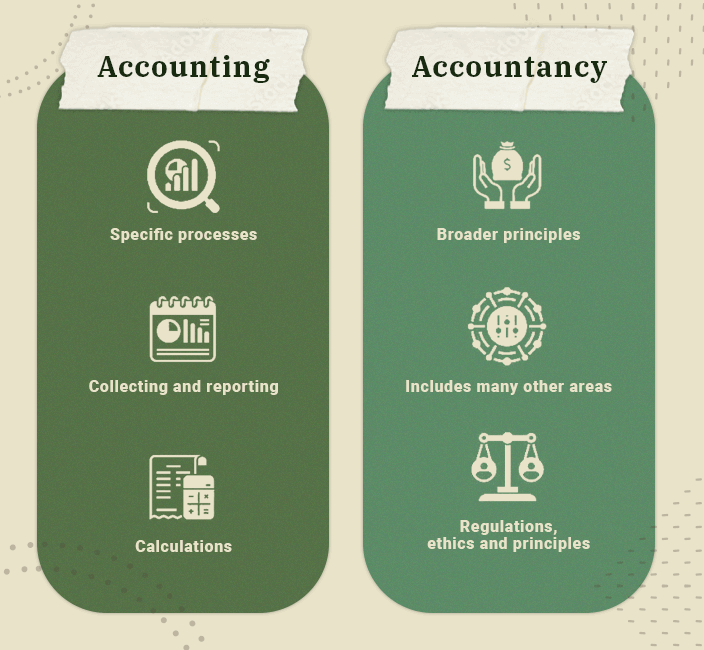
- Accounting focuses on specific processes for recording transactions and creating reports. Accountancy concentrates on broader principles without getting into detailed specifics.
- Accounting focuses on collecting and reporting, while accountancy includes many other areas, such as forecasting, auditing, bookkeeping and financial decision-making.
- Accounting concentrates on the calculations needed in creating required statements and documents, while accountancy focuses on the broader regulations, ethics and principles behind these technical processes.
Despite these differences, accounting students will become intimately familiar with the principles of accountancy during their undergraduate studies and in their careers.
A Bachelor of Science in Accounting degree (BSACC) teaches financial expertise and specialized skills in managerial accounting, estate taxation, advanced accounting research and other important areas. A degree can help students channel a passion for numbers into a career as an accounting professional.
Learn more about accountancy vs. accounting
Ultimately, an accounting career requires a keen understanding of accountancy vs. accounting, along with the actual day-to-day processes of accounting — the how — as well as why, which makes up accountancy principles. University of Phoenix offers online business programs, including a Bachelor of Science in Accounting.
Request more information about UOPX online degree programs, including accounting.

Natalie Pratt, MBA, MC, MEd
Associate Dean, College of Business and Information Technology, University of Phoenix
"Accounting and accountancy impact so many roles within business, but their applications aren’t constrained to just the one field. In fact, those well versed in these concepts can bring value to healthcare administration, operations management, business analysis and project management.”





ABOUT THE AUTHOR
A graduate of Johns Hopkins University and its Writing Seminars program and winner of the Stephen A. Dixon Literary Prize, Michael Feder brings an eye for detail and a passion for research to every article he writes. His academic and professional background includes experience in marketing, content development, script writing and SEO. Today, he works as a multimedia specialist at University of Phoenix where he covers a variety of topics ranging from healthcare to IT.

ABOUT THE REVIEWER
Currently Dean of the College of Business and Information Technology, Kathryn Uhles has served University of Phoenix in a variety of roles since 2006. Prior to joining University of Phoenix, Kathryn taught fifth grade to underprivileged youth in Phoenix.

This article has been vetted by University of Phoenix's editorial advisory committee.
Read more about our editorial process.
FREE Business Programs Guide
Make informed decisions with inside details about our business programs, the skills you’ll earn, the faculty who’ll teach you and more.
Thanks for requesting the Business Programs Guide
Download PDF now. Or access the link in our email.