


 844-937-8679
 Login
Login


Generative AI in higher education
As a university, we understand the need to harness generative AI technology and prepare our students for its use in the workforce.
Generative AI in higher education
As a university, we understand the need to harness generative AI technology and prepare our students for its use in the workforce.
Our philosophy
University of Phoenix embraces new technologies and innovations that impact higher education and are relevant in the workplace to prepare students to be career ready. Generative artificial intelligence (Al) tools are rapidly being deployed in a myriad of ways that are dramatically changing the way people learn and work. We will seek to employ the use of generative AI tools to the benefit of our students and faculty by:
- Encouraging students, faculty and staff to familiarize themselves with generative AI tools and understand their potential applications, as well as their limitations, biases and inaccuracies, both in academic and professional settings.
- Educating faculty on how to help students understand in what context the use of generative AI tools is appropriate and when the use of these tools can result in academic misconduct.
- Continuing to design assignments and assessments that thoughtfully combine multiple approaches to achieve learning objectives and encourage critical thinking.
- Implementing reliable methods of detecting the inappropriate use of generative AI tools.
- Striving to keep our academic integrity policies, procedures and expectations updated to reflect advancements in generative AI tools and to protect the institution's academic integrity.
- Staying current on trends, research, application and innovations related to AI in education and its impact on student learning and workplace readiness.

The Center for AI Resources
The Center for AI Resources is your go-to hub for foundational knowledge and practical tools to thrive as a student in an AI-driven world. From navigating University requirements to mastering the essentials of AI, the Center is here to support you throughout your AI journey in the classroom. As a student, here’s some of the information you’ll be able to access:
- Our policies on student AI use
- The basics of building a prompt
- Tips to stay safe and protect your data
Already a student? Explore the Center in MyPhoenix
Interested in becoming a student?
When you’re ready, submit your online application to start leveraging AI in the classroom.
Understanding generative AI
Artificial intelligence is already part of your daily life. Whether you’re asking an app for directions, getting personalized recommendations from a streaming service, or using autocorrect in a text message, AI is used to analyze data, recognize patterns, and make recommendations that imitate human behavior. But generative AI takes things a step further.
Generative AI elevates artificial intelligence technology, creating entirely new content, such as text, images, music, or even computer code, by learning patterns from existing datasets. Because this technology can simulate human-like communication and creativity, it’s increasingly being used in education, business, healthcare and many other fields.

You’ve likely interacted with generative AI tools, even if you didn’t realize it. Examples include ChatGPT™, Microsoft® CoPilot®, Google™️ Gemini, Adobe® Express, Apple® Image Playground and GitHub® Copilot. Additionally, popular programs like Grammarly®, Canva® and Quizlet® now incorporate generative AI features.

Generative AI tools rely on a technology called a large language model (LLM). These models are trained on vast amounts of text (e.g., books, articles, websites) to recognize and reproduce patterns in human language. When you enter a prompt, the AI doesn’t “think” like a person. Instead, it predicts what is likely to come next based on what it has seen before. That’s how it creates convincing, human-like responses to your questions or requests.

Generative AI best practices


Generative AI has emerged as a powerful tool for enhancing learning experiences, but it is not without risk. Users must understand its limitations and learn to use it responsibly. It’s also important to recognize that there are many questions regarding its use that are still unanswered. Consider the following while exploring generative AI tools:
- Respect intellectual property: Always credit original creators and comply with copyright laws when using AI-generated content. Also, refrain from inputting copyrighted materials, like course content, into open or publicly accessible generative AI systems to prevent unauthorized use or modifications.[1]
- Avoid plagiarism: Use AI tools for inspiration and assistance, but never present AI-generated content as your own. Be transparent by citing your use of AI and ensure your practices align with AI and academic integrity. Students can visit the Center for AI Resources in MyPhoenix to learn how.
- Ensure data privacy: Be cautious with the data you share with AI platforms. Protect your personal information and be aware of the privacy policies of the AI tools you use.
- Verify accuracy of output: AI tools may not always provide accurate or comprehensive information. Use AI-generated content as a supplement to traditional research methods.
- Enhance, don’t replace: Utilize AI to enhance your learning and understanding of subjects. Ensure that AI does not replace your critical thinking and problem-solving abilities.
- Stay informed: Keep up to date with the latest developments in AI technology and its ethical considerations in education. Being informed helps in making conscientious decisions about how and when to use AI tools.
[1] Read more about copyright in our Center for AI Resources in MyPhoenix under 'Benefits & Limitations of AI' (login required).


Benefits of generative AI
AI technology is revolutionizing how students learn and interact with academic material. By integrating AI in education, educators can unlock a wealth of opportunities for personalized learning experiences that cater to students’ unique needs. Students are empowered to explore, understand and excel in ways that were previously unimaginable, hopefully paving the way for a more student-centered education system.
Incorporating generative AI in education offers several benefits, including:
- Enhanced learning materials: Generative AI can create customized study guides, summaries and practice questions, helping students grasp complex topics more effectively and tailor their learning experiences.
- Creative content generation: Students can use generative AI to assist in creating multimedia projects, such as videos, graphics and music, enhancing their creativity and presentation skills.
- Research assistance: AI tools can help students in gathering and analyzing data, generating hypotheses and even drafting parts of research papers, making the research process more efficient.
- Language and writing support: Generative AI can aid in improving writing skills by providing grammar and style suggestions, translating text and even generating content ideas, which can be especially beneficial for non-native speakers.
- Personalized learning experiences: AI can adapt educational content to fit individual learning styles, offering personalized feedback and recommendations to help improve academic performance.
Explore more benefits of generative AI in education through our Center for AI Resources in MyPhoenix (login required).

Generative AI skills
At University of Phoenix, our commitment to providing career-relevant education is rooted in a profound understanding of employer needs. An example of this is our collaboration with Lightcast, a labor market data company that helps us align our degree programs with skills in demand in today's job market. As the effective use of generative AI becomes increasingly important across careers, we strive to prepare our students with necessary skills for the workplace.
What related skills are employers looking for?
Proficiency in leveraging generative AI is not solely a technological skill, but a human skill. Research indicates that employers seeking personnel well versed in generative AI highly value the development of related skills. These skills may include:
- Creativity: Envision innovative uses of AI, enabling employees to develop unique solutions and optimize AI tools for complex challenges
- Adaptability: Keep pace with evolving AI technologies, allowing employees to smoothly integrate new AI systems into workflows, embrace change and continuously learn for maximum benefit
- Critical thinking and problem solving: Evaluate AI-generated data and outcomes, helping employees identify issues, troubleshoot errors and make informed decisions to ensure effective and ethical AI use
- Communication: Articulate ideas, interpret AI insights, foster collaboration and ensure AI initiatives align with business objectives, facilitating integration across departments

Leaders surveyed would not hire someone without AI skills[2]
The employer perspective
Leaders are looking for non-technical talent with the ability to learn and use AI tools.
AI is projected to elevate skills across roles and industries, and soft skills will become critical for employees at all levels.
[2] 2024 Work Trend Index Annual Report, May 8, 2024, AI at Work Is Here. Now Comes the Hard Part
Learn to use generative AI to become career ready
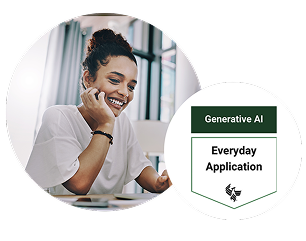
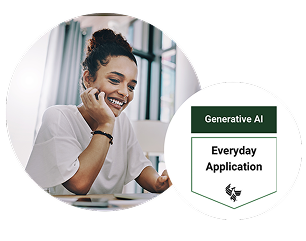
The University offers a 'Generative AI in Everyday Life' course, where you’ll gain hands-on experience with AI tools like Microsoft® Copilot® and develop practical skills to keep up with the AI-driven workforce. Dive into real-world applications and ethical considerations of AI, preparing you to navigate in the dynamic landscape of modern technology. Students can demonstrate their career-relevant skills by earning the Generative AI digital badge.
Learn to use generative AI to become career ready
The University offers a 'Generative AI in Everyday Life' course, where you’ll gain hands-on experience with AI tools like Microsoft® Copilot® and develop practical skills to keep up with the AI-driven workforce. Dive into real-world applications and ethical considerations of AI, preparing you to navigate in the dynamic landscape of modern technology. Students can demonstrate their career-relevant skills by earning the Generative AI digital badge.
Questions other students are asking

Students have free access to Microsoft® Copilot® through their Microsoft 365® accounts. You can log on and start conversing with the AI assistant whenever you want.
Generative AI can be your personal assistant, helping you with research, coding, brainstorming, organizing ideas and editing your work. It can also give you feedback on grammar, content and punctuation. But remember, copying and pasting AI output won't help you learn and puts you at risk for academic misconduct. Use AI to help develop your writing skills and polish your work but be transparent about how you use it, ensure alignment with AI and academic integrity and weigh the ethical considerations of AI in education.
One of the advantages of using Microsoft® CoPilot® is the ability to make real-time changes while working on a Microsoft® Office document, streamlining tasks like writing, data analysis, and presentations. In Word, CoPilot® can instantly assist with drafting essays or reports by generating content based on your topic, while suggesting improvements in grammar, tone, and clarity, making revisions quick and efficient. In Excel, it helps organize data, run formulas, and create charts or graphs in real time, making data analysis more straightforward. When working in PowerPoint, Copilot can transform outlines or key points into polished slide decks, complete with design suggestions and relevant visuals, right as you're building the presentation.
Like any online application, you should be mindful of what information you input into generative AI tools since they operate based on the input they receive. Never share sensitive information with a generative AI tool. However, when using Copilot through your Microsoft 365® account, enterprise data protection encrypts your conversations and keeps disclosed details private.
AI tools are great for gathering initial ideas about a topic. For example, you can ask Copilot a question, and it will provide an answer with links to various sources. This can help you develop your topic and learn how to identify credible sources of information. AI tools may produce output that is inaccurate and untrue, so it is your responsibility to evaluate any output accordingly.
AI tools are not completely reliable in regard to academic research. AI output can sometimes be inaccurate, biased or off topic. AI tools require human oversight, and just like in traditional research, any output should be evaluated for credibility, accuracy and bias. The University Library or Google® Scholar are much better options to help you find credible, vetted resources for your assignments.
The use of AI in education presents several risks that educators and learners should be mindful of. One major concern is the potential for overreliance on AI, which can impede the development of essential skills such as critical thinking, communication and analytical abilities. These skills are crucial in today's workforce, where companies seek employees capable of independent thought and innovation. Excessive use of AI tools might lead students to depend too heavily on technology for solutions, thus undermining their ability to solve problems without automated assistance. Furthermore, there's a risk that creativity could be stifled, as students may opt for AI-generated responses rather than developing unique ideas. To mitigate these risks, it's important to strike a balance between leveraging AI's capabilities and maintaining traditional learning approaches that foster independent thinking and creativity.
Generative AI can significantly enhance your writing and communication skills through several powerful mechanisms. By providing real-time feedback and suggestions, AI tools help you identify areas for improvement, such as grammar, style and clarity. This immediate response allows you to refine your writing iteratively, honing your ability to express ideas more effectively.
Additionally, interacting with AI encourages you to articulate your thoughts clearly, as precise instructions yield better outputs. This process not only improves your technical writing skills but also strengthens your ability to communicate ideas succinctly and persuasively. Over time, the continuous engagement and feedback loop with AI can lead to more polished and impactful communication.
Communication is key to tailoring a generative AI tool to your desired purposes. Start by defining clear objectives and providing context for your interactions. Train the AI with specific commands to ensure accuracy, such as instructing it not to guess answers. You can also ask a question in multiple ways to ensure consistency of the AI output. Try offering regular feedback to refine its performance and specify preferred formats and boundaries to tailor the AI’s responses to your needs. These steps will help the AI deliver more precise and relevant outputs.
Keep exploring

Adobe is a registered trademark of Adobe in the United States and/or other countries. Apple is a registered trademark of Apple Inc., registered in the U.S. and other countries. ChatGPT is a trademark of OpenAI OPCO, LLC. Copilot is a registered trademark of Microsoft Corporation in the U.S. and/or other countries. Canva is a registered trademark of Canva PTY LTD. GitHub is a registered trademark of GitHub, Inc. Google is a registered trademark of Google LLC. Grammarly is a registered trademark of Grammarly, Inc. Microsoft is a registered trademark of Microsoft Corporation in the U.S. and/or other countries. Microsoft 365 is a registered trademark of Microsoft Corporation in the U.S. and/or other countries.