


 844-937-8679
 Login
Login


UOPX alumnus Dr. Wayne McCoy and the things we take with us

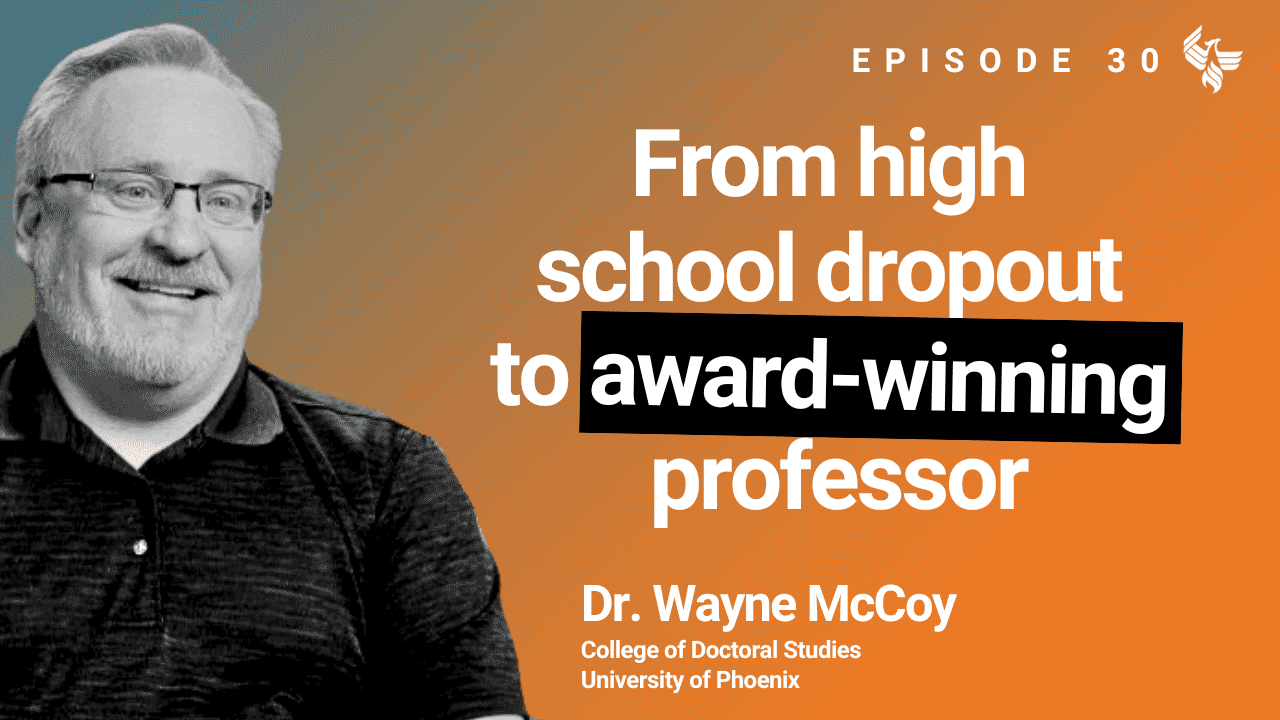
Listen to the podcast episode featuring UOPX alumnus Dr. Wayne McCoy
From Dropout to Doctor: Wayne McCoy’s Journey
Dr. Wayne McCoy earned his Doctor of Management from University of Phoenix and went on to join the College of Doctoral Studies faculty. In this Degrees of Success® podcast, he talks about the importance of education and relationships.
0:00
When we leave this life, in my opinion, we take two things with us, what we've learned and the relationships we've gained.
0:05
Everything else is ancillary and doesn't matter.
0:07
That's my next journey.
0:09
That's the journey I'm on, is to try and make meaningful relationships, help other people along the way as much as possible, and make a difference in the lives of my family and
0:19
other people I come in contact with.
0:20
That's where happiness truly lies.
0:29
you
0:35
Welcome to the Degrees of Success podcast.
0:37
I'm your host, Freda Richards, and today we have an incredible guest, Dr.
0:42
Wayne McCoy.
0:44
He was faculty of the year here at University of Phoenix.
0:47
We're so excited to have you.
0:49
Thank you so much, Dr.
0:50
McCoy, for joining us.
0:52
Thank you.
0:52
Appreciate it.
0:54
For our audience and listeners who don't know who you are, do me a favor.
0:58
Go ahead and introduce yourself and your mission to them.
1:01
I'm Wayne L.
1:02
McCoy.
1:03
am uh an older gentleman who's been in the business world for most of his life.
1:08
And uh I wanted to change that.
1:12
And uh I always found teaching more resonating with me.
1:16
It was something that was very fulfilling uh and got me going because I got to see what other people experienced and see their success.
1:25
And being a part of that was a big deal to me.
1:27
It's always something I wanted to do and finally had the opportunity a few years ago and jumped at it.
1:32
um I guess my mission is to do as much as I can to help other people around along their road to success in education and in business world and to find some of those goals that
1:44
they want.
1:45
I know that you didn't start school right out of high school on the traditional path.
1:51
Tell us more about how you actually started and you were, if I'm not mistaken, working at a pizza place?
1:56
uh
1:58
Yeah.
1:58
So, I mean, it goes back a little bit further than that.
2:01
I'm actually a high school dropout.
2:02
I dropped out of school with a month to go in my senior year and had some familial issues.
2:09
I was raised by my mother and my stepfather.
2:11
My stepfather was a Marine Corps drill instructor that had retired and came into my life as a preteen and that relationship did not go well.
2:20
And so there was a lot of issues there between us and eventually there was some physical altercations.
From High School Dropout to Educator
2:29
Um, and so that, you know, home life broke down.
2:32
I, they, kicked me out of the house when I was, I was close to graduating.
2:36
I never finished.
2:37
I wasn't able to finish.
2:38
I ended up getting the GED and going into the military.
2:41
And then, um, and then after I came out, I met my wife and, we just, we just celebrated 36 years in May.
2:52
Thank you.
2:52
And she, she was the.
2:55
the motivation for everything that happened after that.
2:58
got into the business world.
2:59
At one point I was working two full-time jobs doing audio visual work for one company in the daytime and managing a pizza restaurant in the evening.
3:09
We had our own diner for a little while and tried the food service industry, ended up in some other work and doing some logistics and fulfillment services work for Best Buy and
3:21
Home Depot and some of those people.
3:24
in the organization I left before this, but I've always wanted to get an education.
3:29
I didn't get my first degree until I was in my mid thirties, which is not unusual for University of Phoenix people.
3:35
That's why I can, I can, um, I can relate to a lot of the students that I have.
3:41
then, and then I stayed as a, as a bachelor's student, you know, a bachelor's graduate for several years while I was in, in corporate America.
3:48
And then, and then, uh, decided to get a master's degree because I wanted to teach.
3:53
And so I got a master's degree, applied for teaching jobs everywhere, kept getting beat by people with doctoral degrees.
4:00
And so I said, well, I might as well just keep going.
4:03
So we got the doctoral degree and I got my first opportunity with another university, a competitor actually, worked with them for several years, but still stayed in touch with
4:14
the people that I knew at UOP because it had changed my life so much that I wanted to.
4:21
I wanted to, I know that sounds so cliche to say that you want to give back and I don't know how else to say it, but I just, wanted to come back to UOP.
4:28
That's where I felt at home.
4:30
That's where it had done so much for me and I wanted to be able to be small part of doing that for others.
4:36
So that's where we got, that's where we're here now.
4:39
I don't think it sounds cliche at all.
4:41
As a matter of fact, uh most of the incredible leaders that we interview here at degrees of success have a servant heart and servant leadership is usually uh their style of
4:54
leadership.
4:54
So it doesn't surprise me that the faculty of the year recipient would be a servant leader here at University of Phoenix.
5:02
So I do want to talk about that.
5:03
Tell us more about what you do here at University of Phoenix currently.
5:08
So currently I'm a dissertation chair.
5:10
So I lead students that are in their dissertation process through their doc courses.
5:15
um The iterative process of developing their dissertation chapter was one through five and occasionally I'll have content courses that will work, that will be integrated in with
The Role of a Dissertation Chair
5:25
that to do some of that, the interim um courses that they have to go through in the doctoral program that are not just related to their dissertation, but support that
5:36
dissertation process.
5:38
And so that's a lot of fun.
5:40
I get a lot of ideas, a lot of people's passions comes in.
5:44
I think that the thing that I'm learning the most about it is that everyone in the dissertation process is constantly talking about bias and having to suppress bias as you
5:56
prepare your dissertation and get ready to do your study.
5:58
And that's a really difficult thing because we all have it.
6:02
Our bias is not necessarily a bad thing.
6:04
It's actually not a bad thing.
6:06
Our bias is...
6:08
is our view of how we've experienced life and it comes from our life experience.
6:13
And so every single person that I've worked with so far, every student has expressed a passion about whatever their topic's gonna be.
6:22
And there is an obvious magnitude of bias in that expression.
6:27
You can tell that's what they really wanna do and they're confident in what their results are gonna be.
6:32
And so you have to kind of tap the brakes a little bit and let them know that.
6:36
They haven't done their study yet.
6:37
They don't know what it's going to be, but they may have an idea of it.
6:41
so that's a fun experience to help them develop a mindset towards their study that is more objective and being able to look at it that way.
6:52
So that's a lot of fun.
6:53
I also enjoy finding students that are unsure.
6:57
There's a lot of students that all of them have their master's degrees, but they're still unsure about the doctoral degree.
7:02
It's a different program.
7:04
learning how to write in the proper way and the doctoral voice is sometimes difficult for people.
7:10
They use things.
7:12
One of the big ones that I get all the time is people that are using the pronouns that are ambiguous and they use them all the time.
7:22
And so that's a really big adjustment for people in their writing.
7:25
There's all sorts of little tiny things like that that they have to learn to adapt to and it can be intimidating for them.
7:30
And so being able to connect with them and say, look,
7:33
The process works.
7:34
Just be calm, take it step by step.
7:38
We're here to help and we'll get you through it.
7:40
And as you see that progression and you see their confidence build, it's very deeply fulfilling.
7:47
Well, as a three-time alum, I imagine that students can feel free to lean on you, knowing that you've been through this experience.
7:55
literally here at University of Phoenix, what would you say when you're teaching or when you're in your chair and you're helping people, what stories or what alignment with any
8:03
student did you have to you could see like a powerful shift in which you helped them realign?
The Importance of Support in Education
8:09
So it's different for each one because some of their topics are something that I'm very familiar with and can give them some insights into the topic.
8:17
And some of the topics are not m something I'm familiar with.
8:20
it's my assistance is not topical.
8:25
It's more ancillary, it's more encouragement, it's more figuring out the things that are distracting them from their topic and things like that.
8:32
So helping them get rid of the fears is a big part of it.
8:37
Helping them to...
8:37
to be comfortable and know that they've got someone that's right here supporting them.
8:42
You hit on something that made me think about it.
8:47
people need to understand this.
8:49
There's a huge difference in my experience.
8:51
And granted, it's limited to the few institutions that I've been involved with.
8:55
But UOPX is different.
8:59
uh There's not an elitist mentality among those that are in my position as opposed to
9:06
students that are going through the process, you know, from the student to the instructor to the dissertation chair to uh the research methodologist to the chair peoples of the
9:19
college, the associate chairs and even the deans, all the way up to John Woods.
9:24
There's an attitude of helping one another and not necessarily feeling like, you know, I need to be looked up to.
9:32
And that resonates with students and gives them
9:36
a comfortable feeling that makes them feel like they're welcome and that they can succeed, they can do it.
9:43
That's truly different than other places that I've experienced.
9:48
Absolutely.
9:50
And I have to completely agree to your point.
9:53
uh Monica was my my VP still currently is my VP here at University of Phoenix in the marketing department.
10:01
And I remember initially when she offered the help, I thought, that was nice of her to say, you know, that's that's very sweet of her to say.
10:09
then once I started the program, I never reached out because I thought, you know, she's a VP and she's currently getting her doctorate.
10:17
She doesn't have time for me and me just now starting this journey.
10:21
And she would consistently reach out every eight weeks.
10:24
And every time I would think, no, no, I don't wanna bother you.
10:26
And she's like, so what class were you in?
10:28
Like I've scheduled, I put the 30 minute or a schedule, a 30 minute meeting on our schedule.
10:33
uh So I wanna make sure that we have a conversation about this next class.
10:36
And uh she was just amazing.
Finding Fulfillment Beyond Material Success
10:39
And she still truly is.
10:40
And honestly, I'm thinking, you don't have time for me.
10:43
We're doing so much in marketing right now.
10:45
There's just no way.
10:47
And you're getting your doctorate at the same time.
10:49
And you have like competitive cheer daughters.
10:51
No way that you're gonna have any time for me.
10:54
And uh she was very persistent.
10:57
And to your point, very humble.
10:59
There was no such thing as, I'm a VP and you're a marketing manager, Freda.
11:05
So this is like, was...
11:06
Like, I wanna help you, I want you to win.
11:08
I want you to get this doctorate, you've got this.
11:11
Anyone who's ever met Dr.
11:12
John Woods knows that he exemplifies that.
11:15
He's extremely intelligent and transparent at the same time.
11:22
At the awards get together they had for the faculty of the year, he just opened up a couple of different times.
11:29
He said, ask me any question you want.
11:31
And people asked him questions about the university and he just opened up and told us what was going on.
11:36
was very transparent, very humble about it.
11:38
uh
11:39
and his interactions with us were very congenial and he didn't act like he was a big shot and made us very comfortable.
11:49
So if he exemplifies that, it's easy for us to reciprocate that with him, but also to demonstrate the same thing with our students.
11:58
Absolutely, absolutely.
12:00
I've actually had the honor of interviewing him as well.
12:02
So I could completely agree.
12:04
And I have to say for anyone watching or listening, if you're listening, can't uh necessarily see Wayne, but uh he currently has on an army hat representing his service in
12:14
the military.
12:15
So not only is he a servant leader, but you've served for our country and our freedoms.
12:20
Thank you for your service.
12:22
It's just covering up my hair that's too long and a little too gray.
12:26
So that's all it is.
12:29
And it keeps the sweat out of my forehead while I'm working in the garage.
12:33
my goodness.
12:34
Well, tell me this.
12:35
Do you think that your time in the service, your time in the army, do think your drive came from there?
12:41
No, I think that came from my wife.
12:45
She uh is the most virtuous person I've ever met.
12:50
so she inspires me to act in accordance with the maximum capabilities I have physically and emotionally.
12:59
she was wanting to see her in a better situation and the kids in a better situation was the motivation to work two jobs, but to get to a better position.
13:11
educationally so I could do something else.
The Value of Education in Today's World
13:13
uh You know, she has supported that.
13:16
I mean, there were times, many times where I was doing my doctoral work, even the, even the master's degree, but doing my doctoral work while we were sitting in bed next to each
13:27
other and she would be on her iPad and I would be writing and it would be hours at a time.
13:32
And, and, you know, she was right there with me and, sometimes I would get frustrated.
13:38
m As you've probably experienced as well, were sometimes I would get frustrated with comments that I got from my dissertation committee or corrections that I got from a
13:46
teacher that I thought were wrong.
13:48
uh you know, I had to change things that I was writing and blow up whole sections and do them over again.
13:56
And there were frustrations, there were tears, were mad moments, and she was there through the whole thing.
14:04
And, uh you know, that's...
14:07
between all of that, that's a lot of years of support in silence.
14:13
A lot of people don't understand that.
14:14
In that regard, um that's the support structure that made it possible.
14:20
I couldn't have done it without her by my side.
14:23
There's just absolutely no way I would have given up way too early.
14:27
so she's your foundation.
14:29
Absolutely.
14:30
The kids are grown up now, so they were gone out of the house by the time I started my doctoral journey.
14:36
So now it's grandkids.
14:39
Now it's grandkids?
14:40
Yep.
14:41
my goodness.
14:42
Well, congratulations on being a grandpapa of seven.
14:46
Yeah.
14:47
That's awesome.
14:48
That's awesome.
14:49
So just more to live for.
14:51
I know that you were saying that your wife is your foundation.
14:54
You now have seven grandchildren from your two amazing daughters.
14:58
What could possibly be next for you?
15:00
It's really just about finding fulfillment and what makes you happy.
15:05
And I've learned some things matter and some things don't.
15:09
I had a mentor tell me once that too many people get concerned with the thick of thin things.
15:18
And what he meant by that is we get too impassioned, too involved, too engaged and make too important things that don't really matter.
15:28
uh
15:29
And sure, it's nice to have the income to have a living, but I've been in a position to have a lot of money and it never was enough and it never provided the sense of fulfillment
15:43
that does from seeing my grandchildren learn or from seeing a student get an aha moment or a light bulb go on or see them get a concept that helps them take the next step in their
15:56
journey.
Navigating AI in Education
15:57
and feel a little bit more confidence.
15:59
It's the connection with other people that really matters.
16:03
um I don't want to get too spiritual or religious, but when we leave this life, in my opinion, we take two things with us, what we've learned and the relationships we've
16:12
gained.
16:13
Everything else is ancillary and doesn't matter.
16:16
And so that's my next journey.
16:18
That's the journey I'm on, is to try and make meaningful relationships, help other people along the way as much as possible.
16:27
and make a difference in the lives of my family and other people I come in contact with.
16:32
That's where happiness truly lies.
16:35
We have so many things in life.
16:37
try to, everybody wants happiness.
16:39
Everybody's looking for happiness, whether you're, whatever culture, whatever walk of life, whatever experience you've had, everybody's looking for happiness.
16:48
And so many people are looking for it in a place that it doesn't happen.
16:52
And so it's, you know, that's what it's about.
16:56
finding happiness and trying to help others find it as well.
17:02
finding happiness within and then finding happiness in serving others to ensure that you could be a part of their journey.
17:10
Yes.
17:11
That's powerful.
17:13
And it's clearly how you lead.
17:14
I've watched a few videos.
17:15
I've been reading articles.
17:17
And it's most likely why you won faculty of the year.
17:20
I want to ask you, how do you feel in regards to education, the current environment?
17:28
If you were to be telling our viewers or our listeners, why would now be a good time to go back to school and particularly University of Phoenix?
17:39
Well, that's a two-part question.
17:40
So let me get to the first part of it.
17:43
There's no bad time to go back to school or to gain an education.
17:46
um The environment that we're in, the world around us, it's going to continue to evolve and devolve and make changes and go back and forth.
17:58
um That's not something that you can allow to distract you from your personal goals.
18:06
You can easily get caught up in the fear
18:09
and the rhetoric and the, you I've told my wife this before, it's like new people growing up, young people growing up now, they see the disagreements, let's say politics, you see
18:21
the two different sides of politics.
18:23
There's more than two sides, but the two major sides from politics and they argue nonstop and they create these environments and that's not different.
Navigating AI in Education
18:34
It's always been that way, except that when I was young,
18:38
I could disagree with someone philosophically on something and we could argue back and forth.
18:43
Now, I never thought that person needed to be hurt or killed because they disagreed from me.
18:49
And so it's gotten so ridiculous now that we can't even exchange ideas among those of us that differ, which is the impetus of the founding of our nation.
19:00
The people that founded our country did not agree on everything, but they learned to work together and...
19:06
and create what I think is the greatest country that's ever been.
19:10
And so it affords us freedoms to be able to go to school.
19:15
have an opportunity, all of us do, and I'm not dissuading people from joining trades.
19:24
Trades are important and they need to be there.
19:25
We need electricians, we need plumbers, we need all of those people.
19:29
If that's what you like to do and that's what the opportunity is, that's great.
19:32
But if you don't have an opportunity to do that, you have an opportunity to go to school.
19:36
There's almost an obligation to better yourself so that you have the opportunity to help better those that come after you, your descendency.
19:45
um There's never a bad time to go to school, regardless of the environment that you're in.
19:50
There's always an opportunity there to gain an education, make yourself more aware about the world around you, um learn how to think critically so that you can, you know, that's
20:02
even a method that can help you get rid of some of the...
20:05
ancillary stuff that's going around because you can see through some of the bull crap for lack of a better term and see the truth and and learning how to discern bias and others
20:16
and being able to filter that critically and see it.
20:19
That's an important element of going to school.
20:22
So there's so much that can be benefited that can benefit people from getting an education, getting some perspective and not simply being informed through life by
20:32
their only their life experience.
20:33
And it's like I tell some of my students, education is gonna happen regardless.
20:39
You're gonna get educated.
20:41
You can either take control of that education and direct the direction it goes, or life will educate you.
20:47
But you're not gonna be able to avoid education.
20:50
So you might as well control the direction it goes.
20:52
That is so good.
20:54
And so that's that piece.
20:57
Yeah.
20:59
That actually sparks a question for me because in this current age with AI rising, and I know that my dissertation actually is in AI and marketing and how we can implement it in
21:14
marketing appropriately with the different businesses and such.
21:19
to your point, I'm a little biased.
21:20
I'm trying to lighten my bias because I think that AI could be a good thing, but I've definitely seen how.
21:27
It could be manipulated.
21:28
In this world where there's AI videos, where it takes a second to go, wait, that's not a human or of a script is AI.
21:38
that's not really the person that you may think.
21:41
Maybe it looks like the current president or the previous president.
21:45
I've literally seen videos of both or photos of both doing things that you're like, that doesn't make sense.
21:51
I've seen a photo of them holding hands.
21:54
I'm curious with AI.
21:57
How do you see that impacting education and whether that be to your point, people being educated in life versus people being educated in a university?
22:09
Well, it's definitely impacting education.
22:11
mean, we're adapting to the use of AI by our students and we're using some AI in our evaluations of things.
22:20
It's absolutely more convenient.
22:22
My concern, the overall concern is why do you go to school?
22:28
You go to school to gain knowledge, to learn, to gain experience and to get some perspective and expertise.
22:36
And my concern is that there's going to be a line crossed eventually where students are using AI so much that the AI is the knowledge and the student doesn't actually get to
22:46
retain what they've learned.
22:48
That's the concern.
22:49
I could care less if a student uses AI to help them format a paper.
22:54
That doesn't matter to me at all.
22:55
That's perfectly normal.
22:57
I hated formatting papers.
22:59
It's like an editor.
23:02
When someone writes a book, you give it to your editor and they make all those corrections.
23:06
So I have no problem with that.
23:07
I don't even have a problem if AI is used to generate some ideas based on a concept that a student comes up with to give them some perspective and help them expand what they're
23:17
looking at.
23:18
That's not a problem.
23:19
Where it will develop into an issue is when it becomes the student.
23:25
I don't think we're there yet, although some students try.
23:30
I don't think we're there yet.
23:31
That will be the concern in education and in everything.
23:34
I'm not a conspiracy theorist that think we're going to end up with the Terminator.
23:39
But I do think we can begin to stunt our own growth and development as human beings if we allow too much convenience and too much AI to do the tasks that inform our learning for
23:51
us.
23:52
Thank you for that.
23:53
I think that that perspective on AI is very important.
23:57
And I love hearing it from the university, from the perspective of a university, not just simply what it's like to be on social media and be manipulated, because to your point,
24:08
you're educated in life and, and or you can be educated at a university or at a school.
24:15
I've been bamboozled myself and I find myself to be fairly educated.
24:19
I like to say uh trust and verify.
24:22
So I'll hear what someone says and go, did that happen?
24:25
Okay.
24:25
And then I'm immediately, you know, looking it up.
24:28
The doctoral program will do that to you.
24:31
Make you want to research all things um and make sure you have a valid source.
24:36
m
24:37
But is that AI peer reviewed?
24:41
Exactly.
24:43
Yeah.
24:44
Exactly.
24:44
So um one, I'm grateful for that.
24:46
I think my friends are probably tired of me always like double checking and researching, but I'm giving them valid information.
24:53
With that said, though, because like I said, that in itself was it's an it's an incredible um idea and able something for us to wrap our minds around to say that anywhere you go,
25:04
anything you do, whatever you read, you are educating yourself.
25:07
I never thought of it that way.
25:10
Well, it's Yeah, it's life.
25:13
It's life.
25:14
That's really good.
25:16
Well, is there anything else I want to give the floor to you before we wrap today?
25:21
The floor is yours for all of our listeners, for all of our viewers.
25:24
What would you want to make sure that at the end of this pod that they walk away with something that they remember and hold on to?
25:30
Well, we've talked about a few things and a lot of it has been centered on life experience and things of that nature.
25:36
just, maybe a little bit of a Homer plug here.
25:39
um I would just let people know that the best place I've found, and I'm in advanced stages of life, like I said, the best place I've found to do this education, to find the right
25:51
environment, to find the people that are willing to support and nurture and help a person, even the most introverted person.
25:59
get through the journey, whether it be at a bachelor's level, associate's level, certificate program, or all the way up to a doctoral level.
26:08
The best place I found to do that is the UOPX.
26:10
The support is just second to none.
26:13
m The university is, you know, it's a for-profit institution for now, but it's not about that.
26:21
It's about helping people, and it's got the message, and it's got the focus in the right order.
26:29
in corporate world for so many times, there were times that I would see organizations struggle because their focus was on the profit margin.
26:38
And I understand that's important.
26:39
I understand that's important.
26:41
But the organizations that succeed understand the profit margin is important, but it's secondary to the goal that creates that profit, which is staying true to the message and
26:54
providing a service that is actually necessary and important in people's lives.
26:59
And UOPX absolutely does that.
27:01
It makes opportunities for someone who dropped out of high school and was working two jobs to be able to change his life and the life of his family educationally.
27:12
It makes that opportunity available for people that have grown up in single parent homes.
27:17
It makes that opportunity available for people who don't have the time and have to work crazy amounts of hours just to support their family and put food on the table.
27:25
The asynchronous nature.
27:27
of most of what the university does in remote environments.
27:31
There's a lot of remote universities now.
27:33
It's not a coincidence that so many universities around the world are copying the remote model that started right here with University of Phoenix.
27:43
so um I think we do it the best.
27:47
And I think the, I think the statistics and the results prove that up.
27:53
Again, I'm biased, but I completely agree.
27:57
Dr.
27:57
McCoy thank you so much for joining us on this episode of Degrees of Success.
28:01
We're so grateful for your time as I know you were a busy man.
28:04
So thank you so much for joining us.
28:06
Thank you very much for the time.
28:07
Appreciate it very much.
28:08
You're welcome.
28:10
And somehow that brings us to the end of this episode of the Degrees of Success podcast.
28:15
You heard it here.
28:16
You need to focus on your mission, which is maybe focusing on you, happiness for you, and of course, serving others and helping them find happiness as well.
28:26
Straight from Dr.
28:27
McCoy.
28:28
I'm your host, Richards, reminding you that your next chapter just might be your best one yet.
28:33
See you soon.
Chapters in this video
- The Journey of Learning and Relationships
- From High School Dropout to Educator
- The Role of a Dissertation Chair
- The Importance of Support in Education
- Finding Fulfillment Beyond Material Success
- The Value of Education in Today's World
- Navigating AI in Education
About UOPX alumnus Dr. Wayne McCoy

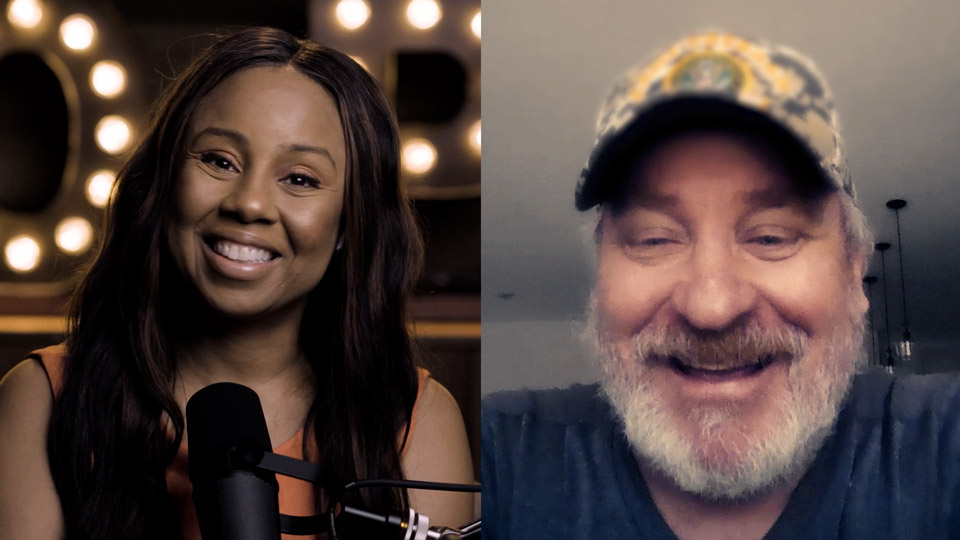
An instructor in the College of Doctoral Studies, Dr. Wayne McCoy is a Faculty of the Year award recipient. He earned his Doctor of Management at University Of Phoenix.
About the Degrees of Success® Podcast
The Degrees of Success® podcast by University of Phoenix brings you inspiring stories of UOPX alumni who have transformed their careers through education. Each episode highlights personal journeys of overcoming obstacles, achieving professional milestones and using education to unlock new opportunities. Whether you’re looking for motivation, career advice or guidance on how education can propel you forward, these alumni stories offer invaluable insights to help you succeed.
Listen to the Degrees of Success® Podcast


