


 844-937-8679
 Login
Login


UOPX breaks the stigma around invisible disabilities


Written by Laurie Davies

Reviewed by Kelly Hermann, MSED, Vice President, Accessibility, Equity and Inclusion

What are invisible disabilities?
How common are invisible disabilities? If University of Phoenix invited 100 statistically representative U.S. adults to its Arizona campus, up to 12 might use a wheelchair or assistive walking device. Six might wear hearing aids or cochlear implants. Almost five — those with visual impairments or blindness — might be using a white cane or perhaps navigating the campus with the help of a guide.
Those disabilities are visible.
Undetected among these guests, however, would be many hidden or invisible disabilities. In fact, according to national statistics:
- 20 would have dyslexia
- 18 would have depression
- 15 would have suffered from migraines
- 4 to 5 would have ADHD
- 2 to 3 would have bipolar disorder
Invisible disabilities can range from chronic pain and fatigue to, as mentioned, dyslexia, migraines, ADHD or mental illness — and many other diagnoses that affect one’s ability to perform life activities. Invisible disabilities (as well as visible ones) can affect both how an individual does a life activity and how long it takes to do the activity.
What is an accommodation?
Students who have visible or invisible disabilities should check with their college to see if they can apply for accommodations or adjustments that can be made to some aspects of the course experience to mitigate the impact of the disability. Accommodations can include:
- More time to complete assignments
- Written materials formatted for text-to-speech tools
- Captions for live or taped video sessions
Unfortunately, asking is exactly the step that some students decide not to pursue — because, like it or not, disability stigma still exists in this world.
What is disability stigma?
There are many examples of painful comments or realities in response to disability accommodations, including:
- A false belief that an accommodated student is helpless
- An assumption that an accommodated student is intellectually challenged
- A false belief that an accommodated student is lying, weak or incapable
- Discrimination or stereotyping

Kelly Hermann, MSED
Vice President, Access, Equity and Inclusion, University of Phoenix
“Hidden or invisible disabilities are not immediately apparent. But their impact on a person’s daily life activities is just as significant as those disabilities we can see. And with adult students, sometimes there’s this feeling of ‘I want to do it myself. I don’t want to ask for help'."
Hermann recounts one of the first students she worked with (at a different college) who was hesitant to use accommodations — a retired trucker who had a back injury that made it difficult to sit in classroom chairs.
“He was hesitant when I explained all the things we could do for him. He didn’t want anyone saying he didn’t earn his degree himself."
Then, Hermann had an idea. She asked the student if he had seen students using wheeled backpacks on campus. He had seen a lot of them, so she asked if using those wheeled backpacks meant the students weren’t doing the work of carrying their books themselves.
"It was like a light bulb went on for him. He said 'No, the students are still getting their books from point A to point B. The wheels made it easier, but they didn’t do the job for them'."
“The wheels are the accommodation. You’re not using all your energy to get from point A to B, so you have the energy you need to focus on your class.”
Accommodations help students succeed
The data don’t lie. In data collected by University of Phoenix as part of its accessibility initiatives, the average increase of 30-day retention for accommodated students at University of Phoenix was 14.3% in 2023 (when compared with students who disclosed a disability but were not using an accommodation).
In other words, more students who used accommodations completed their courses and moved on to the next one.
In 2023, the university accommodated more than 15,000 students. The top-requested accommodation was extended time to turn assignments in without penalty.
What is the right amount of time students need? It depends.
For some students, four days is enough, and they are able to get everything in after their class ends without needing to request an additional extension. For others, the timing may be different.
Will some students experience negative attitudes or perceptions after disclosing an invisible disability? It happens, but it is increasingly rare.
How University of Phoenix can help students with visible and invisible disabilities
For students who want to apply for a disability accommodation for a visible or invisible disability, a link to request an accommodation is available in every course in Blackboard, the classroom management system used at University of Phoenix.
Even if your disability has not been diagnosed (e.g., it’s a recent injury or an ongoing situation you haven’t sought medical treatment for), students are encouraged to apply. University of Phoenix gives accommodations on a temporary basis to give a student some time to get an appointment with a medical provider.
Once a student has filled out the accommodations form, a member of the Student Accommodations Office will reach out by phone within 24 to 48 hours to determine eligibility. This is important since the university's undergraduate classes are only 5 weeks long.
What is the line for who’s eligible?
The standard criteria look at students holistically, and the Student Accommodations Office asks open-ended questions, such as:
- How is this disability showing up for you when you sit down to do your coursework?
- Have you tried to address how it’s affecting you?
- What has worked?
- Do you have a letter from your doctor — or could you get one — that would help us understand the manifestation of your symptoms?
Sometimes its just not possible for a student to provide documentation for invisible disabilities. For example, if a student was diagnosed with a learning disability 30 years ago, the student simply may not have access to those records.
Learn more about the Student Accommodations Office at University of Phoenix.
The disability accommodation process:
1. Apply for a disability accommodation.
2. Connect with the UOPX intake team.
A member will call you, but you can reach them at 602-557-1157.
3. Participate in an intake interview with the Student Accommodations Office.
Share details about your diagnosis and how it affects you. Accommodation applications are assessed case by case.
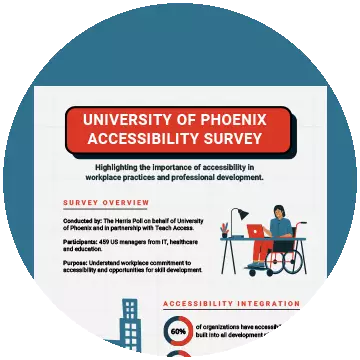
University of Phoenix Workplace Accessibility Report
In order to better understand workplace accessibility awareness and practices for employees with disabilities, University of Phoenix commissioned with The Harris Poll a survey of managers in information technology, education and healthcare. The survey findings illustrate an overall value of accessibility skills in the workplace fields of healthcare, education and technology.
Read more articles like this:




ABOUT THE AUTHOR
A journalist-turned-marketer, Laurie Davies has been writing since her high school advanced composition teacher told her she broke too many rules. She has worked with University of Phoenix since 2017, and currently splits her time between blogging and serving as lead writer on the University’s Academic Annual Report. Previously, she has written marketing content for MADD, Kaiser Permanente, Massage Envy, UPS, and other national brands. She lives in the Phoenix area with her husband and son, who is the best story she’s ever written.
ABOUT THE REVIEWER
As Vice President, Accessibility, Equity and Inclusion, Kelly Hermann leads services to students with disabilities, digital accessibility initiatives and the Office of Educational Equity. She chairs the special interest group for online learning and distance education for the Association on Higher Education and Disability (AHEAD) and the accessibility task force for 1Ed Tech and frequently presents on the topic for AHEAD, OLC, WCET and other national organizations.

This article has been vetted by University of Phoenix's editorial advisory committee.
Read more about our editorial process.