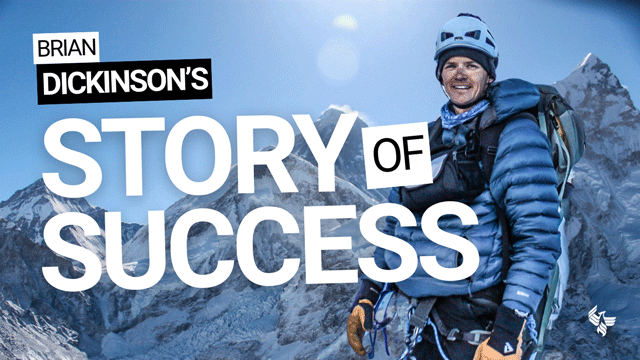
Alumni Mini-Documentary with Brian Dickinson

# How I survived Mount Everest!

## How I Survived Mount Everest!

[Embedded content](https://www.youtube.com/embed/yOIo9k0TQYw?rel=0&controls=1&fs=0&modestbranding=1&cc_load_policy=1)

×  
Chapter 1: The Journey Begins: Overcoming Adversity 0:07 You live and die by decisions you make. I'm wired to push beyond my limits, never give up. 0:16 I was at the highest point in the world, alone, and I'm blind. 0:53 When you grow up, you can't choose your family and the situations that you're in, so you're out of control. There's no plan B. 1:01 You know, when you come from a chaotic environment, you're never going to quit. 1:06 A lot of people that go through that end up actually unconsciously seeking it, getting into special operations and high-altitude mountaineering, getting in those scenarios to now have control. 1:24 that red zone you're always you're always heightened and on. My grandpa was very much filling in the gap of a father figure that I didn't have. 1:36 He was in the Navy, he was manning the guns, shooting down planes that were coming in and, you know, suicide bombers. 1:44 The Navy back in World War II, it's like, it's legit. One of their supply ships got taken out, got sunk. 1:51 They didn't have any food. The whole ship was starving. And when he got back stateside, he went straight to the store. 1:59 bought a head of lettuce, sat on the curb, and just ate it. 2:05 General Douglas MacArthur has been appointed to receive the unconditional surrender of Japan. 2:13 Back then, public display of affection wasn't like a big thing, but he went and seeked out his childhood sweetheart, my grandma, and like just laid a big lip lock on her and his words. 2:24 My grandparents modeled a good love story. But yeah, my grandpa being there, was amazing. 2:31 Taught me to golf, taught me unconditional love, which I never really experienced. 2:40 He was kind of that rock throughout my childhood. Chapter 2: Family Influence and Personal Growth 2:50 My grandma was around, she was present, she ended up passing away from cancer. 2:56 While she was dealing with cancer, I was there for her, kind of staying at her house quite a bit. 3:03 It's a lot to see as a kid. I know that my grandpa really dealt with alcoholism, but when he was influential to me, he didn't drink a drop. 3:13 Once my grandma passed, he... He fell off that wagon and I saw a different side of him. It was just night and day. 3:21 It was really, really sad to see. Eventually when I was in middle of SARS school, he found out he had cancer. 3:28 I took emergency leave, came home, was able to see him. And the last thing he ever told me was, you know, that he was proud of me and I know it's really tough what you're going through. 3:38 Be the best that you can be. I took that back and, you know, just I really channeled that and was able to get through the training. 3:50 Coming from a military family, I don't think I ever really thought I was gonna go in the military. 3:56 I was a little pumped up to do something a little bigger than myself and serve. 4:03 I chose that option because I knew I'd go to school eventually. My dad, served in Vietnam and he was a jet mechanic. 4:10 He told me, not just go in. I wanted to be either a pilot or a Navy SEAL at that point. 4:17 Went into the recruiter, went through the different options, and I remember, you know, Goose getting picked up, you know, from the SAR swimmers. I'm like, that's pretty cool. 4:26 So a SAR swimmer is search and rescue. The men and women that jump out of helicopters for rescue, down pilots, overland rescue, basically anything a helicopter does. 4:40 After boot camp, go to Pensacola, Florida, where aircrew school is. Really tough school. 4:46 Wake up at like 3 4 in the morning and do this extensive training in the pool. 4:52 And just really weeding out, you know, as many people that think it's cool to do these jobs to those that can actually do it. It's tough. 5:00 mean, you're pushed to the point of drowning every day, but the whole point is to remain calm in the most chaotic environments to save lives. 5:10 We were really taught to never panic because we're literally jumping out of a helicopter in the middle of the ocean to rescue someone. 5:20 It could be a pilot that just ejected, or it could be refugees that their barge just sank. It could be any scenario. 5:28 This is my flight jacket. It's issued in 1993. 5:34 I'd lose on average maybe two air crew and swimmers that I knew. every year due to helicopter crashes. 5:42 Our squadron had to go out and cut the bodies out of a burnt helicopter down SoCal. 5:47 Those things stack up, but when I was in, they remained in a box. 5:56 You really compartmentalize a lot of that. You're always just kind of, you know, working in that red zone. Chapter 3: Military Experience and Its Impact 6:05 You're always heightened and on. I didn't open that box for many years. Instead, did what was natural. 6:14 got into high-altitude mountaineering. Let's just heighten this level of trauma and just add onto this unconsciously. 6:33 After my first deployment to the Persian Gulf, got back and met my wife, Joanna. 6:42 It took like six years until we got married, but it was those years of growing up and I did deploy another time while we were together and that's super tough. 6:52 We got married in 2001. Joanna got into the University of Washington for her masters in social work. 7:01 I was taking classes and already kind of preparing to get out. I wanted to get my degree. 7:07 Ended up getting my bachelor's in information technology. I wanted to get my master's degree as well. 7:13 No one in my family had ever earned their master's. 7:17 Did my research and University of Phoenix had an online program that worked really well to get my MBA and especially a focus in technology management. 7:27 One cool thing about University of Phoenix, a lot of my instructors were actually working in the field in project management or finance or marketing. 7:36 It makes a difference. You could tell like. The instructors that have actually walked it out and they have those real world experiences. I had a really good experience at the University of Phoenix. 7:45 So over here is my University of Phoenix MBA diploma. 7:51 After I graduated, I've um had the opportunity to then become an instructor at the University of Phoenix. 7:57 And I took a different step and I taught business ethics. for actually five years. 8:03 Having those real world discussions and understand the mindset of all these different students, different ages, ethnicities, everything, it was very fulfilling. 8:13 It was very, very interesting. think a lot of the students got a lot out of it. I know me as an instructor, I got a ton out of it. 8:22 A few months before I was climbing Mount Everest, University of Phoenix came out and did a photo shoot, an article on me. 8:31 It was called the Seven Summits, one goal. Ended up making the cover for Phoenix Focus Magazine. 8:41 worked in the high tech, got my MBA, University of Phoenix, and we had kids. Chapter 4: Climbing the Seven Summits: A New Challenge 8:50 Like one day I'm jumping out of helicopters and then it's like just full stop doing all this responsible, responsible things in life. 9:00 And during this time, I realized I had this adventure gap in my life. You know, I lived in the Pacific Northwest here. 9:10 There's mountains everywhere. Decided to get a little more active and start climbing. Well, Mount Rainier's here in our backyard. 9:19 I climbed Rainier's 14,000 foot peak, took a class in mountaineering, and then decided to step it up a notch and climb the highest peaks on the seven continents. 9:31 What? Where's this coming from? Her immediate response was, does that include Mount Everest? 9:39 And I'm like, well, that's one of the highest peaks on the seven continents. She's like, OK. 9:49 You don't just show up and climb Everest. There's over 300 bodies on the mountain, every one is a unique scenario. 10:00 It really becomes a lifestyle. Training for me, you I live here in the Pacific Northwest. 10:07 I have 5,000 foot peaks surrounding me. I'd wake up early in the morning, 3, 4 AM, throw 60, 70 pounds. 10:17 In a pack, you know, I'd climb these mountains, you know, eight miles round trip. 10:22 That's the physical side to it, but there's the emotional, the mental side to it, and the discipline. 10:32 So I mean, that discipline plays into it, but there's a lot that goes into, you know, even attempting something like Everest. 10:43 Once I set that goal, I'm committed. With 100 billion people to have ever existed on Earth and only a couple thousand to have summited Everest, people aren't going to understand this world. 10:55 Why would you do something like that? Mount Everest, highest mountain in the world, 29,035 feet. 11:07 only third of the year, so you can't survive long. That's why it takes two months to climb the mountain. You have to acclimate. 11:16 It's 38 miles just to get to base camp, which is at 17,500 feet. So you're acclimating as you're going there. 11:24 And then from there, things get a little more serious. The first major obstacle on Everest is the Khumbu Icefall. 11:32 So it's a couple miles of falling building-sized blocks of ice. 11:41 This is where you see the aluminum ladders that are tied together across these bottomless crevasses. It's a sketchy area. 11:50 And you have to get through that just to get up higher on the mountain to start actually climbing. I ended up having to go through the Khumbu Icefall about eight times, just acclimating. 12:00 You go up Camp One at 19,000 feet, come back down, sleep for four or five days, head back up, get to Advanced Base Camp, come back down. Chapter 5: The Everest Expedition: Preparation and Challenges 12:10 You have to have lot of patience to climb these big mountains because you're doing the same thing over and over and not making a lot of progress. 12:17 But that's just part of the game if you want to survive. I had a friend, Pasong, who's Sherpa. 12:24 He had a couple summits already and super strong, young guy. So we climbed together, but a lot of times we were away from each other. 12:34 Through the Kumu Icefall, you get to Camp 1 at 19,000 feet. From there, you go through this area called the Western Kum. 12:45 Beyond the Western Cume at the other edge of it is Advanced Base Camp at 21,000 feet. 12:51 That's where the climbing of Everest really begins. 12:56 Because you go up this wall of ice and snow and rock just straight up on Lotse Face. 13:04 So Lotse is the fourth highest mountain in the world. You actually climb Lotse to get to the highest camp in the world, which is called the South Coal. 13:12 You're always on rope. 13:14 So if I fall, I only fall to the next anchor point. If you're off rope and you fall, it's certainly game over. 13:25 So on my summit day there were 70 mile an hour winds. Every step, was like pushing Pasaunga myself back. 13:35 A couple people summited that night. One famous Japanese climber passed away on the South Summit. 13:42 So we're heading up, and I get to about 1,000 feet above Camp 3. I stop, I anchor off to an anchor point. And remember, I'm on the side of a wall here. 13:50 Take off my goggles. I put it around my arm and then my mask. And then my foot slips out. My reaction is to grab the rope. 13:58 Well, as I did that, My goggles slid off my arm and fell. 14:06 I thought, this is it. Like I have to have goggles. I have to protect my eyes. Some Sherpa were waving at me. 14:15 They had stopped my goggles. So I came off oxygen, anchored all my gear, and I rappelled down. Once I got to the goggles, I noticed they were cracked. 14:24 I eventually ripped out the internal lens. not realizing that probably cut their effectiveness in half. 14:30 So I put them back on, continued climbing up, made it to high camp in the early afternoon, found Pasong, and we just kind of relaxed, and we'd be going for the summit that night. 14:43 We started getting ready, we radioed down, we're to the different camps, like we're heading to the summit, got our headlamps on, we're moving up the hill. 14:53 Actually got about an hour away from Pasong, so that was concerning. I got to... the balcony at 27,500 feet. Chapter 6: The Summit: Triumph and Trials 15:01 Highest person in the world at this moment, just having this moment of peace. And I waited, I waited for like over an hour. 15:10 A song eventually showed up. So I gave him my water. He took a sip and threw up. And he's like, I'm not feeling good. 15:18 And I'm like, okay, well, at that point I figured we needed to go back down. In these scenarios, you live and die by decisions you make. 15:27 Okay, seriously, we need to head down. He's like, no, no, no, I'm okay. So I'm like, okay, well, let's continue on. You know, I trust him. He's had more summits than I did. 15:38 So we continue on, get to about 28,000 feet. He taps out. He's like, I'm going to go back to the balcony. You continue up. 15:47 You're doing good. I'm overweight there. Didn't really overthink it other than the decision I had to make. 15:54 How was I doing? I felt fine. How was the weather? Weather was good. He turned around, started heading down. 16:03 And I turned around and started heading up. So I start heading up, which wouldn't be much down at sea level, at 28,000 feet in the death zone. 16:14 It's a lot. I get to the top of that section and I look out to my left and that's when I saw this perfect pyramid shadow down on the Himalayas. 16:25 What I was seeing is the sun rising from the highest point in the world casting that perfect pyramid shadow down over the highest mountains in the world, the Himalayas. 16:35 And just to be up in that moment is just... It's a lot to process. 16:41 I keep climbing, get to the South Summit, and at the base of that is Hillary Steppe, which is a 40-foot rock climb. 16:48 It's about two feet wide, and it is a two-mile drop to your left into Nepal and a two-mile drop to your right into Tibet. 16:58 I kept moving very, very slowly, got past that area, and then I can see the True Summit. 17:09 And those last steps, it's a lot to process. 17:24 pierced my crampons on the summit and just took it all in. 17:37 Broke up my radio, called down, and said, hey, this is Brian checking in from the summit of Everest. And like all the camps came to life. Chapter 7: The Descent: Facing the Unknown 17:54 A friend that I had gets on, he's like, Brian, congratulations. You and Pasaung, be careful getting down and give me a call once you get past the South Summit. 18:02 I realized no one knew I was alone. And I said, Pasaung went down over an hour ago. He's like, you're alone? I said, yeah. 18:11 He turned and asked Locke Boshirpa, how long is it going to take Brian to get down? He said, well, Brian, it take him two, maybe three hours. No one would hear from me for seven. 18:32 You spend all this time, you reach the top of the world, and you can't spend a lot of time there. 18:40 An hour at most. And I knew that. 18:52 and got my gear together and started heading down. about 10 feet into it, everything just went completely white. 19:07 and I went snow blind. As soon as that sun banked off the ice it fried my cornea. 19:16 I wouldn't regain my eyesight for a month and a half. 19:23 And I remember at that moment just dropping down to my knees, grabbing the rope I was attached to and assessing the situation. 19:33 I was at the highest point in the world, completely alone, and I'm blind. 19:42 I just got up and I started moving. I could hear the gusts of wind come up. 19:54 And the entire time, just, never felt alone. I would hunker down, lower my center of mass. 20:03 The wind would go over me and I would stand up, take another step. 20:14 I got to the top of Hillary Stepp, that 40 foot rock climb. 20:18 I reversed my gear and I start rappelling down and I like slipped out, pendulum, hit the wall, slid down to this like snow shelf. 20:27 I got up, started moving, had to climb up the south summit, top of the south summit. I slipped out and I'm falling. 20:35 The rope shock loads. I accelerated. so fast, I remember grabbing the rope, it burned a line through my leather gloves. 20:44 My mask is ripped from my face, my oxygen bottle is coming out of my pack, and my heart is just ripping out of my chest. Chapter 8: Aftermath and Reflection 20:54 I kind of stomped in a little ledge and put my oxygen back on and just had to slow my heart rate. 21:01 It was the scariest thing I've still ever experienced. It's like go to the roof, close your eyes and jump off. 21:08 I eventually got down to the point where Pasong had left hours earlier and I almost walked right past the oxygen bottle that he had stashed. 21:17 I don't know why to this day, but I put that extra oxygen bottle in my pack. put my other regulator back on my other bottle and started heading down. 21:28 And I don't know, maybe like 15, 20 feet into it, my mask just sucks into my face. And I ran out of oxygen. 21:38 At this point I had been climbing for about 33 hours, completely blind. I just couldn't do it on my own anymore. I dropped to my knees and I prayed. 21:49 But as soon as I said that prayer, was like someone reached down and picked me up. I tried the other oxygen bottle and I got a positive flow. 21:59 It was like fire reentering my veins. 22:03 Put my gear back on and just I started rappelling down and eventually made it into the last quarter mile, this ice bulge that leads into the South Cole or the Ten Sar. 22:15 And out of nowhere, Pasong just hugs me. It's like, Brian, you alive. 22:24 It's like, I'm so sorry I leave you. And I passed out for like 15 hours. My eyes were glued shut. I lost 20 pounds in that one day. 22:35 We got to get down, Loatsay Face, and got to Camp 2 eventually and had someone dial on a satellite phone, Joanna. 22:45 First time I got to talk to her and just told her I soloed the summit and I'm blind. 22:55 The next day I get the call, I'm blind, I submitted, and the phone went dead. 23:00 So I didn't know if that was something that he was gonna be blind permanently, that he would never see our children again. 23:08 Thankfully that night he was able to call me, so it was like 24 hours later. 23:12 We talked for about an hour, and then I knew the whole story and started researching it and realizing, okay, his eyesight should come back. 23:23 Eventually got to base camp where I was able to call her and have a conversation, you know, cry together and tell her just what happened. 23:32 I'm so glad you made it home. I'm certainly dealing with the injuries from flying in a helicopter and jumping out and all that. 23:44 That craziness to mountaineering, to just the layers of physical and emotional trauma that I've put on my body. 23:55 I'm never trying to outdo what I've done. 23:59 I'm very blessed to, one, have survived and, you know, be in a much healthier place, you know, years later. 24:07 And I've written a few books, so having those book tours and just being able to give keynote talks to groups is... 24:19 There's a lot of humility that goes with that because I'm on stage and I can be in front of thousands and they're hanging on to every word and getting something out of it. 24:29 I have to like realize, know, this is me, I'm a normal, this is just Brian, but I had this experience and I'm just so blessed to be able to share it.
University of Phoenix alumnus, former Navy Air Rescue Swimmer, and mountaineer, Brian Dickinson recounts his story of summiting Mount Everest and being struck with snow blindness.

The video was uploaded on 5/23/2025.  
The video lasts for 25 minutes and 36 seconds.

**Key Moments**  
00:00 - The Journey Begins: Overcoming Adversity  
02:50 - Family Influence and Personal Growth  
05:57 - Military Experience and Its Impact  
08:50 - Climbing the Seven Summits: A New Challenge  
12:10 - The Everest Expedition: Preparation and Challenges  
14:58 - The Summit: Triumph and Trials  
17:54 - The Descent: Facing the Unknown  
20:54 - Aftermath and Reflection

```html
<script type="application/ld+json">{
  "@context": "http://schema.org",
  "@type": "VideoObject",
  "name": "Alumni Mini-Documentary with Brian Dickinson - How I survived Mount Everest!",
  "description": "University of Phoenix alumnus, former Navy Air Rescue Swimmer, and mountaineer, Brian Dickinson recounts his story of summiting Mount Everest and being struck with snow blindness.",
  "thumbnailUrl": "https://www.phoenix.edu/content/dam/edu/videos/img/stories-of-success-podcast-uopx-brian-dickinson-low-res.png",
  "uploadDate": "2025-05-23T03:00:32-07:00",
  "duration": "PT25M36S",
  "embedUrl": "https://www.youtube.com/embed/yOIo9k0TQYw",
  "interactionCount": "9",
  "potentialAction": {
    "@type": "SeekToAction",
    "target": "https://www.youtube.com/watch?v=yOIo9k0TQYw&t={seek_to_second_number}"
  },
 "startOffset-input": "required name=seek_to_second_number"
},
  "hasPart": [
    {
      "@type": "Clip",
      "@id": "#videoclip1",
      "name": "The Journey Begins: Overcoming Adversity",
      "startOffset": 0,
      "endOffset": 170,
      "url": "https://www.youtube.com/watch?v=yOIo9k0TQYw&t=0s"
    },
    {
      "@type": "Clip",
      "@id": "#videoclip2",
      "name": "Family Influence and Personal Growth",
      "startOffset": 170,
      "endOffset": 357,
      "url": "https://www.youtube.com/watch?v=yOIo9k0TQYw&t=170s"
    },
    {
      "@type": "Clip",
      "@id": "#videoclip3",
      "name": "Military Experience and Its Impact",
      "startOffset": 357,
      "endOffset": 530,
      "url": "https://www.youtube.com/watch?v=yOIo9k0TQYw&t=357s"
    },
    {
      "@type": "Clip",
      "@id": "#videoclip4",
      "name": "Climbing the Seven Summits: A New Challenge",
      "startOffset": 530,
      "endOffset": 730,
      "url": "https://www.youtube.com/watch?v=yOIo9k0TQYw&t=530s"
    },
    {
      "@type": "Clip",
      "@id": "#videoclip5",
      "name": "The Everest Expedition: Preparation and Challenges",
      "startOffset": 730,
      "endOffset": 898,
      "url": "https://www.youtube.com/watch?v=yOIo9k0TQYw&t=730s"
    },
    {
      "@type": "Clip",
      "@id": "#videoclip6",
      "name": "The Summit: Triumph and Trials",
      "startOffset": 898,
      "endOffset": 1074,
      "url": "https://www.youtube.com/watch?v=yOIo9k0TQYw&t=898s"
    },
    {
      "@type": "Clip",
      "@id": "#videoclip7",
      "name": "The Descent: Facing the Unknown",
      "startOffset": 1074,
      "endOffset": 1254,
      "url": "https://www.youtube.com/watch?v=yOIo9k0TQYw&t=1074s"
    },
    {
      "@type": "Clip",
      "@id": "#videoclip8",
      "name": "Aftermath and Reflection",
      "startOffset": 1254,
      "endOffset": 1536,
      "url": "https://www.youtube.com/watch?v=yOIo9k0TQYw&t=1254s"
    }
  ]
}</script>
```

```html
<script type="application/ld+json">{
  "@context": "https://schema.org",
  "@type": "WebPage",
  "name": " Alumni Mini-Documentary with Brian Dickinson - How I survived Mount Everest!",
  "url": "https://www.phoenix.edu/videos/alumni/alumni-mini-documentary-with-brian-dickinson-how-i-survived-mount-everest.html",
  "description": "University of Phoenix alumnus, former Navy Air Rescue Swimmer, and mountaineer, Brian Dickinson recounts his story of summiting Mount Everest and being  struck with snow blindness.",
  "image": "https://www.phoenix.edu/content/dam/edu/videos/img/stories-of-success-podcast-uopx-brian-dickinson-low-res.png",
  "datePublished": "2026-06-04T03:00:32-07:00",
  "publisher": {
    "@type": "Organization",
    "name": "University of Phoenix",
    "url": "https://www.phoenix.edu"
  }
}</script>
```