Alumni Mini-Documentary with Fannie McClendon

# The 6888th Postal Battalion

## The 6888th Postal Battalion

[Embedded content](https://www.youtube.com/embed/Rvlqcj0QRdA?rel=0&controls=1&fs=0&modestbranding=1&cc_load_policy=1)

×  
Introduction to Fannie McClendon 0:20 My name is Fannie McClendon. Early Life and Family Background 0:34 I've enjoyed the life. 0:36 I wish I could tell it better than I do, but there's so many things that happened to me while I was in the service. 0:45 uh A lot of people I got to know. 0:49 So when they said she's gonna interview me, I said, my God, I'm gonna have to try to remember all this. 1:20 Most of the people here call me Fannie, which is my real name, but most of the service people call me Fran. 1:30 Lafayette, Louisiana, that's where I was born in 1920. 1:37 I never knew my father. 1:38 My father was dead before when I was just a little kid. 1:44 I remember I was in his funeral when I was five years old. 1:48 But that's the closest I've ever been to my father. 1:52 I was very close to my grandfather and grandmother. 1:56 But my grandfather was... 1:59 Whatever I got into trouble, that's who I would go to. 2:02 We'd get in buggy and leave until the women cooled down and then we'd come back. 2:09 We'd come back later on. 2:12 But after my father passed, mama moved us to New York where she could get work. 2:19 We lived wherever mama could get a job and she worked mostly with nursing homes and places like that. Impact of Pearl Harbor and Military Service 2:27 At the time, 2:28 When they there, she was at Bellevue Hospital in New York. 2:33 She was a live-in nurse. 2:36 We couldn't live there too, so we lived at a Convent School. 2:40 And that's where we were most of the time, either Convent School there or Convent School in New Jersey or wherever she was working. 2:53 We lived in Harlem for a while. 3:04 we did go to the Apollo Theater. 3:07 But I wasn't like going to see the people that were performing at the Apollo Theater. 3:13 And that was the first time I got to see Cab Calloway. 3:18 We'd go for whoever was popular at the time. 3:22 Most of them are dead now. 3:27 We moved to Camden, New Jersey, and that's where I started high school. 3:32 And we lived in the YWCA. 3:36 I graduated from high school, years I can't always remember. 3:44 But I remember that Pearl Harbor. 3:56 December 7, 1941, a date which will live in infamy. 4:06 People were upset about what was happening. 4:09 All I knew was what the newspapers said and what people talked 4:17 And they were talking about people going in the service, especially young women. 4:26 And my mother was not very happy when I decided to go down to Fifth Avenue and take the test to join the Army. 4:35 There were about seven black women. 4:38 One was a doctor, one nurse. 4:43 They told us all seven of the Brock women had failed. 4:51 We didn't know what to do. 4:52 And one of her people said, we'll wait. 4:55 We'll call you and let you know. 4:58 There was one woman who lived up in Harlem who worked for Mrs. 5:02 Roosevelt. Training and Experiences in the Army 5:04 And she told her what had happened. 5:07 And they called and said, everything's all right. 5:10 You're going to go on to Du Bois and be enrolled in the service. 5:15 Because at first we thought, we'd all fail. 5:18 We found out that was not true. 5:20 My mom, she began to accept it after a while that I was in the service. 5:26 My mother, was happy with me in the service. 5:30 I was sworn in. 5:34 I studied on Whitehall Street, I remember. 5:37 But we had most of our training in Des Moines. 5:43 There was quite a few things that happened that we weren't used to in New York. 5:50 We couldn't go to the BX. 5:52 We had to set a list of what we needed by one person. 5:57 There were lots of don'ts. 6:01 There were some that were from the North who had not been involved with people from other parts of the country, especially black people. 6:11 There were mixtures that had not mixed before. 6:15 I remember one woman we disliked because she was a uh teacher and she was very upset about being put with us. 6:25 So they sent her to OCS to satisfy her. 6:29 And we were all very angry about that just because she didn't like being with us. 6:36 They're white folks, let them be white folks. 6:40 This is funny things like that happen. 6:44 After basic uh training, they sent me to officer candidate school. 6:51 And then they sent us off to the war in England. 6:59 They put us girls in charge of fixing the mail system. 7:04 And I'd become an officer. 7:05 And all the offices, they had rented houses for the office to live in, but the girls all lived in an old broken down school building. 7:16 And they got that fixed up and started to work on all the mail. 7:24 They had to do something. 7:26 There was an awful lot of mail. 7:29 The English had been taking care of the mail from the stakes, but they'd done a very bad job. 7:35 And so that's what the girls had to clean up to get it out. 7:41 The girls did an excellent job because they didn't have much to go on. 7:48 They came in, it all intense. 7:51 Sometimes you look at some of the pictures, you see that there's a lot of people working to get the mail out. 8:01 if they couldn't find a name or if they found a name and couldn't find an envelope or anything. 8:07 They made up things and they had a list of things that if you found this, your grandmother might have sent you cookies, but you got cake or something like that. 8:18 And it satisfied a lot of people. 8:22 For fun, we would take the train into London. 8:26 I got to see the prime minister. 8:30 When we were we almost got to see the Queen, but they dragged us out somewhere else. 8:36 Because when we were in London, we tried to see whatever sights uh that we either heard about or wanted to see while we were there. Life During and After the War 8:48 I learned to play golf while I was in England. 8:53 They'll have golf clubs from there. 8:56 As a matter of fact, when I talk of places that I've been, many of the people here today even will say, well, when did you work? 9:08 We went when we had time off. 9:09 We did have some time off. 9:14 And when we moved to France, we had a lot of the German prisoners who did a lot of the work that we didn't do. 9:22 Sometimes it was funny because they hired some of the French women who worked. 9:29 But the German prisoners would make them wash up and everything before they'd go in the dining room. 9:35 There's lots of little details. Reflections on a Life Well-Lived 9:39 On Sunday afternoon or Sunday morning, on church time, 9:44 They'd all get together and uh our troops, they would invite us over for meals, dancing or whatever. 9:55 And a particular Sunday, three of the girls went off with a couple of guys and they were killed in an accident. 10:05 Unfortunately, I was in command, I was in charge of all the girls there. 10:12 I had to go and identify two of the girls because they did not have the dog tags on. 10:23 And that was in one of the tents where they were laid out. 10:29 And this is long before any of you guys were born. 10:40 General Eisenhower informs me that the forces of Germany have surrendered to the United Nations. 10:47 The day the war ended, had our day off and we got down to the Riviera. 10:55 And I thought I heard it, but I wasn't sure. 10:59 The radio, and it said something about the war, was over in Germany. 11:04 So I told the girls, and one says, well, how does she know that? 11:09 It's all in French. 11:10 So another one says, she comes from New Orleans and says, she speaks pop-core. 11:17 And that's how she got to know him. 11:19 So that night I called my boss and she says, yes, the war is over in Germany and we're going home. 11:34 Parade and everything was so nice down the street. 11:44 I learned to correct things when I was in England, in different countries, and that's why I became an antique dealer. 11:54 The dishes in here come from England. 12:00 There's so many things that happened in the years that I was in the service. 12:08 Wars, marriages, deaths, all that sort of thing. 12:14 And it's kind of hard. 12:18 It's been quite a life. 12:22 My name is Fannie McClendon and you're watching Stories of Success. 12:27 Perfect. 12:29 I love it. 12:31 Well, you guys are real nice, but I don't know how you're gonna get my broom back.
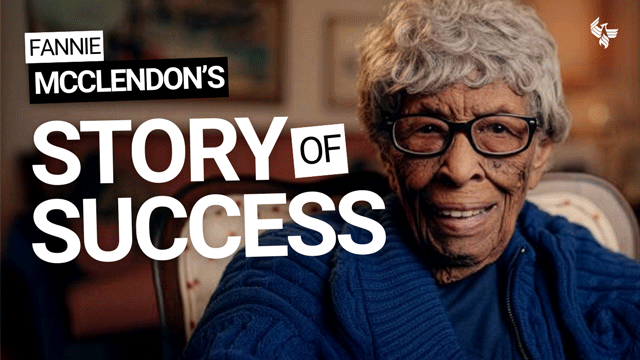
University of Phoenix scholarship namesake Fannie McClendon shares her life story and her decision to join the Army during World War II, and serve with the Six Triple Eight Battalion.

The video was uploaded on 11/20/2025.  
The video lasts for 13 minutes and 17 seconds.

**Key Moments**  
00:00 - Introduction to Fannie McClendon  
00:32 - Early Life and Family Background  
02:25 - Impact of Pearl Harbor and Military Service  
05:04 - Training and Experiences in the Army  
08:37 - Life During and After the War  
09:39 - Reflections on a Life Well-Lived

```html
<script type="application/ld+json">{
  "@context": "http://schema.org",
  "@type": "VideoObject",
  "name": "Alumni Mini Documentary with Fannie McClendon - The 6888th Postal Battalion",
  "description": "University of Phoenix scholarship namesake Fannie McClendon shares her life story and her decision to join the Army during World War II, and serving with the Six Triple Eight Batallion.",
  "thumbnailUrl": "https://www.phoenix.edu/content/dam/edu/videos/img/stories-of-success-podcast-uopx-fannie-mcclendon-low-res.png",
  "uploadDate": "2025-11-20T03:00:05-08:00",
  "duration": "PT13M17S",
  "embedUrl": "https://www.youtube.com/embed/Rvlqcj0QRdA",
  "interactionCount": "9",
  "potentialAction": {
    "@type": "SeekToAction",
    "target": "https://www.youtube.com/watch?v=Rvlqcj0QRdA&t={seek_to_second_number",
    "startOffset-input": "required name=seek_to_second_number"
  },
  "hasPart": [
    {
      "@type": "Clip",
      "@id": "#videoclip1",
      "name": "Introduction to Fannie McClendon",
      "startOffset": 0,
      "endOffset": 32,
      "url": "https://www.youtube.com/watch?v=Rvlqcj0QRdA&t=0s"
    },
    {
      "@type": "Clip",
      "@id": "#videoclip2",
      "name": "Early Life and Family Background",
      "startOffset": 32,
      "endOffset": 145,
      "url": "https://www.youtube.com/watch?v=Rvlqcj0QRdA&t=32s"
    },
    {
      "@type": "Clip",
      "@id": "#videoclip3",
      "name": "Impact of Pearl Harbor and Military Service",
      "startOffset": 145,
      "endOffset": 304,
      "url": "https://www.youtube.com/watch?v=Rvlqcj0QRdA&t=145s"
    },
    {
      "@type": "Clip",
      "@id": "#videoclip4",
      "name": "Training and Experiences in the Army",
      "startOffset": 304,
      "endOffset": 517,
      "url": "https://www.youtube.com/watch?v=Rvlqcj0QRdA&t=304s"
    },
    {
      "@type": "Clip",
      "@id": "#videoclip5",
      "name": "Life During and After the War",
      "startOffset": 517,
      "endOffset": 579,
      "url": "https://www.youtube.com/watch?v=Rvlqcj0QRdA&t=517s"
    },
    {
      "@type": "Clip",
      "@id": "#videoclip6",
      "name": "Reflections on a Life Well-Lived",
      "startOffset": 579,
      "endOffset": 797,
      "url": "https://www.youtube.com/watch?v=Rvlqcj0QRdA&t=579s"
    }
  ]
}</script>
```

```html
<script type="application/ld+json">{
  "@context": "https://schema.org",
  "@type": "WebPage",
  "name": "Alumni Mini Documentary with Fannie McClendon - The 6888th Postal Battalion”,
  "url": "https://www.phoenix.edu/videos/alumni/alumni-mini-documentary-with-fannie-mcclendon-the-six-triple-eight-postal-battalion.html",
  "description": "University of Phoenix scholarship namesake Fannie McClendon shares her life story and her decision to join the Army during World War II, and serving with the Six Triple Eight Batallion.",
  "image": "https://www.phoenix.edu/content/dam/edu/videos/img/stories-of-success-podcast-uopx-fannie-mcclendon-low-res.png",
  "datePublished": "2026-06-05T03:00:05-08:00",
  "publisher": {
    "@type": "Organization",
    "name": "University of Phoenix",
    "url": "https://www.phoenix.edu"
  }
}</script>
```