Skip to Main Content Skip to bottom Skip to Chat, Email, Text

Degrees of Success™ Alumni Podcast Episode 40 – Jenica Lindquist

Entrepreneurship and student success
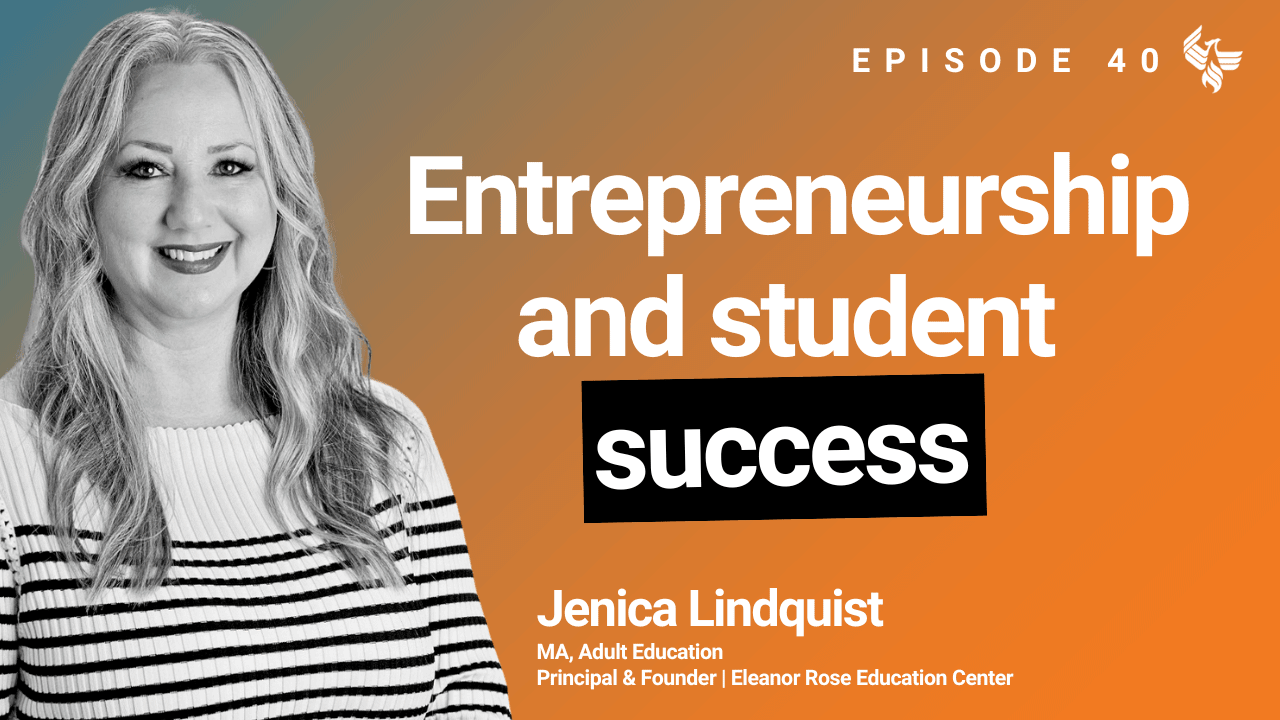
Entrepreneurship and Student Success | Jenica Lindquist


Chapter 1: Entrepreneurship Advice and Mindset 0:00 As you think about those interactions with those other Luminaries, what sort of advice would you give them if they were to approach you with questions about entrepreneurship? 0:08 You have to be fiercely independent. You have to, you know, when you find something that you're really passionate about, cannot give up your tenacity, you know, be tenacious in your approach to what you're doing. 0:21 I talk to people that have these wonderful ideas or these great exit strategies, so to speak, but they just don't have a follow through. 0:29 They don't have a plan and they certainly aren't willing to be tenacious. And I think that's something that's really lacking. 0:36 Right now, overall, I think your approach has to be relentless. You can never give up. Chapter 2: Welcome to Degrees of Success 0:54 Welcome back to the Degrees of Success podcast. I'm your host, Keith Chandler. 0:58 Today's guest is an educator, entrepreneur, and recognized leader who has spent more than two decades rethinking how education can better serve students. 1:06 Jenica Lindquist is the founder and principal of Eleanor Rose Education Center and also the owner and lead educator of My ELL program, LLC. 1:16 She brings over 21 years of experience in education, having taught students across the globe from Japan, Taiwan and the United Arab Emirates to classrooms throughout the United States. 1:27 Jenica is also a University of Phoenix Luminary in the category of entrepreneurship, recognized for building innovative student centered learning models that challenge traditional approaches to education. 1:38 Her work centers on inclusive, experiential learning, language development and creating environments where students of all abilities can grow in confidence and connection. 1:48 Today we are going to explore her journey, her entrepreneurial path in education, and what success looks like when learning is designed with purpose. 1:57 Let's dive in. Jenica, welcome to degrees of success. Thank you so much for having me. It's such an honor to be here. 2:03 uh It sounds so funny when you name off all those accolades. It's like, ah you know, but it's really, it's an honor to be here. 2:13 I feel very honored. It's an honor to speak with you. 2:21 That sounds like a little bit of imposter syndrome coming in too. You have an impressive resume and we're gonna explore the entire thing. 2:28 um One thing I'd like to talk about before we take a deep dive into your experience and your journey with education. Chapter 3: Autism Gala and Community Impact 2:34 I know recently you were actually a guest at an event, a gala in Las Vegas. It was called the Grant a Gift Autism Foundation Gala. 2:43 um I'm kind of curious as a fellow event enthusiast, 2:48 How did it feel being on the field at Allegiant Stadium, kind of surrounded by that community of supporters, looking to achieve meaningful success and meaningful improvement for the lives of neurodivergent families and communities? 3:05 Yeah, was actually, that's the second event that I've attended out there in Las Vegas. So it wasn't the first, I kind of knew what to expect because I had been to one last year. 3:15 uh But this one was really unique because it was specifically for students with autism. 3:22 So the previous one that I had attended was for a Gigi's Playhouse and that organization, uh really focuses on children with Down syndrome. 3:35 So it was kind of neat to compare the two different approaches to what those organizations do and how they put those gala events together. 3:45 Fortunately for this one, we were invited by one of our founding families. 3:51 They are actually big donors for the grant to gift. uh she was one of the first parents that approached me. 3:59 She just found us online through Google search. 4:03 She was one of the first parents that approached me last year and uh we've had her son, you know, since day one, since the doors opened and it's so spectacular to see his growth 4:14 and to be so well connected with that family and to be able to branch out and meet, you know, other people in the organization, the Ackerman Center. 4:24 I was able to meet, you know, the doctors that work there and some of the other RBT's that work there. 4:30 It was just, it was, really, really a fantastic event. beautiful. 4:35 ah So now let's kind of get into the the nuts and bolts of why we're here today and talk about your journey to where you are today. Chapter 4: Early Education and Career Shift 4:42 I like to go back in time a little bit and kind of chat about uh what our alumni's relationship is or was with education whenever they were growing up. 4:52 ah Obviously you have a degree from University of Phoenix, you have a bachelor's degree in polysci from Cal State Fullerton, but going back even further than that, thinking about 5:03 your your elementary middle school, high school self. What was your relationship like with education when you were young and how has that changed as you kind of grew up? 5:12 Yeah, so that's an interesting question. When I was a young girl, I used to love playing school. 5:18 I think a lot of kids like doing that, but I was the bossy cousin and I had to be the teacher and all my other cousins had to sit in their little desks with their papers and pencils and listen to everything I said. 5:30 It was nice that they entertained me and humored me. 5:34 But I think that was kind of like uh my first uh dip into education, honestly, is just playing that as a young girl over and over again with all my cousins and my siblings. 5:46 uh But if you fast forward to college, when I started at Cal State Fullerton, I actually wanted to go into law. 5:55 I was taking pre-law classes and I thought one day I would be an attorney. And I quickly learned that for me personally, it was a personal choice. 6:04 I wanted to get married and have kids young. So I felt like I couldn't do both. 6:08 And I wanted to choose a career path that allowed me to be more intentional domestically and at home. 6:14 So that's when I diverted and I changed my focus from, that's why I have a degree in poli sci. I changed it and I thought, okay, I'm going to focus on education. 6:23 I think that's more suitable for my lifestyle. And I'm really happy that I did because look where I am now. 6:29 Like had I not made that shift in that decision, I wouldn't have had the opportunity to build my own school. 6:36 It's really been a very fabulous transition for me. That's amazing. um We'll talk more about that school that you're building here in just a few moments as well. 6:44 um So whenever you left uh Cal State Fullerton, you started substitute teaching and then went on to take this kind of big international journey to teach internationally. Chapter 5: Teaching Internationally and Career Direction 6:54 You taught in Japan, Taiwan, United Arab Emirates. What was the appeal to going international with your skill set? 7:02 You know, honestly, was sort of like, kind of started off, well, I've always had this fascination with Japanese culture. That's one thing uh from a young age. 7:12 And when I did my substitute teaching work for three years in California, I taught in several different school districts in California. 7:20 I'm originally from Southern California. 7:22 I became sort of, uh I guess the word would be disheartened when I worked in the public education system there to be you know, brutally honest. 7:33 I saw a lot of things that, you know, were upsetting or I thought, you know, can I really do this? Is this what I want to do with my life? 7:41 So I had those three years. I had that experience. 7:44 I learned a lot, but I kind of wanted to regroup and think I took some time off to stay home, experience motherhood, you know, focus on my life at home. 7:54 But then when that was coming to an end or I was feeling that itch, okay, I need to get back out there. I need to enter the workforce again. 8:02 I thought, but what do I want to do? Do I want to go back to teaching at the public schools in California or do I want to try something different? 8:09 And that's kind of how the idea came of teaching overseas. And when I introduced the idea for Japan, uh I told my family, hey, what do you guys think about the idea of me going and teaching overseas in Japan? 8:20 And they all thought it was crazy. They're like, you're never going to do that. You're not going to do that. And I'm the kind of person, because I'm fiercely independent, like if people tell me that, then that's exactly what I want to do, because they think I can't do it. 8:31 So that's how it happened. And I really got the job by chance. 8:36 I was so lucky, because Japan is actually kind of a hard market to break into as a teacher if you don't have any experience. 8:43 And I just happened to meet the right person. I applied for several different schools in Japan. 8:51 and I was fortunate enough to hear back from one, it was a private school, and the interview went well, and they thought, okay, we're gonna take a chance with you and come on out. 8:59 If you're serious, we're gonna offer you a contract. And I was just beside myself. I didn't think I would really get it, and I did, and I just, I did it. 9:07 it was probably one of the most terrifying things I've ever done in my life, honestly. I was terrified to go move to another country. 9:15 I took my daughter with me. So at the time, it was just myself. and my nine-year-old daughter, and I thought, okay, we're gonna go do this. 9:23 And like I said, a lot of people thought I was crazy, but I did it, and it brought me to where I am now, so. 9:30 Wow, that's a very, very bold move to go from the United States all the way over to Japan. Chapter 6: Education Systems and Cultural Differences 9:36 When it comes to just like comparing the education systems of the United States and Japan, what was some of the kind of culture shock that you experienced whenever you initially went there? 9:47 my gosh, there were so many. I think Japan is probably the one country that I've been to where it really feels like it's the most unlike the United States. 9:56 So these other countries that I've traveled to and lived in, there's a lot of similarities or not a lot. 10:02 There are some similarities to the US culture, but in Japan, don't, it's hard to name any really similarities with the US culture. 10:11 They're very different over there. uh It's a very homogeneous society for one. So that was like the first noticeable difference. Everyone looks the same. 10:19 Everyone is alike. uh They're just so well organized and clean. 10:28 uh Their society in general is extremely clean compared to the United States. 10:32 But as far as the education system specifically, I was able to really see some meaningful differences because my daughter went to school there. 10:41 So I was working at a private school and then I put my daughter in the public school. And of course, everybody there only spoke Japanese. 10:49 So she was the first, you know, international student to even come to that public school at the time. This was back in 2009. 10:59 So the school was just kind of like, what are we going to do with them? 11:02 You know, but it was fantastic because we got to all figure it out together and she became like a really big hit at the school. 11:10 Everybody loved her and all the kids wanted to learn English from her. And she got to see how the Japanese school system works, which is very different than ours. 11:20 Some of the things that are noticeably different are the fact that, well, at the time, and I don't know if this is still true, but one thing is they don't have any standardized testing before the age of 10 in Japan compared to the US. 11:32 And another thing is they don't have custodians. There's no such thing as custodians at the schools because the kids clean the schools. So I thought, my gosh, this is amazing. 11:41 This is exactly what she needs to really learn how to, you know, take care and honor, you know, your classroom, your teacher. 11:50 They're very respectful to the teachers. Everybody is called sensei. Even they called me sensei, even on the street when they see me. 11:57 So it's just a really different kind of, uh, my goodness, not just culture, but it's a different approach to education in general. 12:07 uh One of the really cool anecdotal stories I remember was when she was taking her science class there and this was, was in fourth grade and she came home and she was so excited. 12:20 She's like, we're building robots at school. It's so amazing. It's so fun. And I thought, what are we doing in fourth grade here in the US? 12:26 at the time, you know, I think that our education system has evolved and I have a lot of wonderful things to say about our education system. 12:33 But it was like this is 15 years ago, you know, and they were just so advanced in the classroom with these kids. It was incredible. Chapter 7: Learning Japanese and Adapting Abroad 12:41 I'm kind curious when you went overseas to Japan, did you have any experience with the Japanese language or like how much language did you have to learn? 12:49 Just a little bit because actually, the situation that I was in, my ex was Japanese or is still Japanese. 12:58 So at the time I was already introduced to that culture. So I kind of had some insights being married to him. My children were half Japanese. 13:06 So it was kind of like there was a connection there, uh fascination with the culture. I learned a lot from him, from my ex-mother-in-law. 13:15 And so... I sort of felt like I was a little bit more familiar with going in there. But of course, it's still vastly different. 13:23 If you're American, being born and raised in Southern California, and you really don't have a lot of experience with the language or the culture, it really is like being baptism by fire. 13:34 You're just thrown in there and you're like, my gosh, what do I do? But as soon as I got there, uh I met some colleagues and coworkers. 13:44 They were wonderful. They started teaching me Japanese. So I started learning like just small phrases. I'm by no means like fluent in Japanese. 13:51 My daughter speaks much better than I do and she can write as well. 13:55 But like for me, I just kind of got by with the basics, just the very basics of communication, understanding how to say, I'm sorry, excuse me, know, things like that. 14:05 But yeah, so it was truly a learning experience, that's for sure. Chapter 8: Returning to the United States and Career Reset 14:10 So after these experiences internationally in Japan, Taiwan, United Arab Emirates, what brought you back to the United States and to our education system? 14:19 In 2015, I went to Dubai and then I took a teaching contract there. And I was there for four years. 14:26 I was there from 2015 to 2019. And towards the end of that contract, well, honestly, it's kind of like a personal shift in my life. 14:35 I had just gone through my divorce and I thought, okay, my kids were older. They had both graduated from high school. I had my children young. 14:42 So it was sort of like starting my life over and thinking, okay, Truly, was like, well, okay, what state do I want to live in? I could go anywhere now. 14:50 I could land myself in any state I want, which was a bizarre kind of approach. 14:55 But my family being from Southern California mostly, they had also already branched out to different states. 15:01 So I had one sibling in LA, I had another sibling in Seattle, another one was in Tennessee. And then my parents had decided to retire in Nashville, Tennessee. 15:12 So there was a lot of different options that I could go with. uh But I ended up in Phoenix because I had applied for only one teaching position and it was the only one I wanted. 15:23 And it was a school called Academies of Math and Science. And I was just so impressed with our marketing online. And uh I thought, you know, this is really where I want to go. 15:32 I want to go and teach at this school. This sounds really fascinating. And I love teaching math and science. So it was really a perfect fit. 15:41 And I had so much training out in Dubai with uh like uh science and science Olympiad and you know, the background of that, of STEM. 15:50 So I thought, let me just go to a school that specializes in that and I can really hone in on the things that I love to teach and learn more. 15:58 uh They offered all these wonderful professional development trainings and things like that. So I thought, okay, that's the perfect fit for me. 16:06 So that's truly how I ended up in Phoenix. It was just by chance, I found the perfect job. And I ended up here. I didn't know anyone. 16:13 I had two friends that had graduated high school with and they ended up here because they went to ASU. So I knew two people from high school and that was it. 16:22 I had no family out here and I ended up starting over. You have that bravery to kind of reinvent yourself a little bit, I've discovered. 16:30 That's a good trait to have, absolutely. I admire that feeling of adventure, to move to basically a brand new place where you don't have a of connections. 16:39 But you've built a lot of connections here. we'll talk more about those connections as we move along as well. 16:45 uh You talked a little bit about your interest in teaching in the STEM environment, uh now sometimes called STEAM environment, because I think they added an A to it, right? 16:56 uh So what's your appeal um to teaching in the STEM environment and why kind of the K through the elementary level? Chapter 9: Passion for STEM and Early Education 17:05 So, uh well, with STEM, I just love science. When you teach science, it's so different than the other subjects because it's so project-based. 17:16 So you take a science standard and you can break that down. You can unpack the standard and then you can just roll with it. You can really do anything you want. 17:24 To me, there's so much autonomy as a teacher with science. That is not true with the other subjects. With the other subjects, it's very... 17:33 curriculum-based, standards-based, and you can't veer off too much when you're teaching math or ELA. 17:40 But with science, it's just kind of like a world of possibility opens up and you can really do anything you want. 17:47 You could teach prisms or you could teach them how to create a butterfly or teach the life cycle. There's just so many options that you can do with that. 17:56 And science also is so easy to use cross-curriculum. 17:59 So if you're teaching a lesson on the life cycle, you can also teach your kids, okay, let's create a storyboard about the butterfly and how the life cycle is created. 18:08 There's so many things you can do. You can really venture out. So that's my passion for STEM. 18:15 As far as K through six, I honestly, um when I first started teaching, I really wanted to focus on the older grades, like junior high and high school. 18:25 And when I started teaching overseas, I even got trained in teaching adults. I got a lot of experience with teaching adults and I loved it. 18:32 But when I went to teach in Dubai, they hired me under the pretext that I would be teaching older kids. 18:41 And when I got there, they're like, just kidding. We need a first grade teacher. And so I thought, oh my God, what am I going to do with them? You know, I've never taught first grade before. 18:50 So I did. And the first year after a lot of crying and tears and horrible moments as a teacher, which a lot of teachers go through, I realized, I really love this. 19:00 This is great. Because these kids, unlike the older kids, they're still very impressionable. 19:07 You still have a lot of room to help shape and mold and nurture their growth. And I found that very appealing. 19:14 So that's when I started really generating a love for teaching the younger grades. And then the year after that, they said, hey, you did great in first grade. 19:24 Now we want you to teach kindergarten. I thought, no way I can't do kindergarten, which is so hard, by the way. 19:28 think that kindergarten teachers out of all teachers anywhere should be paid the most and given the most vacation holiday breaks. 19:36 It's such a hard job. But so yeah, so that's how I generated a passion for the K through six. 19:42 And I thought whenever I start my own school, I definitely want to start with the lower grades because that's the critical 19:50 timeframe that you are really helping to shape and mold their cognitive thinking skills, their behaviors in the classroom, their uh belief system about the education in general. 20:04 So I've just gravitated towards the K through six for those reasons. Yeah. Chapter 10: Pursuing a Master’s Degree in Education 20:10 And you also touched really briefly on you originally had the expectation of teaching more adult learners or learners in the higher education level. 20:19 um You have your master's degree from University of Phoenix in adult education training. 20:25 um Was that the appeal to pursue that master's degree originally or what kind of motivated you to pursue a master's degree? 20:33 Well, I really thought I was going to be teaching adults. thought, okay, maybe I'll end up teaching at the college level, teaching university courses. 20:41 So that was the appeal. I knew I wanted to stay in education. I loved education, but because I was sort of dabbling in different areas of education, I still hadn't quite found my niche. 20:53 uh It became experimental, I guess you could say. 20:59 Sometimes in our career paths, we end up in places that we don't expect to end up. But sometimes it's truly a blessing in disguise because we realize, my gosh, I would never have chosen this for myself. 21:10 But because I'm now here, I realized that I'm really good at it. And the kids are very responsive to me. So I think I'll try this on for a while. 21:18 So you've discovered your passion for this K through six elementary uh education space. 21:27 And one of the uh ventures that you have is the My ELL program, LLC, that supports children through enriching seasonal camp programs that combine educational growth with exciting, inclusive activities. 21:41 What was your motivation for starting that organization? So that also kind of was happenstance, honestly. Chapter 11: Building My ELL Program 21:49 I was teaching in Japan at the time and in Japan there are a lot of uh side hustles that you can create as a teacher because there are so many students in Japan that want to learn English. 22:04 So I was getting approached, you I'm teaching at a school and I have a full-time job, but I was getting approached like right and left just by word of mouth, just by talking to people. 22:13 Hey, do you offer private lessons on the side? I'd really like to get my daughter involved or I have a brother that has to learn English for his, you know, uh corporation. 22:22 So there was a lot of opportunity for that. And I just started doing it on the weekends. You know, I started making extra money on the weekends. 22:29 It was really easy and they were willing to pay you quite a bit. And I uh built up a student list of uh people that I was connecting with on the weekends. 22:41 And then when my contract was coming to an end, and I knew I was going to move back to the States, I thought, you know, I could probably continue this and just continue teaching them online. 22:50 So I asked my students, my current students, hey, when I move back to the US, would you still like to be my student? And we could just, you know, uh do the lessons online. 22:59 And they were open to it. And that's really how my ELL started. I came back home and I already had a list of students. 23:05 And then that spawned into uh other companies contacting me that approached me and said, hey, we see that you're doing online teaching. 23:15 How would you feel about doing a summer program with our students from China? So it just kind of snowballed from there. 23:22 And it really honestly was one of those situations where I did not pursue it myself. It sort of came to me and I ran with it. 23:31 That's beautiful. So I'd like to talk a little bit about your entrepreneurial spirit. Chapter 12: Starting Eleanor Rose Education Center 23:36 So another of your primary roles right now is the principal and founder of Eleanor Rose Education Center. 23:44 This year in 2025, as we're speaking, you opened a new school in Scottsdale, Arizona. There's one in Las Vegas, Nevada. 23:52 It's a K through six school serving gifted neurodivergent and special needs students. 23:57 But before we talk a little bit more about Eleanor Rose Education Center, I'm kind of curious about what was the spark of entrepreneurial spirit that you had within you to pursue this endeavor. 24:09 So, you know, that's kind of a funny question for me because when people ask me, you you have such an entrepreneurial spirit, I really don't see myself that way. 24:20 I think that there are certain people that know they want to be an entrepreneur and they know that they're very independent, their thought process, and they know that they don't want to be part of a bigger company or organization. 24:33 But for me, I'm not really wired like that. I like to be a part of a community and an organization. And even one that already exists is fine with me. 24:41 But I'm also the type of person that through my years of working as a teacher, because I've been a teacher for 21 years, I see a lot of uh gaps and a lot of holes in the system. 24:53 And I'm the kind of person that likes to fix that or fill those things in. 24:58 it's really hard for me to stand on the sidelines and think, huh, you know, they really could be doing this a lot better if they did it like this. 25:04 And so that kind of turned into or transitioned to me becoming an entrepreneur. 25:11 It sort of felt like a, I don't want to say an obligation, but I felt like I had to, I felt like I had to, it was like a burden for me to start this school because I thought, you know, these kids are there. 25:27 Needs are not being addressed in our current public school system and somebody needs to address their needs. So who better to do it than someone like me who has the experience. 25:36 I see what's missing. I can fix it, so to speak. And that's kind of how it happened. 25:42 It really wasn't a point where I thought as a young kid or even, you know, as a young adult, I want to have my own business and I want to be an entrepreneur. To be honest, it's hard. 25:51 So it's not something that I would... recommend to my friends and family, hey, be an entrepreneur. It's not fun. 25:59 It's a lot of work. It's grueling. uh But I'm happy that I'm doing it because I know that I'm really changing these children's lives. 26:10 I see it every day. Their parents are ecstatic to be with us, and I wouldn't change it for anything. Chapter 13: The Reality of Entrepreneurship 26:17 It takes a large amount of passion to get behind entrepreneurship to your point. 26:22 ah There's that certain level of motivation of knowing that you're working towards a cause, whether it's a cause that's external or internal to you. 26:29 And I think you've truly discovered that. So tell us a little bit more about Eleanor Rose Education Center and how you support students. 26:37 Yeah, so our centers are, you they're very small micro schools right now. So we only have a few students. 26:45 I think the two things that really set us apart from what you see at the public schools, charter schools, or even other private schools are two components. 26:54 And one is our individualized lesson plans. So for us, we take each student individually and see what their needs are and create lesson plans specifically for that. 27:06 one student. So in typical classrooms, you'll see a lesson plan m and the lesson plan is created for all 30 students. 27:14 And there's a little bit of differentiation there and that's good. 27:18 But if you have a classroom of 30 students and you have five students that have an IEP, it's really not possible for one human being to be able to provide the needs for each of 27:30 those students with those IEPs, not to mention the other 25 kids that still need to be taught. It's really an impossible task. 27:38 So what we offer is, you know, an individualized lesson plan where we can truly address that child's need, that individual child's needs. 27:46 The second component I think that really makes us different that we are very prideful of is our relationship with our parents and our community. Chapter 14: Parent and Community Involvement 27:56 So in the United States, we tend to have this idea that administration or teachers are on this side of the fence and then parents 28:04 are on that side of the fence and you stay over there and you do what you're told and then we'll stay over here and we're the professionals. 28:11 And I learned by teaching overseas that is not how the rest of the world operates. 28:16 And many other countries take a much different approach to that and they have a very strong connection with their parents and their communities so that they can assist the child's development in the classroom as well. 28:28 So uh through very painful... uh process of learning that, like I said, it's kind of like baptism by fire. 28:37 In Dubai, I was thrown into a classroom that had this big window where the parents could come and just watch you teach all day long. 28:46 uh it was wow, and they did something similar in Japan, to be honest. So I thought, okay, I'm going to have to get used to this really fast in order to, you know, up my game. 28:57 And I did. And I hated it at first. I hated having that transparency where, you know, the teacher was just basically there for everyone to view. 29:07 And, you know, I thought, my gosh, they're going to see all my mistakes. And what if I say something wrong? But you got you get used to it. 29:13 And I realized, OK, this is actually a good thing, because now you have a relationship with the parents and you can teach a lesson at school and then you can regroup with the parents and say, hey, this is how I taught it. 29:25 Here's my lesson plan. please try to reinforce this at home. Your child is really struggling with reading or your child is really struggling with subtraction. 29:34 This is what you can do with that child at home. In the US, we really don't do that. We really don't do that at all. 29:40 So I think those are the two things that really set our framework apart from the other systems. 29:47 Eleanor Rose Education Center has a podcast. And by the time this episode is released, your podcast will have launched as well. um IEP, Inc. Chapter 15: Lessons from Global Education Systems 29:56 podcast. Tell us a little bit about your journey with that podcast so far and what that podcast is about. Yeah, so I'm really excited about this project. 30:04 It's been really fun to uh film these podcasts. 30:09 Really the intention of it is to provide a platform for both parents and students to listen in and to maybe learn a little bit of, you know, kind of behind the scenes, what's 30:22 going on with Eleanor Rose, and also just like tidbits of information on things that we can be doing better to help our students with special needs and gifted students. 30:33 You are a luminary in the category of entrepreneurship with University of Phoenix. 30:38 The Luminary program highlights some of the brightest examples of how University of Phoenix education is igniting lasting impact in the community. 30:47 So I'm kind of curious, what does it mean to you to be named part of our inaugural class of 76 alumni who are kind of shining the light on future innovation? 30:57 my gosh, it's such an honor. I was so excited when I got that email and that notice. I love, like I said, being a part of bigger organizations. Chapter 16: University of Phoenix Luminary Recognition 31:06 I love when things have already been put together. 31:12 University of Phoenix, think, is amazing. I've really enjoyed my education there and getting my master's. 31:20 I thought it was a wonderful experience. So what a great way to really honor that and be a part of something bigger than myself. 31:27 uh The only thing I can say is it's such an honor to be a part of that. I love being a part of that. 31:34 I hope that uh there can be more that comes from this, more that evolves from this. I would really like to meet some of the other luminaries. 31:42 I would love to go to any events that they host for that. I think it's spectacular, but it's just great. 31:48 Jenica Linquist is the founder and principal of Eleanor Rose Education Center and also owner and lead educator at MyELLLprogram LLC. 31:56 You can also check her out on the podcast IEP Inc. Jenica, thank you so much for joining Degrees of Success. 32:04 Yes, thank you so much. appreciate everything, Keith. It's been a pleasure.

Jenica Lindquist shares her journey from teaching in the United States to working internationally in Japan, Taiwan, and the United Arab Emirates.

The video was uploaded on 5/21/2026.
The video lasts for 32 minutes and 21 seconds.

Key Moments
00:00 Entrepreneurship Advice and Mindset
00:54 Welcome to Degrees of Success
02:34 Autism Gala and Community Impact
04:42 Early Education and Career Shift
06:54 Teaching Internationally and Career Direction
09:36 Education Systems and Cultural Differences
12:41 Learning Japanese and Adapting Abroad
14:10 Returning to the United States and Career Reset
17:05 Passion for STEM and Early Education
20:10 Pursuing a Master’s Degree in Education