Skip to Main Content Skip to bottom Skip to Chat, Email, Text

Degrees of Success™ Alumni Podcast - University of Phoenix Commencement 2026

Dr. Paul White, Graduating With a Doctor of Business Administration in 2026
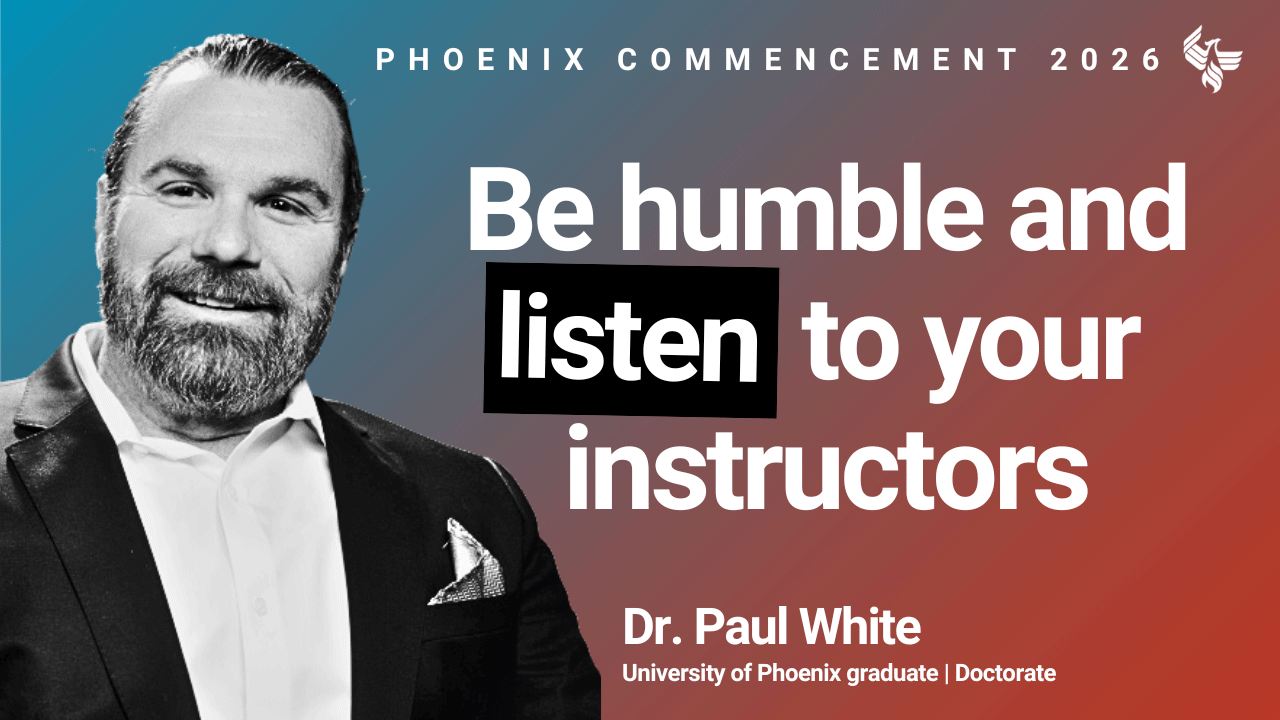
2026 Commencement - Doctor of Business Administration: Dr. Paul White


Chapter 1: Introduction and Dr. White’s background 0:00 The more I delved into the DBA, the Doctor of Business Administration, it showed me how much I didn't know. 0:08 I think that's the interesting thing. So at some point you graduate and you're a doctor and such, but there's so much more to learn. 0:17 And one of the things I love is this idea of lifelong learning. 0:21 Not just stopping when you get your degree or when you graduate, but saying, no, I'm gonna keep that childlike wonder of the world. 0:30 alive in me, burning inside me, and I'm going to continue to learn and grow throughout my life, however long that may be. 0:37 So I think that's just so important. 0:40 you Hello and welcome to the Degrees of Success podcast. 0:54 I'm your host, Stephen Paskel and we're here in Phoenix at the 2026 commencement. And we have a doctor with us today. 1:04 I'm so excited. This is an exciting day for you. Could you introduce yourself to everybody? Yes, my name is Paul, Dr. Paul, David White III. Chapter 2: Journey from mortgage industry to higher education 1:13 I don't know why they kept going with that, uh but very excited to be here, very excited to be able to interview with you. 1:21 uh obviously, this is commencement ceremony today, so I'm very excited about that. So I know you're humble, Dr. White, but I'm gonna call you Dr. 1:30 White if that's okay. Because you have earned it and it's been a journey getting here, hasn't it? It has, it's quite a journey, professionally and personally, absolutely. 1:38 So I want to get into that, but first tell us a little bit about you. Tell us about what's got you to this day, your background, anything you want to share. 1:45 Oh yeah, it's interesting because sometimes where we start out is not where we end up, right? You know, and so I start out in a very different industry. 1:52 I started out in mortgages years ago and you know, obviously there were some changes with that, you know, in the economy and such. 2:01 And so I found myself back in school and uh you know, I ended up finishing my bachelor's and then I thought, you know, I'm going to keep going. 2:08 I'm going to go and I'm going to get my MBA and I got my MBA. And I thought, you know, I think I can go get a doctorate as well. 2:16 now, course, saying that, if I knew how much work was going to go into the doctorate, I might have not done it. 2:24 It was kind of an interesting little surprise. you know, anyway, along the way, you know, I was able to progress professionally. 2:33 I'm a controller for a nonprofit. And so was able to kind of progress, you know, within my career. I was able to. 2:40 give that example to my children as well. I think that's probably one of the most important things I wanted to really show them is that you're never too old to reinvent yourself. 2:52 You're never too set in your ways or old to go back to school and to improve yourself. Chapter 3: The importance of lifelong learning and curiosity 3:00 Let's talk about that a lot because that's our family, right? That's universal. It doesn't matter where you're from, right? Your family is something that's near and dear. 3:08 Yes. Now those lessons you wanted to instill. Take us through, before we get there, take us through that because you just mentioned, like, just got my bachelor's, got my master's. 3:16 let's go back for the doctorate. Yeah. What's along the way? And working full time too, right? Right. Doing that. What gets you there? 3:23 What's that mindset that takes you from, I got the bachelor's, now I need the master's, I haven't had enough? I wanna go for the doctorate. 3:30 You know, I think uh part of it is there's a part of me that believes in perpetual self-improvement. 3:38 And of course, not everyone probably maybe agrees with that, but I think it's something very, very important. It's something that's driven me. 3:46 watching my children grow up, watching them succeed in various things. And then of course, they fail. 3:53 I think one of the most important things in life is to fail and to uh know what that feels like. 4:00 And um we've all, you know, have times where we fall. But what I want to show them is, you know, getting back up is the most important thing that you can do. 4:10 You got to get back up and you have to keep moving. so within, like I said, within my career, my career had stalled a bit, you know, with mortgages and such. 4:17 And so, you know, um you know, of course, I wasn't really on top of a hill. I was more in a valley at that point. 4:24 And I knew that I needed to get on top of that hill. 4:27 And um for me, education you know, was the way to do that. And I wanted to show them that. 4:33 you know, someone told me a long time ago, um if you have a gift, you, you know, if you have, if you have that spark, that intellect, um you know, you have to pursue that. 4:44 You have to go for that and you have to pursue it, you know. And I wanted to show my children that that is something that's possible. 4:52 then, you know, me going back to school, two of my children got their bachelor's degrees at the University of Phoenix. which I was very, very proud of them. 5:00 So, yeah. It's such a powerful thing. You mentioned that thought about failing. Right. Right. Right. 5:08 And I don't know enough, especially those that may be earlier in the career or going on, don't always appreciate that. Just like your educational career, it doesn't sound like everything was linear. 5:17 There were some setbacks. But talk to me a little bit more about that example that it's OK to fail. But what's most important when those setbacks happen? Chapter 4: Embracing failure as a learning experience 5:25 I think recognizing that failure is a learning opportunity. 5:30 I think one of the things I've had to learn and one of the humbling experiences, especially going through my doctorate, uh was that A, it's okay to fail, and B, it's 5:40 necessary sometimes in order to uh be able to see the much bigger picture. 5:46 And so I think that for me, when I saw those things, I tried not to take them personally. I think... 5:53 And life sometimes is hard not to take things personally when your chips are down, you know. ah So I think one of the things I wanted to focus on was, you know, being grateful for everything I did have. 6:04 And then what was in my control? What could I go do? How can I make a difference in my own life and then maybe eventually make a difference in other people's lives around me? 6:12 And of course, those people around me are my children. They're my family members. Right. Life's going to hit you down. There's there's no way to avoid that. 6:20 Life. for all of us is going to get us down sometimes. 6:24 But getting back up and pursuing uh excellence and trying to improve yourself, focusing on what you can control, your controllables, that's huge. 6:36 I wanted to model that for that's outstanding. So often we talk about how for that next generation, right? How do you bridge a gap sometimes? 6:42 Or how do you do that thing that we all want to do is set our kids up better than us. Your example is compelling, right? They could you don't have to tell them words. 6:51 They're seeing the actions. No, you just your doctorate. Yes. 6:56 Like for those of us that may be right thinking about it or maybe it's OK, it took a whole bunch to get an MBA, get the masters. Why would I ever go back for a doctorate? 7:04 Tell me a little bit. What was that journey like? How long was it? What was involved? So for me, it took four years. Chapter 5: The challenges and rewards of pursuing a doctorate 7:11 I've heard some people do it under three. That's crazy. don't know. I've my hats off to them. 7:17 um You know, the journey, uh I'll tell you this. 7:21 When I first started my doctor, when I first decided I made that decision, um it's almost like uh the gates of hell opened up on me. 7:31 And I was put through this refiners buyer kind of uh element. 7:36 um And I think, again, as I stated before, if I knew how much work beforehand was going to go into it, I mean, of course, you know, going from a bachelor's to a master's, there's definitely a leveling up. 7:48 There's definitely a lot more work and such. um But I was astonished at how much work goes into a doctorate. 7:55 And it's I would say it's almost an order of magnitude greater. than what you do in an MBA or a master's. 8:02 And not to take any away from anything, but it's like doing a couple different masters at the same time. And they don't tell you that. 8:09 I mean, to put it in context, for my dissertation, the last two months of my dissertation, um I put about 300 hours. 8:19 300 hours, yeah. There were weeks I was putting 20 or 30 hours a week in making adjustments, grammatical changes. 8:27 um know, content changes and such as I was directed by my chair in my URM. 8:33 So it's astonishing how much work goes into it, you know. I'm always, sometimes people talk about degrees they're like oh not exactly sure. 8:43 Some weeks 30, and again, still working full time. working full time. So you gotta let me know, is it worth it? It is absolutely worth it. 8:50 Much like I'm sure someone who climbs Mount Everest would probably say, you know, it was brutal, it was hard, it was freezing, but it was worth it getting to the top. 8:59 I mean, and I'll be honest, you know, it took me about a month or so for it to really sink in. 9:05 You're in the trenches and you're working your butt off that whole time. And then all of sudden you look up and you're getting ready to do your oral defense. 9:13 And you're like, oh my gosh, I'm here. And then you successfully pass your oral defense and then you're a doctor. 9:22 And it doesn't sink in right away. At least for me, it didn't. It took a little while for me to like, oh, wow, I'm a doctor. And then someone called me doctor. 9:31 I'm like, oh, wow. It was just this kind of surreal experience in many ways. All those hours paying off. Yes. Chapter 6: The significance of humility and listening to mentors 9:38 all those hours and the sacrifices. 9:40 mean, I think again, anyone that goes for a doctoral or again, any education, whether bachelor's, master's, the amount of sacrifices you have to make, you're sacrificing those 9:52 short term wants and such for long term uh opportunities. 9:59 And uh I think that's one of most amazing things is that those weekends, those nights, all that effort you put in that you you know, when you're in the weeds, you can't really see through. 10:10 It starts to make more sense as you start approaching the end. then when you when you finish, I mean, it's it's kind of this exhilarating, unbelievable feeling, you know. 10:19 So, yeah. You've gone that journey, you've gone through the bachelors, you've gone through the master's program, the doctor. What lesson? 10:27 Because there's some that are looking at this that are different stages, right? There may be some that are looking, they've got their masters and they're thinking about whether to go to the next level. 10:36 Some may be just starting their journey or thinking about it. What words of wisdom would you share that you've received along your journey at each way? 10:44 And was all of it, was it traditional four years here, two years there? I'll tell you a funny story. 10:50 So when I transitioned from my, I finished my MBA, you know, I was, was feeling pretty good about myself. You know, I, I graduated with a 4.0. 10:59 I felt very, very good, you know, and I entered the first class of my doctorate and I went in there, maybe a little, made me a little more proud than I should have been. 11:09 Right. And the very first paper I wrote, I failed. I got an F on it. Wow. And so I, I, course I was upset. 11:18 I'm an A student, what's going on? And so I got a hold of my professor and I talked with her and she basically said, this is different. 11:27 This is not an MBA. This is a doctoral level. This is completely different. We do things differently. 11:35 We write differently. It's more scholarly type writing. 11:39 And what occurred to me in that moment and it took me through and it helped guide me through the rest of my doctorate was, Be humble, listen, listen to your instructors. 11:51 They know. And so I did exactly what she told me to do, everything. And my next paper, I got an A on it. 11:59 And it was a learning opportunity. And one of the things I found through the whole doctoral program, and really, think anyone that's starting in a bachelor's, know, master's, is be humble. 12:12 Listen to your instructors. They know what's best. They've been through it. We all have this tendency as humans to think I know better, I'm smarter. 12:21 No, in this capacity when you're going to school and you're in these courses, you have to listen to your instructors. 12:29 And my chair, for example, I had a hard time in the beginning liking him. 12:36 I came to actually really respect him and like him as I started approaching the end because I could see more clearly he had my best interest in my. 12:47 He was giving me tough love and I needed it. There was times where I had to be redirected and he been through the process so many times he knew exactly what I needed to do. 12:59 And so I'm very, very grateful. So I think for all students that are embarking on this journey, be humble. 13:06 Listen to your instructors, be humble. So that's Dr. White telling us to be humble. That's a powerful message in itself and a lesson to your kids. 13:13 One of the interesting things too is uh the more I delved into the DBA, the Doctor of Business Administration, it showed me how much I didn't know. 13:26 I think that's the interesting thing. at some point you graduate and you're a doctor and such, but there's so much more to learn. 13:34 And one of the things I love about UOP is this idea of lifelong learning. Chapter 7: The value of continuous education and curiosity 13:40 not just stopping when you get your degree or when you graduate, but saying, no, I'm going to keep that childlike wonder of the world alive in me, burning inside me, and I'm going to continue to learn and grow throughout my life, however long that may be. 13:56 So I think that's just so important. Wow, that's a powerful message. I'm gonna ask for more. Yeah, yeah. 14:03 So especially for now, as we're wrapping up, and this is a hard one, because you've been through so much. Yeah. 14:08 If there was something you wanted those that are listening in, that are taking this all in, to take away from your journey, your experiences that you think might help them, what might be one or two things you would want to share? Chapter 8: Key lessons for aspiring students 14:18 I think the first thing is also rely upon your social network or your family. 14:24 ah My family, I don't want to understate that they put up with a lot. 14:30 I think anytime you embark on something ah as big as school and you make changes and sacrifices, your family is there all along the way to support you and to deal with your BS sometimes. 14:44 ah So I would say rely on that network. rely on those friends, those family members, um include them in your journey. 14:54 I think that's the other thing, you know, not everybody in your family is going to want to do what you set out to do. 15:01 But it doesn't mean that you can't include them in that process. you know, you know, again, that's beneficial for everybody involved, in my opinion. 15:13 So. Well, that's gold. 15:15 Because sometimes we think about, you're stepping up your game, you've talked about the different reasons doing it along, but when you bring your family along, when you bring others along... 15:23 Well, and it's especially, think, for me, so myself and my siblings, we're the first generation to get degrees, even bachelor degrees and such, you know. 15:31 And one of the things I realized is that, you know, it's not that my parents weren't smart or my grandparents. I mean, they were very intelligent, gifted people in many, many ways. 15:40 But it was all this unrealized potential. And I'm like, I have an opportunity here. 15:48 again, I want to show my children, I want to set that example for my children. But I have family members, parents, grandparents that want to see me do this. 15:59 Maybe it's something that they wanted to do. And I think that's, again, bringing them along in the journey. My victories are their victories. 16:08 I'm not just winning. It's not just me. I had a lot of help along the way and people that were there for me to support me and that they have every right to take part in my success. 16:21 Yeah. Thank you for sharing that. I got to tell you, I'm uh first off, congratulations again. Thank you. 16:27 It's an inspiring story, but your, your expressions motivating me, right? 16:33 I have a couple little boys too, that example that's being shown all along the way that you're helping. And for all those that are watching this now too, they may be on the, and again, I'll give you one, like your last words to them. 16:43 They may be on, they're not, they may decide to go left or right or not exactly sure if they should jump into it. What would you tell them? Chapter 9: Encouragement and final advice for learners 16:50 I tell them that I think one of the most important things in life is consistency. Sometimes we look at hard work. Hard work is important. 16:57 um if you're a, especially if you're a remote learner, if you're an online learner, consistency is the most important thing. 17:06 Develop those habits, develop that discipline, and just keep going, even when you don't feel like going. Make yourself do it. 17:14 Eventually, even when you don't feel like doing it, if you do it enough, you'll like doing it, you'll enjoy doing it, and you become better and better at it. 17:22 And I would say, you know, like any muscle, you have to keep exercising that. But if it's something that you really want, if there's something that you're passionate about, stick with it. 17:33 Don't give up. Just hang in there. It will get better. Well, there you have it. We got Dr. Paul White here laying out this golden lessons for us. 17:42 And I'm sure I speak on behalf of all your fellow UOP alum. Congratulations. Thank you for taking the time to share your journey. 17:50 Thank you for taking the time to inspire us. And thank you for setting a great example for us fellow parents as well. 17:58 I'm Stephen Paskel, and thank you so much for joining us for the 2026 Commencement.

University of Phoenix Doctor of Business Administration graduate Dr. Paul White explains his path from career shifts to earning a doctoral degree.

The video was uploaded on 4/9/2026.
The video lasts for 18 minutes and 16 seconds.

Key Moments
00:00 - Introduction and Dr. White’s background
01:09 - Journey from mortgage industry to higher education
03:00 - The importance of lifelong learning and curiosity
05:25 - Embracing failure as a learning experience
07:09 - The challenges and rewards of pursuing a doctorate
09:36 - The significance of humility and listening to mentors
13:40 - The value of continuous education and curiosity
14:18 - Key lessons for aspiring students
16:50 - Encouragement and final advice for learners