Skip to Main Content Skip to bottom Skip to Chat, Email, Text

Degrees of Success™ Alumni Podcast - University of Phoenix Commencement 2026

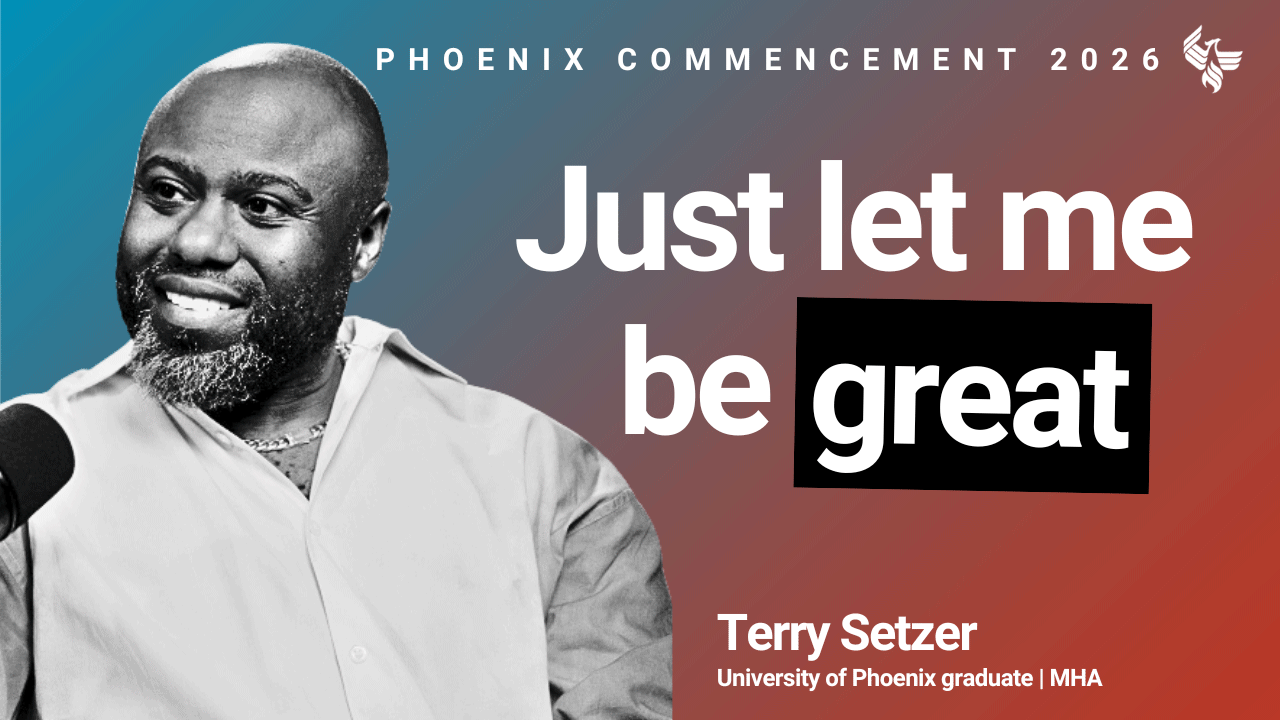
Terry Setzer, Graduating With a Master of Health Administration in 2026
2026 Commencement - Doctor of Business Administration: Terry Setzer


Chapter 1: Introduction 0:00 Today at graduation, they said something that stuck out, right? 0:03 They said that the University of Phoenix was built for or designed for people who you just described, who are in school, who have children, single parents, right? 0:13 And so I would say that if those are your circumstances, right? Working full time, like I was doing as well, if those are the circumstances that you fit in, right? 0:24 This program is built just for that. I love it. I love it. It's built for working professionals trying to go to that next level. You're an example of that. 0:32 Yes. 0:44 Hello and welcome to the Degrees of Success podcast. I'm your host, Stephen Paskel and we're here in Phoenix at the 2026 Commencement. Chapter 2: Terrys Background 0:52 And I'm sitting next to and I'm excited about what we're going to talk about. Terry, could you introduce yourself? Hi, I'm Terry Setzer, um a recent MHA graduate. 1:02 I live in Connecticut now, um and I'm just excited to be here. You just graduated. 1:10 Tell us what your degree is in again. So my degree is a master's of health administration. Health Administration. Correct. 1:17 Okay, so tell, what brought you, well, you know, I want to get into that. I want to get into all what brought you to University of Phoenix even to get that degree. 1:26 Tell us a little bit about your background. So my background is in data, data analytics. 1:32 And I was working at Yale University um and I was covering um some data um infrastructure, some databases for the health school of medicine. 1:45 Was there for a little while, learned healthcare administration from the data standpoint, and then went into being a healthcare administrator for a service line. 1:57 a nice little Ivy League school there. You did all that and then now what brought you to the University of Phoenix for the degree? 2:04 So University of Phoenix, I was looking for a program, a master's program that had a certain accreditation. 2:12 so I said, that's checked one box and the other box that it checked was it had a program that was competency-based that was very similar to my undergrad. 2:26 And so I said, this is another box that it checked. And so that's why I chose this program. So I'm a proud alum myself. 2:33 when you think about health care, right? That's one of, I think about some of the day jobs, some of the things I've done, right? I could always say the worst case, no one's gonna die. 2:41 That's not the case when you're in a career in health care. Correct. Right, so now you worked at Yale and you were looking for a degree program that met certain characteristics and you said the University of Phoenix checked those boxes. 2:53 Correct. 2:54 Now I bring that up because it's funny because when you think about sometimes health care degrees, I don't know if people suddenly think about the University of Phoenix in terms of healthcare, but tell us a little bit about it. 3:03 Was it an easy degree to get? So I believe the program is rigorous. 3:07 um I believe that the program um is, it aligns with day-to-day operations um at Yale um and health care, everyday health care work, um from CPT codes to human resources. 3:22 And so um it aligned very well. um It wasn't just theory, but actual um practice. 3:30 Yeah, and I want you to talk about that some, because I've had the privilege of meeting some other alumni who've gone through the program. 3:37 And when they were telling me the vigor of the program was to get through it. So it's an accomplishment itself just getting through, because there's certain requirements even to get into the program, isn't there? 3:47 So this program, yes, because it's a competency-based program and I was able to get into that program based on that. 3:55 I applied, they checked my credentials, checked my background, and when I got accepted, I was excited because they said, you're in the program and it will be a year program. 4:05 And so was able to accomplish this degree in a year. Wow, based upon your experience and being able to meet the rigorous requirements to get in. 4:13 Correct, in my experience with the healthcare operation. Yeah. So now tell me, because you had a good career, right? Yes. Why did you want more? 4:22 Well, I believe I work with healthcare professionals every day, right? Doctors, MDs, APPs, right? 4:30 Nurses, right? And I believe that we require these people in this health profession to have additional credentials, right? 4:40 And if I'm gonna consider myself a healthcare administrator working in these environments, right? 4:47 I feel that I need to be credentialed in this healthcare field as well. So I had a bachelor's degree. 4:52 said, this next step is um to get credentialed in healthcare administration so I can have my MHA. 5:00 One of the funny things about this, um I was in leadership um in my department and when they put a screen at one of our meetings and had all the different leaders in this 5:12 department, and then I was there, everybody had a comma behind their name, Comma MD, Comma DO, Comma APP. 5:20 I was the only one with no comma. So I said, I cannot be the only one without a comma. I need to have my credentials too. 5:27 So now today I will have, it would say Terry Setzer comma MHA. Yes, it will. Yes, it will. 5:34 So like, tell me, in addition to getting the credential, right, you just outlined some of the reasons for it. It gives you immediate credit. 5:42 You knew the job. Yes. Right. You have some experience, but that credential just sets you, right, it gets you at the table. It gets you in the room where you need to be. 5:49 Correct. What else would you tell me about the experience? So I'm curious to know, right, because there's such a need for medical professionals as a whole. 5:57 And this is such a vigorous degree. What else did you get out of the program personally? 6:02 So personally, um I lead with this brand, I lead with strategic and empathy, right? 6:10 And so one of the courses that we took um had to do with empathy, leading with empathy, and that is part of my brand as a leader within itself. 6:20 And so I really got the theory behind that. So I know what I do every day. I said, let me get the theory behind this. 6:28 And so that is one of the big things I got out of that. when we're leading teams, especially in healthcare, make sure you lead with empathy. 6:36 And so I really, that owned in on that. And you hear that a lot in corporate America too, right? 6:43 It's sort of like a buzz, it can be a buzzword sometimes, but the actual executing, being empathetic, especially in healthcare, right? 6:51 Because that's what it doesn't matter where you're from, how much money you make when you're sick or something, you need something. 6:58 That's at the core and that's where you need that empathetic leadership even more. So it's encouraging to see that as part of it. So now to get to this point today, right? 7:06 uh One of the things, again, It usually takes a village. Correct. So what are some of the people that have helped you along the way to get you this point? 7:16 So I've had friends who have helped me. My mother, she's passed away now, but she was really into education. 7:26 Her belief is people can take anything from you, but they can't take away your education from you. 7:31 And so I've had mentors, and not so much in the healthcare field, but just in general, to say, hey, this is how you lead. 7:43 This is how you... Document things, know things like that. So showing me how to work in corporate America Which is health this where I'm at where I was at. 7:54 It's not corporate so much, but it has a corporate feel right and so Just and people around me. 8:02 I'm most of our friends. 8:03 We try to encourage Each other I have a friend who's here with me today She I was telling her I wanted to get my degree and she said, you know Go for it a year a year comes and 8:15 goes And when you look up, when the years pass, you'll have something that you've obtained. 8:19 uh Like your mom said something that can't be taken away from you. Yeah, exactly. Wow. I love it. 8:25 So now tell me, so, and you mentioned, and you mentioned something interesting because mentors are so important. Mentors, sponsors, especially those that can make things happen going through. 8:34 And you mentioned you've had lots of them, but not very, not many in the health field. Correct. 8:39 So now let me, I'm curious now because right, even though it may not be as known as the University of Phoenix medical programs and the fact that our faculty members or practitioners that have done it. 8:52 Have you seen that sort of changing now going through your program? Have you picked up some more mentors along the way? 8:57 I have, yes I have, because some of the professors in these courses, they are in their field or some of them are retired from the field. 9:07 And so even when I have questions about some of assignments, I talk to them about the assignments, but then they also give me just background about different things that we're working on or different things they've experienced. 9:19 A lot of them are consultants in the field now. So I'm getting those um mentorship, um I would say, 9:27 qualities without them being a mentor, I guess, on paper. Yeah, that's pretty cool. Chapter 3: University of Phoenix 9:35 Now, so again, for our listeners, those that are watching, our fellow University of Phoenix alumni members, some that may be thinking about it, what is the University of Phoenix meant to you? 9:44 Well, I believe that it is uh a community um of, it's a big community, let's say that, right? 9:53 It is. There's so many alums across the US, right? 9:58 I'm gonna lean on some of those individuals, especially like when looking for my next opportunity using LinkedIn, I can see that there's a lot of alums in these healthcare systems, a lot of the places where I'm trying to go. 10:15 Well, I gotta tell you, one of the things I appreciate about, I mean, even this podcast, right, the Degrees of Success, we forget sometimes how big the University of Phoenix family is. 10:25 You think about different institutions and their groups getting together, we do have a large organization, and it's hearing inspirational stories like this that helps remind us of what we've been able to accomplish and what we can. 10:37 So first off, again, before I even said it before, thank you for taking the time to share your story. I'm curious now, what's next for you? You did all this, right? 10:45 You've worked for Ivy League schools before. You've gotten, you're now a doctor. You've gotten the credits to go along with it. 10:52 What's in store for you next? So just to be, I'm not a doctor yet. But that's coming. So you're speaking it into existence. 11:00 uh I'm going ahead, right? You're going convince me. yes. So eventually I would love to obtain my doctorate degree in health administration. 11:11 And that is a goal in the future and that's in the near future, not too far. 11:17 I would love to go to the School of Medicine, the Morehouse School of Medicine. And so that's one of my goals in the future. 11:26 But at the moment, I'm trying to expand my horizons, looking for some new opportunities, looking all over the US. 11:33 to say, you know, where could I um use my skills and my background and my experiences and to lead another team? 11:40 and we talked a little bit before, I see that commitment, you have your plan clear in front of you, and for me it's like you're already there. 11:48 So like the sky's the limit going forward. So now what would you tell us, right? 11:51 Because you've had this journey, you saw the need for it to get the credential to go to that next level, you're already looking ahead, and like you said, the not too distant future of what's next for you. Chapter 4: Final Thoughts 12:02 For those that are on the cusp sometimes, right, life's hard, there's challenges. Many of our listeners, they're working full-time jobs now. 12:10 They're trying to figure out what's next for them. Can they even do this? What would you tell them if they're on the fence about whether or not they might be thinking about continuing their education? 12:19 Well, today at graduation, they said something that stuck out, right? 12:22 They said that the University of Phoenix was built for or designed for people who you just described, who are in school, who have children, single parents, right? 12:32 And so I would say that if those are your circumstances, right, working full time, like I was doing as well, if those are the circumstances that you fit in, right, this program is built just for that, which was... 12:46 m told to us today. So I would reiterate what they said. I love it. 12:54 I love it. It's built for working professionals trying to go to the next level. You're an example of that. Yes. All right. 13:00 And any parting words of wisdom for us after this incredible day, the accomplishment, all the stuff that's on their horizon? 13:07 You know, I used to, and I still do, right? I have this saying and I say, just let me be great, right? 13:16 Just let me be great. And so my parting words for people who are thinking about this, people who are in it now, just be great. 13:25 Just be great. Just be great. Be great in whatever you do. And if you let other people be great, and if you're great, right, you can see the greatness in others. 13:37 Thank you, Terry. Thank you. Well, this discussion was great. And we all want to thank you for taking the time and for being with us. And again, thank you for taking the time for being a part of the Degree Success podcast. 13:46 Just another incredible story that shows what our alumni can do, what they're doing now, what you accomplished today, and what I'm sure you're going to accomplish tomorrow. 13:55 Thank you for joining. Yes. I'm Stephen Paskel. And thank you so much for joining us for the 2026 Commencement.

University of Phoenix Master of Health Administration graduate Terry Setzer shares how he advanced his healthcare career through education.

The video was uploaded on 4/16/2026.
The video lasts for 14 minutes and 14 seconds.

Key Moments
00:00 - Introduction
00:52 - Terry's Background
09:35 - University of Phoenix
12:02 - Final Thoughts