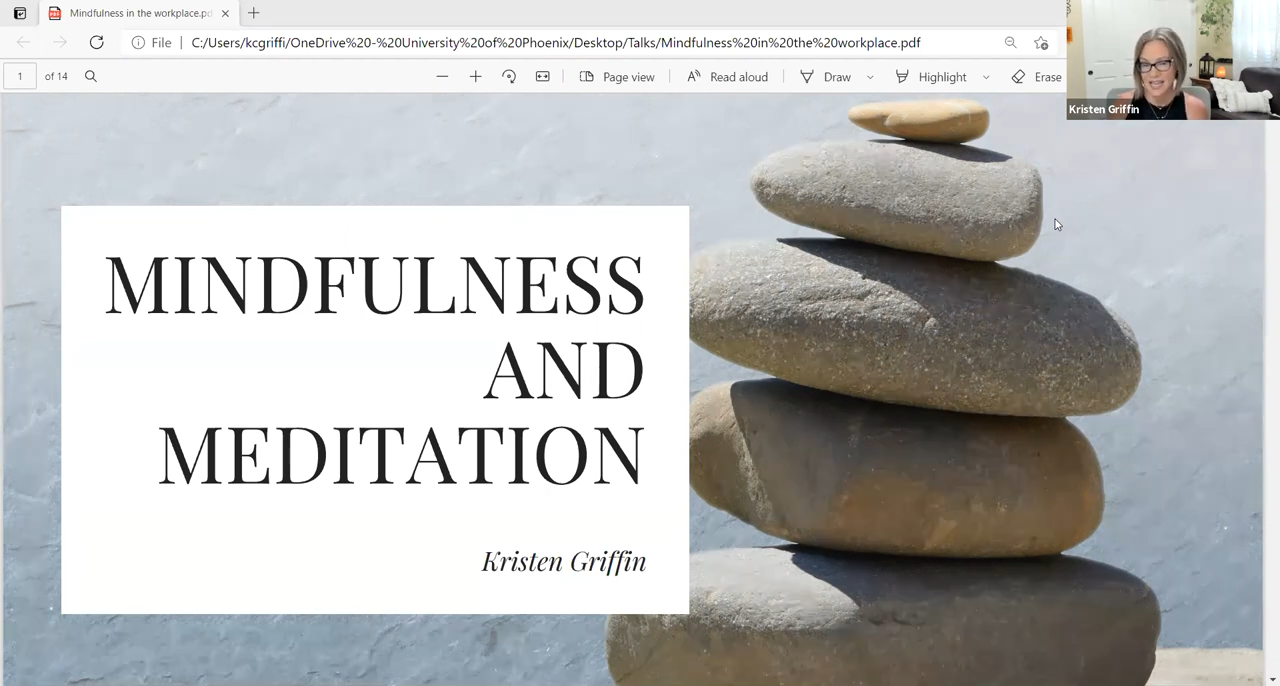
# Mindful Meditation For Nurses

## Mindful Meditation For Nurses

[Embedded content](https://www.youtube.com/embed/39XiR41Nw2k?rel=0&controls=1&fs=0&modestbranding=1&cc_load_policy=1)

×  
00:00 Kristin is the Vice President of Student Services here at University of Phoenix. She is a full-time executive, mom, yoga enthusiast and mindset coach. She has been teaching, coaching and mentoring since 1997. Kristen’s role at the university is to ensure working adults have the services they need to juggle school and life. 00:54 Kristen thanks nurses and those who support nurses for the work they do. She explains that healthcare and wellness roles require a significant amount of energy, and her intention is to provide one small practice that participants can use for themselves and share with others. 01:30 Kristen invites participants to use the chat, share questions and reflect on what brought them to the session. She asks how stress is showing up for them and explains that the session will focus on mindfulness and meditation. 02:12 Kristen explains that the session is for people who have heard of mindfulness, already practice it, or want to learn how it can help in daily life. She describes mindfulness and meditation as tools that may help people reduce stress, lessen anxiety and support overall wellbeing. 03:21 Kristen introduces the difference between mindfulness and meditation and shares context about the growth of meditation practice. She explains that mindfulness and meditation have become more common and that employers have increasingly offered mindfulness training. 04:37 Kristen explains that the session will remove some of the mystery around mindfulness and meditation, cover benefits and challenges, and include a practice. She asks participants to think about where they can be comfortable for the guided portion. 05:04 Kristen explains that reading about inspiration or knowing the benefits of meditation is not the same as practicing it. She says mindfulness and meditation are not about eliminating all stress, but about practicing how to return to a centered place during stress and life’s demands. 06:36 Kristen answers a question about minimum or maximum meditation time. She explains that even one minute of practice can provide value and that people can continue returning to the practice throughout the day. 07:06 Kristen explains that meditation has several forms, including compassion meditation, consciousness meditation and transcendental meditation. She describes mindfulness as a type of meditation that involves recognizing a full mind and pausing to be present with what is happening. 08:35 Kristen guides participants to pause, close their eyes and notice the sounds around them. She explains that mindfulness includes noticing the environment, sensations and the body. 09:08 Kristen discusses benefits of meditation, including stress reduction, emotional health, anxiety reduction, focus, attention span, awareness, sleep, blood pressure, immune system support, mood and happiness. 10:29 Kristen compares meditation practice to hiking a trail. She explains that repeated practice can create clearer mental pathways toward calm, just as repeated walking can make a physical trail easier to follow. 12:08 Kristen explains that thoughts and emotions can show up physically in the body through signs such as headaches, tension or overwhelm. She says meditation helps people connect mind and body. 13:08 Kristen introduces four common challenges in meditation and mindfulness: patience, time, busy minds and diligence. 13:39 Kristen discusses impatience and the urge to do something else during meditation. She recommends ending a session early if needed, acknowledging impatience without judgment and letting distractions go repeatedly. 16:20 Kristen answers a question about knowing whether someone is meditating correctly. She explains that there is no single right way to meditate and that the goal is to notice, let go and avoid judgment. 17:17 Kristen discusses time as a common challenge. She explains that people often say they do not have time, but if something is important, it becomes a priority. She connects self-care with being able to show up for family, work, customers, patients and peers. 19:51 Kristen discusses the busy mind. She explains that when people quiet themselves, worries and thoughts can become more noticeable. She suggests getting curious about those thoughts rather than judging them. 21:58 Kristen answers a question about consistency, location, position and whether eyes should be open or closed. She explains that consistency can help build a habit, but the timing, position and location can be adapted to the person. 23:43 Kristen responds to a comment about using short mindfulness activities throughout the day. She encourages starting with a minute and gradually building from there without making the practice difficult or self-critical. 24:35 Kristen discusses diligence. She explains that people may give up because meditation is internal and the benefits are not always immediately visible. She recommends staying with the practice briefly after reaching a sense of calm. 26:20 Kristen transitions toward practice and invites questions, tips and concerns from participants. She answers a question about meditation techniques for people with health conditions such as asthma and recommends choosing breathing practices that feel comfortable and breathing normally if needed. 28:30 Kristen recommends meditation resources, including Insight Timer and Headspace. She explains that guided meditation can help people focus because they can listen to another person’s words rather than trying to empty the mind. 30:45 Kristen responds to comments about a racing mind and visualization. She explains that visualization can help keep attention focused and can help people notice the body. 32:02 Kristen begins the guided practice. She asks participants to find a comfortable space, close their eyes and notice the body in the space it occupies. 33:01 Kristen guides participants to notice the breath. She introduces a simple practice of silently noticing, “I’m breathing in, I’m breathing out.” 34:40 Kristen introduces diaphragmatic breathing. She asks participants to notice the belly rise on the inhale and release on the exhale, then deepen the breath through the belly, ribs and chest. 37:07 Kristen introduces the 5-5-7 breath: inhale for five, hold for five and exhale for seven. She guides participants through several rounds of the breathing pattern. 39:47 Kristen brings the breath back to neutral and asks participants to notice how the breath feels different without judging it as good or bad. 40:17 Kristen guides participants to bring attention back to the body, notice the body’s weight and become aware of sensations while continuing to breathe. 41:45 Kristen begins a body scan, guiding awareness from the top of the head through the face, jaw, neck, shoulders, arms, chest, ribs, hips, legs, feet and spine. 46:03 Kristen guides participants to visualize the spine as a hollow tube filled with space and breath. She invites them to imagine relaxation, peace, space, calmness and stillness. 47:23 Kristen guides a visualization of light spreading from the spine into the arms, torso, hips, legs and feet until the whole body feels filled with calm and centered energy. 49:30 Kristen guides participants to notice the room, sounds, smells and the floor or chair underneath them. She asks them to slowly open their eyes while keeping awareness and breath. 50:58 Kristen pauses as participants return from the practice. She invites comments and questions and shares that her intention was for participants to take one practice from the session to use for themselves or share with others. 52:08 The host thanks Kristen and reflects on feeling relaxed. The host notes that the practice may be helpful before bed when the mind is racing and thanks the nurses for joining. 52:35 The host mentions additional Nurses Week webinars, including a session on male nurses and another mindful meditation session. The host also notes that the recording will be available for nurses who were not able to attend. 53:13 Happy Nurses Week Everyone!
University of Phoenix explains meditation for nurses through mindfulness guidance, stress awareness, breathing techniques, common practice challenges and a guided body scan meditation.

The video was uploaded on 06/30/2021.  
The video lasts for 53 minutes and 34 seconds.

Key Moments  
00:00 Introduction  
02:12 Mindfulness and meditation overview  
05:04 Why practice matters  
07:06 Mindfulness compared with meditation  
09:08 Benefits of meditation  
13:08 Common meditation challenges  
26:20 Practice setup and questions  
32:02 Guided breathing practice  
41:45 Body scan and visualization  
50:58 Closing reflections and resources

```html
<script type="application/ld+json">{
  "@context": "https://schema.org",
  "@type": "VideoObject",
  "name": "Mindful Meditation For Nurses",
  "description": "University of Phoenix explains meditation for nurses through mindfulness guidance, stress awareness, breathing techniques, common practice challenges and a guided body scan meditation.",
  "thumbnailUrl": "https://www.phoenix.edu/content/dam/edu/articles/video-thumbnails/mindful-meditation-for-nurses.png",
  "uploadDate": "2021-06-30T12:34:03-07:00",
  "duration": "PT53M34S",
  "embedUrl": "https://www.youtube.com/embed/39XiR41Nw2k",
  "interactionCount": "9",
  "potentialAction": {
    "@type": "SeekToAction",
    "target": "https://www.youtube.com/watch?v=39XiR41Nw2k&t={seek_to_second_number}",
    "startOffset-input": "required name=seek_to_second_number"
  },
  "hasPart": [
    {
      "@type": "Clip",
      "@id": "#videoclip1",
      "name": "Introduction",
      "startOffset": 0,
      "endOffset": 131,
      "url": "https://www.youtube.com/watch?v=39XiR41Nw2k&t=0"
    },
    {
      "@type": "Clip",
      "@id": "#videoclip2",
      "name": "Mindfulness and meditation overview",
      "startOffset": 132,
      "endOffset": 303,
      "url": "https://www.youtube.com/watch?v=39XiR41Nw2k&t=132"
    },
    {
      "@type": "Clip",
      "@id": "#videoclip3",
      "name": "Why practice matters",
      "startOffset": 304,
      "endOffset": 425,
      "url": "https://www.youtube.com/watch?v=39XiR41Nw2k&t=304"
    },
    {
      "@type": "Clip",
      "@id": "#videoclip4",
      "name": "Mindfulness compared with meditation",
      "startOffset": 426,
      "endOffset": 547,
      "url": "https://www.youtube.com/watch?v=39XiR41Nw2k&t=426"
    },
    {
      "@type": "Clip",
      "@id": "#videoclip5",
      "name": "Benefits of meditation",
      "startOffset": 548,
      "endOffset": 787,
      "url": "https://www.youtube.com/watch?v=39XiR41Nw2k&t=548"
    },
    {
      "@type": "Clip",
      "@id": "#videoclip6",
      "name": "Common meditation challenges",
      "startOffset": 788,
      "endOffset": 1579,
      "url": "https://www.youtube.com/watch?v=39XiR41Nw2k&t=788"
    },
    {
      "@type": "Clip",
      "@id": "#videoclip7",
      "name": "Practice setup and questions",
      "startOffset": 1580,
      "endOffset": 1921,
      "url": "https://www.youtube.com/watch?v=39XiR41Nw2k&t=1580"
    },
    {
      "@type": "Clip",
      "@id": "#videoclip8",
      "name": "Guided breathing practice",
      "startOffset": 1922,
      "endOffset": 2504,
      "url": "https://www.youtube.com/watch?v=39XiR41Nw2k&t=1922"
    },
    {
      "@type": "Clip",
      "@id": "#videoclip9",
      "name": "Body scan and visualization",
      "startOffset": 2505,
      "endOffset": 3057,
      "url": "https://www.youtube.com/watch?v=39XiR41Nw2k&t=2505"
    },
    {
      "@type": "Clip",
      "@id": "#videoclip10",
      "name": "Closing reflections and resources",
      "startOffset": 3058,
      "endOffset": 3214,
      "url": "https://www.youtube.com/watch?v=39XiR41Nw2k&t=3058"
    }
  ]
}</script>
```

```html
<script type="application/ld+json">{
  "@context": "https://schema.org",
  "@type": "WebPage",
  "name": "Mindful Meditation For Nurses",
  "url": "https://www.phoenix.edu/videos/career/mindful-meditation-for-nurses.html",
  "description": "University of Phoenix explains meditation for nurses through mindfulness guidance, stress awareness, breathing techniques, common practice challenges and a guided body scan meditation.",
  "image url": "https://www.phoenix.edu/content/dam/edu/articles/video-thumbnails/mindful-meditation-for-nurses.png",
  "datePublished": "2026-07-09T12:34:03-07:00",
  "publisher": {
    "@type": "Organization",
    "name": "University of Phoenix",
    "url": "https://www.phoenix.edu"
  }
}</script>
```