Nursing Degree Programs

# Battling nursing burnout during a crisis

Last updated: August 3, 2026

## Battling Nursing Burnout During A Crisis

[Embedded content](https://www.youtube.com/embed/265LVFSiXts?rel=0&controls=1&fs=0&modestbranding=1&cc_load_policy=1)

×  
Introduction 03:51 So I would like to introduce Dr. Brooks and I'd also like to thank again 03:58 Craig Rodel Market Director and Daniel Sullivan Market Services today for helping out 04:04 Dr. Brooks is the associate Dean of undergraduate and master's non FMP nursing (laughing) 04:11 programs here at University of Phoenix. As a researcher, she studied the long-term outcomes 04:16 of weight regain in bariatrics surgery population. She has several publications 04:23 in the areas of critical care and nursing education 04:29 completing her master's of science and nursing in 2000, she went on to complete her PhD in 2018 04:35 from the University of San Diego. Dr. Brooks has been on the front lines 04:40 of the pandemic of SARS. So she knows what it's like to have stress and trauma during a pandemic. 04:47 So she brings us some great knowledge, Dr. Brooks' practice extensively in ISU, critical care. 04:55 She is a Doris Howell scholar and she does so much for the impact. She does so much for the community 05:02 and helping women's rights and advocacy. So I am so pleased to have her here today. 05:09 She has been with me on a couple of different webinars. She just brings a positive glow 05:15 and I know all the nurses appreciate it when she can speak for us. So I thank you so much, Dr. Brooks, 05:20 and I'm gonna let you go ahead and share your screen. - Thank you, Ava. 05:26 And thank you team for being here this morning for this event, and it's an honor. 05:31 So I'm gonna jump right in and share my screen. 05:42 Come on let's put it in this small here. Okay, how's it looking? Dr Brooks Introduction 05:48 It looks good. - Okay, excellent. Thank you everybody. It's an honor to be here. 05:55 And as Ava shared, I've been a registered nurse since 1993. 06:01 And during the late 1990s, early 2000s 06:08 I served 17 years at the bedside and I was serving in a university medical center, 06:15 downtown San Diego during the SARS crisis, which as you all know 06:21 is the cousin of COVID or evolved into COVID. 06:27 And so it was to this day. I do believe that, you know, 06:32 there are some after effects of PTSD a little bit from having served in that space. 06:38 And hopefully today I'll be able to share with you my experience and how to really support yourself 06:46 and your colleagues and happy nurses week by the way to all my colleagues out there. We appreciate the hustle and embrace the grind. 06:54 Thank you for all you do. So today we're gonna be looking at three things Agenda 07:02 that we'd like for you to take away with you and bring into your practice. 07:08 We'd like to look at figuring out what are common reactions to fatigue 07:14 and stress at the bedside, especially during crisis such as the one we're experiencing today. 07:20 Identifying the signs and symptoms on how to recognize that fatigue and burnout to stop that from happening or prevent it 07:28 be more preventative especially during our shift fatigue problems 07:33 and describe effective measures for prevention of fatigue. 07:39 And I'm just gonna have a sidebar. This is more of a storytelling for me. So I wanted to share with you that I recall 07:47 after working for 12 hour shifts straight, you know, you get the phone call from your manager 07:52 that says, hey, Ray, you know, we're paying about $100 an hour tonight do you wanna come in for time and a half. 07:58 And this was back in the late '90s. So you can imagine, but at some point in time, you know 08:05 first couple of times I was like, yeah, sure, I'm on board. But after a while, you know, after the fatigue 08:13 and after not being able sometimes to, you know 08:18 feel like I was fully engaged and fully there for my patient, I had to start saying no. 08:24 And that's part of some of the tips we're gonna share with you today. So what you're seeing is the reality of nursing Reality of Nursing 08:34 in our present day, oftentimes as nurses, you know 08:40 we are expecting to do wonderful things and we do we do absolutely do 08:45 but it's not always daisies and roses, right? Fatigue is real. 08:51 Burnout is real, mental health is real, stress is real. 08:56 And I want you to feel that it is normal given the day and age. 09:02 I want you to understand that we need to make an effort to bring this forward 09:07 and to normalize this, you are not alone. You're not alone. 09:14 So this is what we truly experience on a day-to-day basis. And this is what we really signed up for, right? 09:20 We signed up to make a difference cause we love to care and we are passionate about making a difference 09:26 in people's lives. And as you know, nurses are in the unique position 09:31 to help support someone's very first breath as they come into this world at birth 09:38 and support their very last breath as they exit this world. 09:44 So the job we do is extremely important, and this is what we'd like it to be every single day. Nursing Fatigue 09:52 So let's dive in to nursing fatigue. It is multi-factorial, it's like an onion 10:00 with many, many layers, and this is not limited, right? This list that you see in front of you, 10:07 oftentimes, especially during this pandemic, short staffed, right? There was a huge upscaling of skill 10:14 to the critical care units for nurses to be able to care for the critically ill especially with the advanced respiratory distress syndrome. 10:22 That happens as a result and critical care needed to support 10:29 COVID, advanced COVID. Charge nurses are demonstrating a high level 10:34 of anxiety and stress, right? They're getting the calls from the ER, find me a bed. I need a bed. 10:40 You know, the doctor's calling the charge nurse I need a bed, make space discharge wherever you need to discharge. 10:45 Give me that space. I need to admit this patient. Poor support at home and work, right? 10:52 How many nurses had to actually isolate themselves for purposes of not spreading COVID? 11:00 You know, so there's isolation and not that it was purposeful, 11:06 but perhaps there's no support there because you're having to go home, you know, and be by yourself 11:12 and not being able to decompress effectively. Not enough information provided regarding staffing 11:20 or changes in the policy. So one day a policy is one way and the next day it's another. 11:26 Other departments lacking communication between team members. So a great example of that is 11:32 I remember times when I would call and say, hey is my unit of packed red blood cells ready yet? 11:38 And they say, well, when did you put that order, right? No blames, no pointing fingers (laughing) 11:44 but there is a lack of communication. Perhaps it's even our system, right? 11:49 The computer systems and how we're communicating with each other. Nurses can't even take a break. 11:57 I remember working the night shift, 7:00 pm to 7:00 am 12:02 and having this full bladder filled with five cups of coffee (laughing). And my patient's heart rate is 170 atrial tachycardia. 12:12 And I am afraid to go use the bathroom because the other nurses my other colleagues have just 12:19 as a critical patient that they're caring for. Crossing professional boundaries. 12:26 So as a stress rises the fatigue rises, bullying lateral violence 12:31 and incivility are real. So again, this is not a limiting list. Your Experiences 12:38 So right now, with all that said, and that list of lots of fatigue out there, 12:46 and reasons why layers of onion in the chat, I want you to take a moment 12:51 and share some attitudes that you have experienced or witnessed, 12:59 that demonstrate fatigue and burnout. So let's take a couple minutes in the chat, 13:04 be bold, be brave. It's your week, nurse's week. Help me out. What have you experienced? 13:11 And I'm gonna ask Danielle and Ava to help me out as the chat starts to populate. 13:17 All right, I see seen as weakness should overcome by being stronger. 13:24 That's a great point, culturally I was taught growing up that, you know 13:31 if you complain and you're whining about your, 13:37 the job that needs to get done, that is not acceptable. And so I would have this stoic 13:43 very straight face coming in, especially towards the end of my shifts. So that's a great point. 13:53 The chat's kind of quiet. - Okay (laughing), thank you for sharing whoever the brave person was (laughing). 13:59 Short fuses. - Absolutely, absolutely. 14:09 I remember, you know, needing to turn my patient you know, you've got a patient on a ventilator. 14:14 They're basically being induced into a coma just preserve oxygenation. 14:20 And the patient is, you know, on their back and I need to turn them every two hours and I'm looking around going where is everybody 14:27 I need help here, help my knee. I can't turn my patient on my own. 14:32 And I remember getting extremely frustrated really quickly when I looked down the hall and there was no one to be seen or found 14:40 The next comment, feeling helpless and hopeless. - Absolutely, absolutely 14:47 helpless and hopeless those are really, I would like to validate that 14:53 especially at the end of your shift and feeling like what is it that I could have done better? 15:01 I remember many a day driving home after my 12 hour shift which turned out to be 13 or 14 hours 15:08 because of documentation that has to happen after your shift has ended, right? And you had a code blue at 7:00 am, as you were getting off. 15:17 And I remember driving home and thinking and feeling helpless or hopeless and saying to myself 15:23 what could I have done better as a nurse for that patient? 15:30 Dealing with demanding family members of patients. - Absolutely, absolutely. 15:37 As nurses, we are caring holistically for our patients, right? We're caring for not only the individual that's in that bed, 15:44 that's vulnerable, that needs our care but also the helpless family members who are on that journey with them, 15:51 they're just as vulnerable. And it is also, we are case managers, right? 15:57 We are case managers as nurses we are psychotherapists as nurses we are janitors. 16:04 We are engineers and troubleshooting our machines. And at the very most important role 16:11 is helping to communicate and bridge that communication between families and the practitioner 16:17 that's actually, you know, caring for the patient. 16:24 Okay, I'm gonna move forward to the next slide. If there are any more please feel free to stop Daniel and add in. 16:33 Absolutely. Thank you. So reactions, let's talk about reactions to fatigue. Reactions 16:41 Let's dive in a little deeper. So physically we are exhausted you're having some emotional fatigue 16:48 and that really undermines a person's ability to feel positive about what you're doing. 16:55 It can stem from always being on right, 24/7. And even when you go home, right 17:02 you still have family members as well that are expecting you to educate them. That's the privilege that we get as nurses 17:08 everybody counts on us to help. It's what we do. You're under intense time pressure, too much to do. 17:18 And perhaps maybe not even having the skills to accomplish it. I can't tell you how many times 17:23 back in the late '90s where I was floated, right? 17:30 I'm a surgical ICU and trauma nurse and they floated me down to the OB. 17:36 What do I know about female (laughing), female women's health? 17:42 I didn't. And unfortunately, the patient I was caring for at the time 17:48 was 16 year old patient who had 17:55 placenta previa and abruptio. So the placenta, as she was giving birth at 16 18:01 started ripping away from the uterus wall early and she was bleeding. 18:07 So the patient essentially was a trauma patient which was my expertise. So, but I remember thinking 18:14 as the OB GYN walked in the OB GYN asked me, "Nurse, did you check the fundus?" 18:21 And I thought to myself, I just looked at him and said, what's a fundus (laughing)? 18:26 Fundus is you know, doing a vaginal check to see you know, if the uterus has now contracted 18:32 and becoming strong, so the bleeding would stop. So in that case, I definitely felt like 18:37 I did not have the necessary skills to accomplish my job. Cynicism, depersonalization. 18:45 I remember how many New Year Eve, New Year's Eve did I work. 18:50 And it was the year 2000. We had a running bet 18:56 how many motor vehicle accidents? Let's have a pot here. Let's start taking a pot here 19:02 who wants to put a dollar in the pot? How many do you guess how many motor vehicle accidents, 19:07 how many of those do you think are gonna be drunk drivers? And that's very cynical, but it's true. 19:13 It's the reality. Is ways that we're coping, right? And I never won that pot by the way (laughing) 19:21 one of the nurses Danny he was really quite good in guessing. Inefficacy. 19:28 This is a fancy word. That just means lack of confidence. Efficacy, self efficacy is a fancy term. 19:36 It's a concept that says that we have the confidence to accomplish what we need to accomplish. 19:42 In this case, inefficacy because of burnout and fatigue is incompetence 19:47 and feeling like that's not, you're not able to succeed at what you need to succeed at. 19:53 And our patients are depending on us. So we'll pause here 20:01 because we're gonna yawn and take in our oxygen. And remember that at the end of the day (laughing) 20:11 at the end of the day, nurses, colleagues you are the most trusted profession in this nation. 20:20 I think there was only a couple of years where we were knocked out that first ring according to Press Ganey survey, 20:26 serving thousands of Americans in this country, it was when 9/11 hit 20:32 and firemen actually rose to the top of that list. Other than that, we have been on the top. 20:38 Number one spot. Nurses we are the most trusted profession. 20:43 And from the minute we enter our patient's room to the minute we leave that patient's room 20:49 we are being scrutinized and watched. You have the privilege of caring 20:55 for a patient at their most vulnerable moment. Again, from the very first breath on this earth 21:01 to their very last breath on this earth it is your privilege. It is our privilege. 21:06 Know that we are being observed. So we don't have time to show fatigue or burnout. 21:11 We are expected to be present every minute we are with our patient. 21:18 I have a few comments in the chat Dr. Brooks - Please share Danielle (laughing). 21:24 Even in the face of exhaustion, nurses will push on because they know the patients need them especially in crisis situations. 21:32 And nurses represent the best of humanity for a variety of reasons, made my recent knee replacement tolerable. 21:39 Oh, thank you for sharing. Amen to that (laughing). Thank you for sharing. 21:45 Absolutely. You are capable of remarkable things Why 21:53 and oftentimes we lose our why 21:59 and during burnout and fatigue, it's easy. It's human nature. And I want to validate you 22:05 and understand that it's true. We can lose our why. And I'm here to share with you 22:12 that maybe the journey isn't so much about becoming anything. When you became a nurse, 22:17 maybe it's about unbecoming everything that really isn't you. So you can be what you were meant to be in the first place. 22:31 Rediscovering your passion and your why is extremely important. And this is a picture of my father. 22:37 He is a veteran. He served 30 years in the US Navy in our country, including in the Vietnam war. 22:45 And this is my grandson. He's two and he's a firecracker (laughing). 22:52 And if you're not willing to learn, no one can help you. If you are determined to learn, no one can stop you. 23:00 And during our time at the moment, of our fatigue and our burnout 23:06 this was my why I wanted to make a difference. I knew I wanted to become a nurse 23:12 because I wanted to be able to care for my father who by the way, had asbestos exposure 23:18 and has lung issues because of serving 30 years down in the engine room of a big carrier for 30 years. 23:27 And back then the Navy did not know that asbestos was cancer causing 23:34 and they put it in the walls. And he was in the engine room which unfortunately is at the very, very bottom deck 23:41 of the boat, of the ship those Navy vessels ships the fighter ships carriers 23:46 that carried all the airplanes to launch off to fight. 23:51 So he and my grandson are the why and it's important for us to find that compass 23:58 to navigate back to our why to help us. And you're right 24:03 whoever shared that we push forward. 24:09 Caring and service at the end of the day. That's truly what our profession is all about. 24:17 I love this quote, Grant me the strength to focus this week, to be mindful and present, 24:25 to serve with excellence and to be a force of love. Quotes of Excellence 24:33 More quotes of excellence in our daily practice. 24:38 So excellence is an art won by training and habituation. We do not act rightly because we have virtue or excellence 24:46 but rather have those because we have acted rightly we are what we repeatedly do. 24:52 Excellence then is not an act, but a habit. And I remember as a brand new nurse 24:59 coming onto the floor, my first job actually was in a skilled nursing facility. 25:04 I was a certified nursing assistant for six years before becoming a registered nurse. 25:10 I completed an associate degree at a community college in San Diego and that was my very first degree 25:16 and I'm proud of it. And I remember my very first critical care job 25:21 was a telemetry unit. And I would come onto the unit. And I loved seeing there were certain nurses 25:28 that I just loved seeing because they were my role models no matter how busy or short staff we were, 25:35 they would be smiling. They're always willing to help, very kind and generous 25:40 and giving of their time to patients and families. And I remember specifically, 25:46 and her name was Ava (laughing). Her name was Ava, oh Ava. I know and I called her Mana Ava because she was 25:54 that's a sign of respect. And I, you know, during in passing I'd always call her Mana Ava 26:00 because it was a sign of respect in my culture. And I'd say, hi, Mana Ava good evening. 26:06 And I remember passing by and the curtain was drawn and I kind of paused and I stopped. 26:13 And it was Mana Ava talking to her patients and the family. And she said to them, 26:18 "Can I get you anything else Because I have the time," 26:24 knowing she had six other patients waiting for her, but I loved that. And I thought, oh my goodness, what a wonderful thing 26:32 to say to families and patients, especially, you know with this patient being so sick. 26:37 And I use that, I learned that I assimilated that. And I use that every single time. 26:44 Cause I didn't ever want my families and my patients' families to feel like, they were 26:49 I was in a rush to get to my next patient. I was present. And I loved that fact about, you know 26:56 making sure that we're present with our patients and to let them know that. And what better way, right? Preventing Fatigue 27:03 Can I get you anything else because I have the time. 27:10 Let's shift it. Let's talk about preventing fatigue. 27:15 So take charge, take charge of your practice. You're a team member but you are also a leader in the space. 27:23 People are watching you whether it be your patients' families, your patient 27:29 your colleagues, your fellow coworkers, your staff, nurses that work with you 27:35 and to develop a role model mindset. So take a minute and ask yourself these difficult questions. 27:42 How am I portraying myself to my peers and coworkers? When I experience fatigue? 27:47 Now, again, we're only human. So I want you to also be forgiving of yourself. 27:52 Am I being a good role model to other nurses and team members I work with? And how am I portraying myself 27:59 to my patients and their families? Do I really know the stakeholders that need me 28:06 to bring my A game? In other words, do I really know that they are depending on me, 28:13 my team's depending on me my patient and their family's depending on me to bring my A game. 28:20 Give yourself permission to be vulnerable. This one is a very difficult one for me 28:26 because again, in my culture it's all about being strong and being just pushing forward. 28:33 But we're only human. And I'm here to normalize and share that it's normal (alarm ringing) to feel like, sorry. 28:40 That was my alarm telling me to hurry up, move it on, move forward. 28:45 Apologize. But I'm here to share and validate that it is normal. During this pandemic crisis. 28:54 It is normal to feel helpless, to feel hopeless and we need to validate that and support each other. 29:01 And I love this analogy. This is another one that I heard from a wonderful role model nurse. 29:07 She said, I need you all to lean in. I need you all to lean in. 29:14 We need to get through this shift. We got people lined up waiting for these beds. Every single one of you has an admission. 29:22 I need you all to lean in. So ask yourself, do I openly share 29:29 that I'm experience a high level of fatigue, anxiety or stress? Do I openly ask for help 29:35 and seek clarification and guidance if I don't understand the outcome. Doctor, what's a fundus, right? 29:42 I remember the OB GYN when he asked me if I checked the fundus. What's the fundus? So ask, right? 29:49 Ask your questions, seek clarification if you don't understand. Do I demonstrate the courage 29:54 to call out others who are impacting my stress. Look lab, I appreciate that you're getting the blood ready. 30:07 And I just want you to know I have a patient that's lost four liters of blood and we're waiting on that blood. 30:13 So if you could please put a step on that unit of blood waiting, 30:18 and I'll be right down to pick it up. As soon as you're ready, please let me know. Identify Your Support 30:25 Prevent compassion fatigue. Identify your support people at work. 30:30 So Mana Ava was a wonderful example. I always remember, this is my 20 year old self, right? 30:38 This was my 20 year old self. I was a new nurse on a telemetry floor cardiac unit 30:44 and Mana Ava, she was a very seasoned veteran nurse. And despite that she did not one day ever exhibit burnout 30:53 or fatigue. Sure you know, there were times when she was a little stressed out as we all were at the, you know 30:59 anytime you had a busy shift but she was always professional, extremely professional. 31:04 And she was my support in anytime I had to debrief. 31:10 Identify professional development opportunities. There's wonderful opportunities to be able 31:16 to identify what it is you need. Always be willing to learn be an open book 31:22 and go seek out opportunities that will help you 31:28 decompress, distress that will help you to be able to lean in and support one another. 31:35 Set professional boundaries. Look, I just received an admission. 31:42 Is there anyone else that can take this admission this patient is extremely unstable. 31:48 I don't have the capacity or the workflow bandwidth to support this patient. And I wanna do my best and be my best for this patient. 31:55 Find someone else. Can you call someone in? So set your professional boundaries. 32:01 Debrief. Again, in that break room Mana Ava was my rock. 32:07 My husband at the end of the day I didn't have to tell him the patient's name but I can certainly express to him 32:13 all of my stress and anxiety that I had during that shift. He is an honorary nurse, by the way, 32:18 for listening to me, debrief for 28 years (laughing). 32:24 Mentoring. If you are the Mana Ava, 32:30 you need to identify nurses and lean in who are struggling. 32:35 Be mentors. It's not about saying, look at me, look at me. It's about how can I help you be the best you can be. 32:43 This is what I've found to be helpful for me. Let me share it with you. 32:49 Strong nursing leadership. Again, look around who is it? 32:54 Who are your role models? If there are none, then you become one, become one. 33:01 Again, it's in the habits that we do every day and self-care finally take care of your own. 33:09 We're the worst, nurses are the worst. We wanna care for everybody else. And in the meantime, we're not caring for ourselves. Take Your Breaks 33:17 Take your breaks, stay hydrated. Don't be the five cup of coffee nurse 33:24 especially at the end of your shift. When you know that you have to come back that very next night. 33:29 You know cut it off at 4:00 am (laughing) or cut it off at 4:00 pm at the end of your shift. 33:34 So you can get a good night's sleep, right? Take time to talk to your family and talk to a friend. 33:41 Again, you don't have to disclose all the details of your work but certainly at the core essence of being vulnerable, 33:48 you know, you need that support and you need someone to listen. Master your sleep schedule, 33:54 know that, you know, close the blinds. If you work the night shift, use some blackout curtains, right? 34:01 Again, milk used to help me sleep. So I would down a couple of glasses of milk. 34:09 Take a hot shower, warm bath to help your muscles relax. Especially if they're all the way up by your ears 34:15 from working, know that code blue that happened at 6:30, code blue, you know, bed five ICU bed five. 34:21 Oh, that's my patient. As I'm sitting there documenting, oh my goodness. So jumping across the nurse, you know, 34:31 I can't remember, but the running around the nursing documentation wall that, you know 34:38 you stand there and you document for one second that you go to sit down your patient codes, right? 34:45 So you're gonna need that relaxation in that bath. Eat a high protein meal. 34:51 Cause that also research sharing that right before that milk, for example, 34:56 will help promote sleep. These are some fun ways to help yourself. 35:05 Take a walk, have a lot of green flowers talk to a friend, 35:11 set priorities, play with your pet. Pets are wonderful. 35:16 Listen to some music that really changes instantly your catecholamines 35:22 and provide some really wonderful dopamine, right? To help relax and to have wellbeing 35:29 those hormones and neurotransmitters. Read a book. Exercise is a great one, 35:35 but not before you go to sleep because that gives you a fitful sleep. Maybe even before you work, your shift starts. 35:47 So this time I wanna thank you nurses and healthcare partners for all you do 35:53 it's been an honor and a privilege and happy nurses week celebrate you. 36:01 I'm gonna stop there for the moment to be able to have our participants share some thoughts 36:06 and things that they do that are affected because we all hear some wonderful tips 36:13 that you're all doing that are helping you with your stress, fatigue or helping to get some rest and sleep. 36:19 Yes, I have some great comments here in the chat. Nurses are respected and trusted 36:24 because they almost always put their patient's needs first rather than serving the interest 36:30 of the medical groups or insurance companies. Someone also posted, it looks like an article. Closing 36:40 Nurses are the backbone of health care. And what COVID-19 has taught us about nursing. 36:48 Someone mentioned that she's Filipino and she is your Ava to the younger nurses. So she appreciates your cultural reference. 36:56 I love it. 37:02 And that's all I have in the chat for now. - Awesome, thank you Dr. Brooks, thank you Danielle. 37:10 This was just so inspirational and I know we have three more coming up of our webinars 37:16 so I'm very excited for male nurses bridging the gap, mindful meditation. We have two versions of that 37:22 with Christine Griffin and Christopher Dennis. So just a whole exciting jam packed week for us (laughing) 37:30 for our nurses and appreciation and tributes. And again, if anyone wants more information 37:36 about nursing degree options, that's in the chat and I believe we'll also throw in the, yup. Thank you, Danielle. 37:42 To have registered for webinars. We have them going on all week. So we thank you all for joining us. 37:48 And again, if anyone wants to reach out to us please do any questions for Dr. Brooks as well. 37:55 We'll have her email information as well. - We do have some time Ava if you want me to hang out just for a few more minutes. 38:02 I'm impeded. - Yeah, do we have any more questions from the chat, Danielle coming through 38:09 Nothing at this moment in the chat. - Okay and did we have any questions about any of the nursing degree options while we're here, 38:18 RN to BSN, MSN doctoral? Do we have any questions about ways to cope 38:24 and manage stress (laughing) during this crisis? I know the pandemic is lifting up, right? 38:29 Vaccinations are clearing up this pandemic hopefully very shortly. 38:35 I know every state's a little bit different with that. 38:40 I'm not seeing any more questions unless you are Danielle. - No, I don't see anything either. 38:46 I'll share one last story. One last story. 38:52 And this is hopefully gonna be an inspiring one for you because it certainly was for me. And I remember in the early 2000s 39:00 this patient actually came in young and he was a doctor. He actually served at the VA hospital across the street 39:07 from UCSD Medical Center where I was the trauma nurse. And I got the call from ER saying, 39:13 look we got to admit this patient. He's a doctor across the street. And he short of breath 39:19 and we can't figure out what's going on. And of course it was SARS. We didn't know it was at the time, 39:24 but it was SARS. But by the time we figured it out the patient I'm gonna refer to him as a patient now 39:30 because you know you take away all of those roles and titles at the end of the day, they're the patient. 39:36 And I remember, you know, he was sitting up and he wouldn't let me lay him down 39:43 when they wheeled him in the gurney into the ICU. And he would not lie down flat 39:48 because his lungs are filling up and the X-ray showed wide out meaning there was no oxygen exchange. 39:54 And I knew he was gonna get intubated and put on a ventilator because his arterial blood gases were horrible 40:02 despite being 100% oxygen FIO2 his oxygenation PCO2 kept rising 40:09 and his oxygenation kept dropping on our chart blood guests and long story short he ended up 40:15 on full life support, one month in the ICU not only on full life support 40:20 but the minute we intubated him, you know the team, respiratory therapists, the pulmonary 40:28 pulmonologists myself as ICU nurse he dropped his blood pressure. 40:33 And so he was on full basal pressors and ended up on renal failure. 40:38 So he was on 24 hour dialysis. CDPHD at the bedside and his lungs were still not perfusing. 40:45 So we ended up reversing him and forcing oxygen, time cycle on the ventilator 40:50 he ended up also having the ECMO which is the same machine that we use 40:55 for heart lung bypass during heart transplants, heart open heart surgeries, lung transplant surgeries. 41:03 It's a machine that oxygenates the blood outside of the body while the lungs or the heart is not working. 41:11 And so he was on ECMO, CDPHD which is the renal dialysis 41:17 and full pressors and time cycle on the ventilator. And I remember at the time 41:23 thank God he was a one-on-one. So I was a nurse running all those machines thank goodness not the ECMO in the state of California. 41:31 We have perfusionists that can run the ECMO but oftentimes across the nation, I'm hearing that because of this, COVID 41:38 this very same reason nurses are running the ECMO machine, the CDPHD, the multiple pressors 41:44 and the ventilator, the drips you know, and you can imagine the spaghetti of IV lines 41:49 coming to the patient's neck. You know, the patient's completely comatose on purpose. 41:54 So their body and their muscles not using any oxygen and we're trying to preserve it for all the major organs 42:00 the brain, the heart, the lungs, the kidneys, the liver and in the month that he spent there, 42:07 I must've cared for him at least twice a week under my 12 hour shifts. 42:14 And he got better. He actually became extubated, not without losing a lot of muscle mass, 42:19 a lot of weight and was transferred to a step down ICU floor. 42:25 And I never really knew what happened. I suspect that he being a 30 year old, 42:30 strong healthy patient, that he was gonna recover, not without some residual lung issues, 42:37 you know, scarring of the lungs and being on steroids and an inhaler probably lifelong 42:42 and muscle atrophy. So he would probably have to re-engage those muscles 42:49 get a lot of physical therapy, but a couple months later this very handsome gentleman 42:56 with a cane walks in and he's got this huge basket of Godiva chocolate 43:02 and pink scrubs, scrub tops like rolled up in this huge basket. 43:07 And it was so cool. And I said, oh, this is so nice. Hey my name is Ray, this is so nice. 43:14 How are you sir? oh yeah, I was a patient here. Oh, you were. And he said his name. 43:20 And I said, oh my goodness. I'm so thankful you came back. Thank you for letting us know that you're doing well 43:27 cause in the ICU. You never see them. You transfer them over and you just assume that they do well. You never see them discharged home, right? 43:34 They don't go from ICU to home. They go from ICU to a lower care. So that was just, that made my day. 43:42 And I'll never forget that. And my understanding is that he's back to his his normal practice, 43:48 not in the ER anymore though. Cause that's where he, you know, he actually got the exposure to a patient 43:54 because he was an ER nurse ER doctor in the VA. - That's a great story. 44:00 Those are the stories every nurse probably cherishes, right? Yeah, so, I mean, would they have gotten us 44:06 through this pandemic? And we really do appreciate all nurses. I know it's been a difficult year for everybody 44:13 but especially for our healthcare heroes. And I'm so amazed at the inspiration 44:20 you brought to us today Dr. Brooks. We truly appreciate this. - That my colleagues, my fellow nurses 44:30 I appreciate the hustle and I am so thankful to them for appreciating the hustle and embracing the grind. 44:36 I feel you out there, I feel you. And I see you. 44:41 We appreciate you all. And thank you all for joining us for battling burnout during a crisis. 44:46 We certainly well, would love to see you at our next three series. So please do check that out 44:52 and happy nurse's week. - Happy nurse's week.
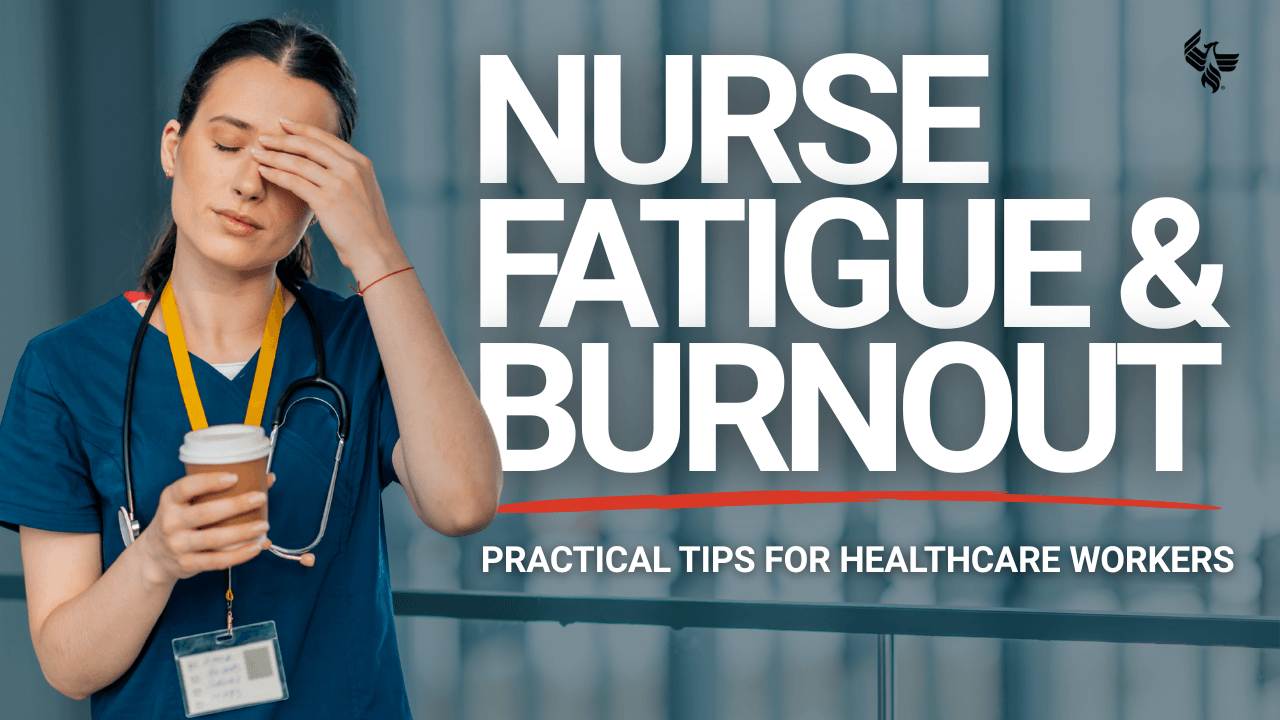
University of Phoenix explains burnout during a crisis, with Dr. Raelene Brooks discussing nursing-fatigue warning signs, workplace pressures, professional boundaries, support systems and practical self-care strategies.

The video was uploaded on 06/30/2021.  
The video lasts for 45 minutes and 2 seconds.

**Key Moments**  
00:00 Webinar opening  
03:51 Speaker introduction  
07:02 Fatigue and burnout agenda  
08:34 The reality of nursing  
09:52 Causes of nursing fatigue  
16:41 Reactions to fatigue  
21:53 Reconnecting with purpose  
27:03 Preventing fatigue  
30:25 Support, boundaries and mentoring  
33:17 Breaks, recovery and self-care

```html
<script type="application/ld+json">{
  "@context": "https://schema.org",
  "@type": "VideoObject",
  "name": "Battling Nursing Burnout During a Crisis",
  "description": "University of Phoenix explains nursing burnout during a crisis, with Dr. Raelene Brooks discussing nursing-fatigue warning signs, workplace pressures, professional boundaries, support systems and practical self-care strategies.",
  "thumbnailUrl": "https://www.phoenix.edu/content/dam/edu/videos/img/nurse-fatigue-and-burnout-thumbnail.png",
  "uploadDate": "2021-06-30T12:33:50-07:00",
  "duration": "PT45M2S",
  "embedUrl": "https://www.youtube.com/embed/265LVFSiXts",
  "interactionCount": "9",
  "potentialAction": {
    "@type": "SeekToAction",
    "target": "https://www.youtube.com/watch?v=265LVFSiXts&t={seek_to_second_number}",
    "startOffset-input": "required name=seek_to_second_number"
  },
  "hasPart": [
    {
      "@type": "Clip",
      "@id": "#videoclip1",
      "name": "Webinar opening",
      "startOffset": 0,
      "endOffset": 230,
      "url": "https://www.youtube.com/watch?v=265LVFSiXts&t=0"
    },
    {
      "@type": "Clip",
      "@id": "#videoclip2",
      "name": "Speaker introduction",
      "startOffset": 231,
      "endOffset": 421,
      "url": "https://www.youtube.com/watch?v=265LVFSiXts&t=231"
    },
    {
      "@type": "Clip",
      "@id": "#videoclip3",
      "name": "Fatigue and burnout agenda",
      "startOffset": 422,
      "endOffset": 513,
      "url": "https://www.youtube.com/watch?v=265LVFSiXts&t=422"
    },
    {
      "@type": "Clip",
      "@id": "#videoclip4",
      "name": "The reality of nursing",
      "startOffset": 514,
      "endOffset": 591,
      "url": "https://www.youtube.com/watch?v=265LVFSiXts&t=514"
    },
    {
      "@type": "Clip",
      "@id": "#videoclip5",
      "name": "Causes of nursing fatigue",
      "startOffset": 592,
      "endOffset": 1000,
      "url": "https://www.youtube.com/watch?v=265LVFSiXts&t=592"
    },
    {
      "@type": "Clip",
      "@id": "#videoclip6",
      "name": "Reactions to fatigue",
      "startOffset": 1001,
      "endOffset": 1312,
      "url": "https://www.youtube.com/watch?v=265LVFSiXts&t=1001"
    },
    {
      "@type": "Clip",
      "@id": "#videoclip7",
      "name": "Reconnecting with purpose",
      "startOffset": 1313,
      "endOffset": 1622,
      "url": "https://www.youtube.com/watch?v=265LVFSiXts&t=1313"
    },
    {
      "@type": "Clip",
      "@id": "#videoclip8",
      "name": "Preventing fatigue",
      "startOffset": 1623,
      "endOffset": 1824,
      "url": "https://www.youtube.com/watch?v=265LVFSiXts&t=1623"
    },
    {
      "@type": "Clip",
      "@id": "#videoclip9",
      "name": "Support, boundaries and mentoring",
      "startOffset": 1825,
      "endOffset": 1996,
      "url": "https://www.youtube.com/watch?v=265LVFSiXts&t=1825"
    },
    {
      "@type": "Clip",
      "@id": "#videoclip10",
      "name": "Breaks, recovery and self-care",
      "startOffset": 1997,
      "endOffset": 2702,
      "url": "https://www.youtube.com/watch?v=265LVFSiXts&t=1997"
    }
  ]
}</script>
```

```html
<script type="application/ld+json">{
  "@context": "https://schema.org",
  "@type": "WebPage",
  "name": "Battling nursing burnout during a crisis",
  "url": "https://www.phoenix.edu/videos/fields-of-study/battling-nursing-burnout-during-a-crisis.html",
  "description": "University of Phoenix explains nursing burnout during a crisis, with Dr. Raelene Brooks discussing nursing-fatigue warning signs, workplace pressures, professional boundaries, support systems and practical self-care strategies.",
  "image url": "https://www.phoenix.edu/content/dam/edu/videos/img/nurse-fatigue-and-burnout-thumbnail.png",
  "datePublished": "2025-06-10T12:33:50-07:00",
  "publisher": {
    "@type": "Organization",
    "name": "University of Phoenix",
    "url": "https://www.phoenix.edu"
  }
}</script>
```