


 844-937-8679
 Login
Login


How to build strong relationships with online instructors


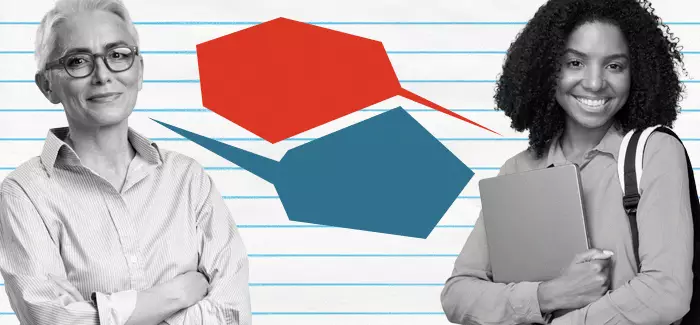
Whether you’re accustomed to making social connections online or not, you can take steps to help build meaningful relationships with your online instructors. Here, Dr. MaryJo Trombley, the associate dean of psychology and human services at University of Phoenix, weighs in on why and how.
Why connecting with your online instructors matters
Just as you would practice good communication habits with friends and family, you have to be intentional when interacting with your online instructors too. You’re not just getting or giving information, you’re building a relationship.

Dr. MaryJo Trombley
Associate Dean, Psychology and Human Services
“A strong relationship is built on empathy, trust, respect, communication and collaboration,” Trombley says. “You know you’ve made a connection when communication flows both ways — not just from the instructor — and when students feel seen, heard and valued. This shows up when they respond to discussions, use feedback and demonstrate persistence in their progress.”
According to the American Psychological Association, positive relationships between students and instructors can help shape their academic development. The organization states that supportive relationships can lead to students attaining higher levels of achievement.
Trombley says she sees a difference between students who engage with their instructors compared with those who don’t. She has observed that students who engage often complete assignments at higher rates and push through challenges. On the other hand, she has seen that students who avoid communication may fall behind or struggle with deadlines more.
“When students feel supported, they are more likely to reach out, stay engaged and remain motivated,” Trombley says. “Even small acknowledgments from faculty can boost confidence and remind students that they belong. That connection [can] make the difference between pushing through a tough week or stepping away.”
Another potential outcome to building these relationships and putting your best foot forward in your courses is that instructors may be more lenient when you are struggling to meet deadlines later in the course. While this may not be the case for all instructors, and nor should it be the only reason you make an effort, it may prove to be helpful later if you’re seeking additional support in unique circumstances.
Ways to connect
Introduce yourself early to your online instructor via email. You can keep it relatively short: Simply state who you are and that you’re looking forward to taking their course. If you want to go a step further, you can mention a specific topic from the syllabus that you’re looking forward to learning more about. This is also a time to ask questions you might have that were not covered in the introductory period or to seek clarification about something in the syllabus.
When reaching out to your instructor throughout the course, be sure to do so only if you have specific questions for them or need to inform them of important conflicts with deadlines. (You don’t want them to feel like you’re wasting their time asking questions you may be able to answer with a bit of independent research.) Be as clear and concise as possible while remaining friendly and professional.
“Many [students] wait until the last minute, which limits options if faculty can’t respond immediately,” Trombley shares. “Others are vague in their requests, requiring multiple exchanges to clarify. Tone can also be an issue — overly casual or demanding communication sets the wrong tone for the relationship.”
Show engagement in class activities
Communicating with your instructor is only one part of relationship building. You also have to keep in mind how you choose to communicate with your classmates and engage with your assignments.
For example, Trombley notes that stand-out students show patterns of consistency. Instructors may notice how frequently you engage and the quality of that participation. How do you respond to feedback? How much effort are you putting into your assignments?
Ultimately, students who build strong relationships with their online instructors go beyond simply “checking the box” when it comes to turning in their assignments or participating in class discussions.
“Deepen the conversation,” Trombley suggests. “Share personal or professional experiences, connect the topic to current events or reference relevant research. This turns posts into meaningful contributions that benefit the whole class.”
Other practical tips include:
- Attend virtual office hours if your online instructor hosts them and discuss topics or assignments you might need further help understanding.
- Double-check grammar in all communication if that’s an area you struggle in.
- Ensure you’re doing your part in group projects and own your responsibility.
Be professional and respectful
It may seem obvious that you should maintain professionalism with, and be respectful to, your online instructors, but don’t forget to apply these courtesies to interactions with your classmates as well. For example, you may be asked to respond to a given prompt and reply to a few classmates’ answers to promote discussion. When doing so, take your time, be thoughtful and consider everyone’s perspective. This is a chance to connect with your classmates and show your instructor you are engaged.
“Students and faculty are aware and sensitive to communication that is respectful,” Trombley says. “Respect means being timely in responses, using polite language and avoiding sarcasm or slang. The more respectful communication is, the more collaborative and engaging the classroom becomes.”
Trombley adds that she feels professional communication can establish credibility and signals to your instructor that you are serious about your education. Being mindful of tone is also important. Online communication lacks nonverbal cues, so it’s easy to misinterpret someone’s meaning or be misinterpreted yourself. If you struggle with tone, consider asking a friend or family member to review your emails or assignments before you send them.
Go beyond coursework
Depending on the connection you make with your online instructors, you may be inclined to reach out after your course or degree to see if they might know of organizations hiring in your field. In some cases, they may even keep you in mind and reach out first if a good opportunity arises. None of that can happen without students showing initiative.
“The first step is for students to reach out to faculty letting them know of their interest,” Trombley says. “Requests should be specific and professional. A student might write, ‘I admire your background in I-O psychology and would love to hear more about your experiences.’ Once faculty share resources, it’s important for students to follow up and engage.”
This means following up on the lead and thanking the instructor for their help. An email is a good idea to let the instructor know how much you appreciate the help.
Online instructors at University of Phoenix
University of Phoenix offers numerous courses taught by online instructors who have real-world experience in their respective fields.
Students can explore courses and degrees in such disciplines as healthcare, business, IT and general education.
For many working adults, the skills-based curriculum offered in UOPX’s flexible, online format makes higher education more accessible. While there are set deadlines for projects, students can do the coursework on their own time. Request more information about the various degree programs UOPX has to offer.




ABOUT THE AUTHOR
Aleece Reynaga is a writer and editor based in Los Angeles. She has written for The Los Angeles Times and holds an MFA from Columbia University in Fiction. She currently applies her love of process and properly edited copy to University of Phoenix's PhoenixConnect blog, but in her spare time, you'll find her reading science fiction/fantasy, honing her video gaming skills or checking out LA's vegan scene.

ABOUT THE REVIEWER
Christina Neider is the associate provost of colleges and former dean of the University of Phoenix College of Social and Behavioral Sciences. Neider’s career spans more than 30 years in academia, healthcare and the U.S. Air Force. She has held several academic leadership roles at University of Phoenix, and she is the Vice President of membership for the Arizona Chapter of the Healthcare Information and Management Systems Society.

This article has been vetted by University of Phoenix's editorial advisory committee.
Read more about our editorial process.