


 844-937-8679
 Login
Login


How Timothy Riffe used transfer credits to earn his bachelor’s degree


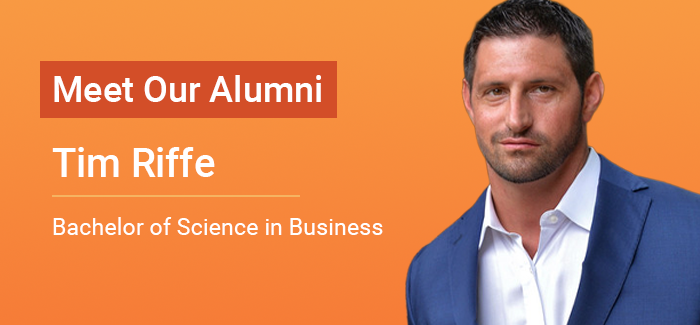
For University of Phoenix Alumni Luminary Timothy Riffe, each major career decision has been driven by passion, education and, intentionally or not, crises. The terrorist attacks of 9/11 spurred him on to join the Marines after graduating high school. The financial crisis of 2008 preceded his career in wealth management. And today, as an AI architect and law school student studying (what else?) law in technology,* Riffe makes the case that education is a lifelong affair.
Why Timothy Riffe believes in doing the hard thing
When Riffe started his senior year of high school, his graduation plans did not include military service. But his career in the Marines, which was prompted by the attacks of September 11 and spanned eight years, turned out to be remarkably successful. He served as a machine gunner in the Battle of Fallujah, he says, and a squad leader. Later, he worked as a martial arts and water survival instructor before moving into recruitment.
It would’ve been easy to continue along that path. He was good at it; there was opportunity for him. But such an outlook directly contradicts his guiding principle: Never let fear hold you back.
“If you identify an opportunity and you’re certain about it, you’ve got to go all in and just deal with that fear,” Riffe says.
Thus, Riffe left the Marines and began to pursue a career in finance. The worst of the financial crisis seemed to have passed, but the industry was still feeling the aftershocks.
So, Riffe decided to buckle down at school to better prepare for this transition. He’d taken a couple of classes while on duty, although the experience had been hindered by the fact that the community college where he enrolled didn’t have a robust online presence.
“I had taken two classes while I was in Afghanistan,” he says. “Back then, it wasn’t online. They gave us a little Palm Pilot to do this stuff on while we were in between missions and things.”
With a handful of courses under his belt, Riffe enrolled at a Minnesota college before transferring to a large public university to study economics. He also got a job with an investment firm as a financial advisor and seemed on track for a lucrative career in finance.
Before he could complete his degree, however, Riffe found himself with a tough decision to make: Stay in Minnesota and finish, or move to California where his ex-wife had relocated with their kids. Ultimately, family won out and Riffe stepped away from his degree program to head west.
How did transfer credits help Timothy Riffe graduate?
Once he was settled in Bakersfield, Riffe took a position as a financial advisor with a new organization. Completing his degree was somewhat harder. He looked at transferring to a highly regarded public university in Los Angeles, but the commute was substantial and he found that most of his college coursework would not transfer in.
There were closer options, but Riffe didn’t believe in the quality of the programs. That’s when he came across University of Phoenix, which had a campus in Bakersfield at the time. Thanks to the University’s generous transfer policy, Riffe wouldn’t have to start over in a bachelor’s degree program. And while the University didn’t offer a focus of study in economics, Riffe was able to enroll in a business administration degree program and graduate in two years.
Transfer credits play a role for many students like Riffe. Approximately 13% of all U.S. continuing and returning undergraduates transfer into a new institution, according to a 2024 report by National Student Clearinghouse Research Center, and they must navigate a process that can vary by institution. For completed coursework to be accepted for credit, it may need to meet certain criteria related to the accreditation status of the institution where it was completed, the rigor of the course taken and the grade a student earned.
University of Phoenix made that process straightforward and productive for Riffe.
Riffe embraces the AI-powered future with more school
Never one to take the easy path, Riffe left behind his career in finance to focus on business consulting and, recently, AI-powered solutions and enterprises. Today, he works as a senior AI/ML architect for a global technology services company. His focus is embedded AI, which consists of smaller models that operate directly on physical devices.
Riffe explains: “I’m sure [the big large language models] are doing everything right and wonderful, and they say they’re not using people’s data if they don’t want them to, right? But once it’s sent to their server, you have no way of actually knowing what your information is doing, whereas, if it’s running locally on your laptop or on your cellphone, it stays on your device unless you connect it to something.”
This focus on privacy complements Riffe’s next educational step. He is starting law school online to study tech law.
Riffe’s decision to pursue another degree might strike some as unexpected, especially at this stage of his career and life. But he sees an opportunity to do something at the intersection of law and technology, and he doesn’t believe in doing things halfway.
This principle guided him into his career in finance and then out of it. It also guided his work as a consultant. To be at the top of his game in any of these fields, he had to deepen his knowledge.
All this, he notes, is part of pivoting and growing.
“It’s important to recognize your own capabilities and skill level before doing these things,” he says. “Like, ‘OK, there’s a really big opportunity, but I don’t have the skills to do it.’ … So, do I need to take a class? I’ve taken many classes that have nothing to do with getting another degree. It’s like, ‘I just need to learn this particular skill.’”
What’s next for Riffe?
In addition to law school and his role as an AI architect, Riffe continues to innovate in his spare time. Sometimes that takes the shape of gadgets he designs for the home but for which, he cheerfully points out, there’s no viable market and therefore no incentive to produce at scale.
One innovation, however, does have a market, and that’s an AI-powered platform he describes as helping individuals reach their goals through a series of smaller decisions. Inspired by his days in personal finance when clients would arrive with established levels of wealth and success, Riffe aimed to create a “personal-decision engine” that can take a holistic look at users’ employment, financial status, physical health and other metrics to guide decisions big and small.
Riffe is uniquely qualified on that front. In addition to having the technical skills to build such a platform, and the professional experience to understand what building wealth entails, he is also personally familiar with setting and reaching goals. His success in this realm earned him a spot among the 2026 UOPX Alumni Luminaries, which recognizes 76 alumni each year for their community leadership, industry leadership or entrepreneurship.
Innovating his platform is a fitting project for Riffe, whose curiosity and courage have defined his life path so far. As he enters his next stage of education and career opportunities, it’s safe to assume there’s more to come.

PHOENIX FAST FACTS

How Timothy Riffe went from the military to an AI-fluent entrepreneur
Job title
Senior AI/ML architect
Company
A global technology services company
UOPX degrees
Way Timothy saved
Resumé at a glance
- Senior AI/ML architect
- AI consultant
- Management consultant
- Financial advisor
- Bank teller
- U.S. Marine
What advice would you offer a prospective student considering higher education?

Take advantage of all the opportunities that are out there, not just from the school but especially in the school. And make sure to get to know and use the alumni network, because the biggest thing schools have to offer is that alumni network. [I think] most of the information that all schools are teaching is the same. They have different delivery systems and things like that, but the information is mostly the same. The big benefit to choosing University of Phoenix is the opportunities it has within its technology and then also that massive alumni network. You’ll find opportunities you didn’t know existed.”




ABOUT THE AUTHOR
Elizabeth Exline has been telling stories ever since she won a writing contest in third grade. She's covered design and architecture, travel, lifestyle content and a host of other topics for national, regional, local and brand publications. Additionally, she's worked in content development for Marriott International and manuscript development for a variety of authors.

This article has been vetted by University of Phoenix's editorial advisory committee.
Read more about our editorial process.