Skip to Main Content Skip to bottom Skip to Chat, Email, Text

Don’t let math and science keep you from enrolling in college
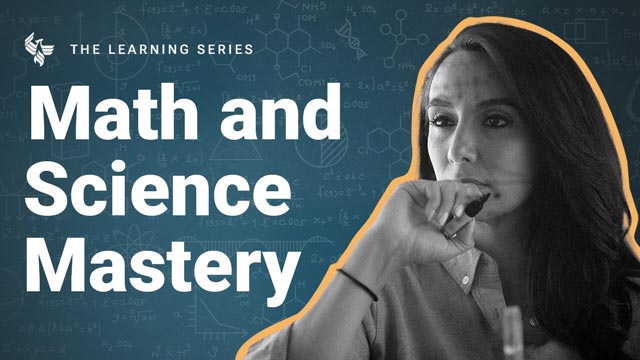
How to Learn Math and Science Effectively


0:00 - Picture this, (upbeat music) 0:01 you're ready to go back to school to finish your degree, 0:04 but there is that one math or science course 0:06 that is freaking you out 0:07 and making you rethink everything. 0:10 Sound familiar? 0:11 You are not alone, and I can help! 0:13 Hi, I'm Jacquelyn Kelly, 0:15 and I study how students learn math and science 0:18 to create classroom environments 0:19 to set students like you up for success. 0:23 One of the strongest predictors of success 0:26 for college learners (mouse clicking) 0:27 is academic self-concept: (bell ringing) 0:29 our internal perception of our own academic abilities. 0:32 (upbeat music continues) 0:33 I have five strategies 0:35 to help you improve your academic self-concept 0:37 so that you can start 0:38 your math and science courses worry-free. 0:41 Let's dive in. Start from the beginning 0:42 (air whooshing) (upbeat music continues) 0:43 When we see experts in any discipline, 0:46 we often forget that they too were once novice learners. 0:50 We've all had experiences 0:51 where we see someone successfully completing something 0:54 that we are having a hard time with. 0:56 It can be easy to accidentally start judging ourselves. 1:00 Without realizing it, 1:01 we start to decrease our academic self-concept. 1:05 So, what can you do? 1:07 Remind yourself that we all start from the beginning 1:10 when we are learning something new. 1:12 It is normal and expected 1:15 to not be an expert on your first attempt. 1:17 Talking to the people around you 1:19 can really help get things in perspective. 1:21 If you see your peers succeeding where you're struggling, 1:24 ask them about some of their first experiences 1:27 in the discipline. (air whooshing) 1:28 Examine your experiences. 1:30 We always hear that failures 1:32 are a great opportunity for learning, 1:34 but sometimes we forget to reflect about them 1:37 so that we can actually realize those learnings. 1:40 If you have struggled in math or science before, 1:42 have you thought about why? 1:44 If you notice yourself engaging 1:46 in overwhelmingly negative self-talk 1:48 about these experiences, 1:50 try to reframe the context. 1:52 Take stock of the challenges 1:54 that you've overcome in your life. 1:56 Write them down 1:57 along with the lessons you've learned overcoming them. 2:00 You may find that you've already overcome 2:02 the challenges you face in class in a different context. Take feedback 2:05 (air whooshing) (upbeat music continues) 2:06 Take feedback in stride. 2:08 Feedback comes in many forms. 2:10 It might be written comments, 2:12 a grade, verbal statements, 2:14 or even the dreaded red slash through some work. 2:17 Think about some feedback 2:18 you have received in math and science. 2:20 What did it sound like? 2:21 How did it make you feel? 2:23 And how did you use the feedback? 2:25 Some people are incredibly skilled 2:27 at providing feedback to others 2:29 so that as uplifting and motivating. 2:31 Unfortunately, many people are not as skilled. 2:35 As a result, if we receive constant feedback 2:38 about a particular topic, 2:40 it can negatively impact how we feel 2:42 about our ability to engage with certain disciplines. 2:45 So, what can you do? 2:47 Next time you get feedback, 2:49 remind yourself that it is not a reflection 2:51 of your self-worth. 2:52 We all need help when learning new things. 2:55 Feedback is just a way to give you clues 2:57 about how to be successful moving forward. 3:01 While reviewing feedback, write down two things. 3:04 First, what it means, 3:05 and second, something you will do because of it. Celebrate success 3:08 (air whooshing) (upbeat music continues) 3:09 Celebrate your success. 3:11 When you use numbers in the real world, 3:13 have you ever stopped to think about 3:15 how you did so successfully? 3:17 (air whooshing) (upbeat music continues) 3:17 Try to intentionally realize 3:19 when you use numbers doing your normal daily things, 3:23 celebrate yourself for being successful in these moments. 3:26 By intentionally taking the time 3:28 to recognize and reflect on these situations, 3:31 you give yourself the opportunity to experience mastery 3:34 over and over again, 3:36 which adds up over time. Why 3:38 (air whooshing) (upbeat music continues) 3:39 Ask yourself why what you're studying is important? 3:43 We've all been told before various reasons 3:46 why math and science are important in the real world. 3:49 But have you stopped to think about 3:51 why you value the topics? 3:53 Maybe you have some complex desire 3:55 to understand and explain phenomena 3:57 within the natural world. 3:59 However, value doesn't have to be 4:01 that holistic and complicated. 4:03 Maybe you need to learn a specific skill, 4:05 like how to run a statistical test. 4:07 Or maybe you just need to pass the class 4:10 so that you can move on to other things. 4:13 Maybe you want to learn 4:14 how to help your child with homework. 4:16 Each of these scenarios describes different sorts of values 4:20 someone might have related to math and science. 4:22 Take some time to reflect 4:24 about how you value math and science. 4:27 Don't feel bad about it, 4:28 just write it down so that you know. 4:31 When you're struggling with something, 4:33 ask yourself, "Why am I learning this? 4:35 What will this help me achieve?" 4:37 And when you get frustrated or hit a challenge, 4:40 remind yourself your answers to these questions 4:42 so that you know why the struggle 4:44 of learning new things is worth it. 4:46 (upbeat music continues) 4:47 Okay, I hope you're feeling a little less worried 4:50 about math and science. 4:51 Remember, the way you think about yourself matters. 4:55 How you compare yourself to others, 4:57 perceive your past successes and failures, 5:00 internalize feedback, experience mastery, 5:03 and determine the value of knowledge 5:05 all help impact your internal perception of yourself 5:08 as a math and science learner. 5:10 If you take the time to reflect about your thinking 5:13 to improve your academic self-concept in math and science, 5:17 you can single handedly 5:18 set yourself up for greater success. 5:21 And hey, maybe you'll even enjoy 5:23 your math and science journey in the process. 5:26 (upbeat music continues)

Learn how to develop math and science learning confidence that may be keeping you from enrolling in college.

The video was uploaded on 12/07/2023.
The video lasts for 5 minutes and 31 seconds.

Key Moments
00:00 Introduction
00:42 Start from the beginning
01:28 Examine your experiences
02:05 Take feedback in stride
03:08 Celebrate your success
03:38 Ask why math and science matters
04:47 Reflect on academic self-concept